
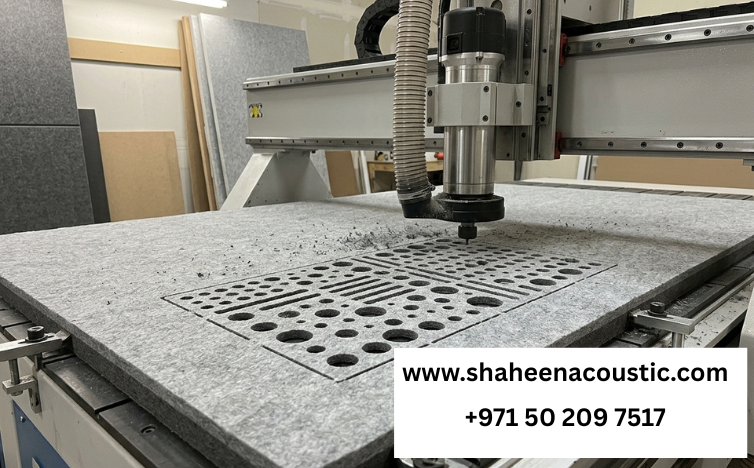
Acoustic performance is not only defined by the material used—it is heavily influenced by how accurately that material is fabricated and installed. This is where CNC (Computer Numerical Control) precision becomes critical. In modern acoustic systems, CNC cutting directly affects both NRC (Noise Reduction Coefficient) and STC (Sound Transmission Class) by ensuring that every panel, perforation, and joint performs exactly as designed. Without this level of precision, even high-quality acoustic materials can fail to deliver expected results.
CNC technology allows panels to be manufactured with exact dimensions, consistent patterns, and tight tolerances. This accuracy ensures that acoustic systems behave predictably, maintaining both sound absorption and sound isolation performance across the entire installation.
Understanding NRC and STC Before Precision
To understand the impact of CNC precision, it is important to first define NRC and STC. NRC measures how well a material absorbs sound within a space, reducing echo and improving clarity, while STC measures how effectively a structure blocks sound from passing between spaces.
In simple terms, NRC controls sound inside the room, and STC controls sound between rooms. Both depend not only on material properties but also on how accurately those materials are fabricated and assembled.
Why CNC Precision Matters in Acoustic Fabrication
Acoustic panels are engineered based on specific parameters such as thickness, density, perforation ratio, and surface geometry. Even small deviations in these factors can significantly alter acoustic performance. CNC cutting ensures that these parameters are maintained with high accuracy, eliminating inconsistencies that typically occur in manual fabrication.
Precision cutting also guarantees uniform panel dimensions, which is essential for proper installation. Misaligned panels or uneven edges create gaps that allow sound leakage, directly reducing STC performance and weakening overall soundproofing.
Impact of CNC Precision on NRC (Sound Absorption)
NRC performance depends heavily on how sound interacts with the surface of a panel. For perforated or slotted acoustic panels, the size, spacing, and distribution of openings are carefully calculated to optimize sound absorption.
CNC machines replicate these perforation patterns with exact consistency, ensuring that each panel absorbs sound in the same way across the entire surface.
If perforations are inconsistent or incorrectly sized, the panel may reflect more sound instead of absorbing it, reducing its NRC value. Since NRC is influenced by factors like porosity, thickness, and surface design, precision manufacturing plays a direct role in maintaining high absorption performance.
Impact of CNC Precision on STC (Sound Blocking)
STC performance depends on how well a structure prevents sound from passing through it. One of the most critical factors affecting STC is airtightness. Even small gaps or misalignments can significantly reduce sound isolation.
CNC precision ensures that panels fit tightly within wall and ceiling systems, minimizing gaps and preventing sound leakage.
In addition, precise cutting allows for better integration of acoustic materials with structural components such as frames, joints, and seals. This improves the overall integrity of the assembly, which is essential for achieving high STC ratings.
Eliminating Gaps and Flanking Paths
One of the biggest threats to acoustic performance is flanking noise—sound that travels through gaps, joints, or indirect paths. Poorly cut panels often leave small openings that become pathways for sound leakage.

CNC-cut panels are manufactured to exact dimensions, ensuring seamless alignment and reducing the risk of flanking paths. This is especially important in ceiling systems and modular wall panels, where even minor gaps can compromise the entire soundproofing system.
By eliminating these weak points, CNC precision helps maintain both absorption efficiency (NRC) and sound isolation (STC).
Consistency Across Large Projects
In large-scale acoustic installations, consistency is critical. Variations in panel size, shape, or pattern can lead to uneven acoustic performance across different areas of the same space.
CNC technology ensures repeatability, meaning every panel is produced with identical specifications. This uniformity guarantees that acoustic performance remains consistent throughout the project, which is essential for meeting design and compliance standards.
Supporting Complex Acoustic Designs
Modern acoustic solutions often involve complex geometries, including curved panels, diffusers, and custom patterns. These designs are not just aesthetic—they are engineered to control sound reflection and diffusion.
CNC cutting enables the precise execution of these complex designs, ensuring that they function as intended. Without precision, these elements lose their effectiveness, reducing both NRC and overall acoustic balance.
Call us: Contact Shaheen Acoustic Soundproofing Expert in Dubai For Soundproofing: +971 50 209 7517
Conclusion
CNC precision plays a fundamental role in achieving high NRC and STC performance in acoustic systems. From maintaining accurate perforation patterns to ensuring airtight installation, precision cutting directly influences how sound is absorbed and blocked.