
Introduction
Noise in a Dubai office can turn every call, meeting, and workday into a strain.
Glass walls, hard floors, and traffic outside only make it worse.
Our How to Soundproof an Office in Dubai: Complete 2026 Guide explains how to cut that noise, step by step, so an office feels calm, private, and professional. We look at sound absorption, sound blocking, sealing gaps, surface treatments, and smarter layouts that fit Dubai’s towers and fit-out rules. Along the way, we show where expert help from Shaheen Acoustic makes the biggest difference.
If you want a quieter workspace that supports deep work and client trust, keep reading. We will walk through what works, what does not, and where to start when you soundproof an office in Dubai.
Key Takeaways
Before we go deeper, here are the big ideas in this guide:
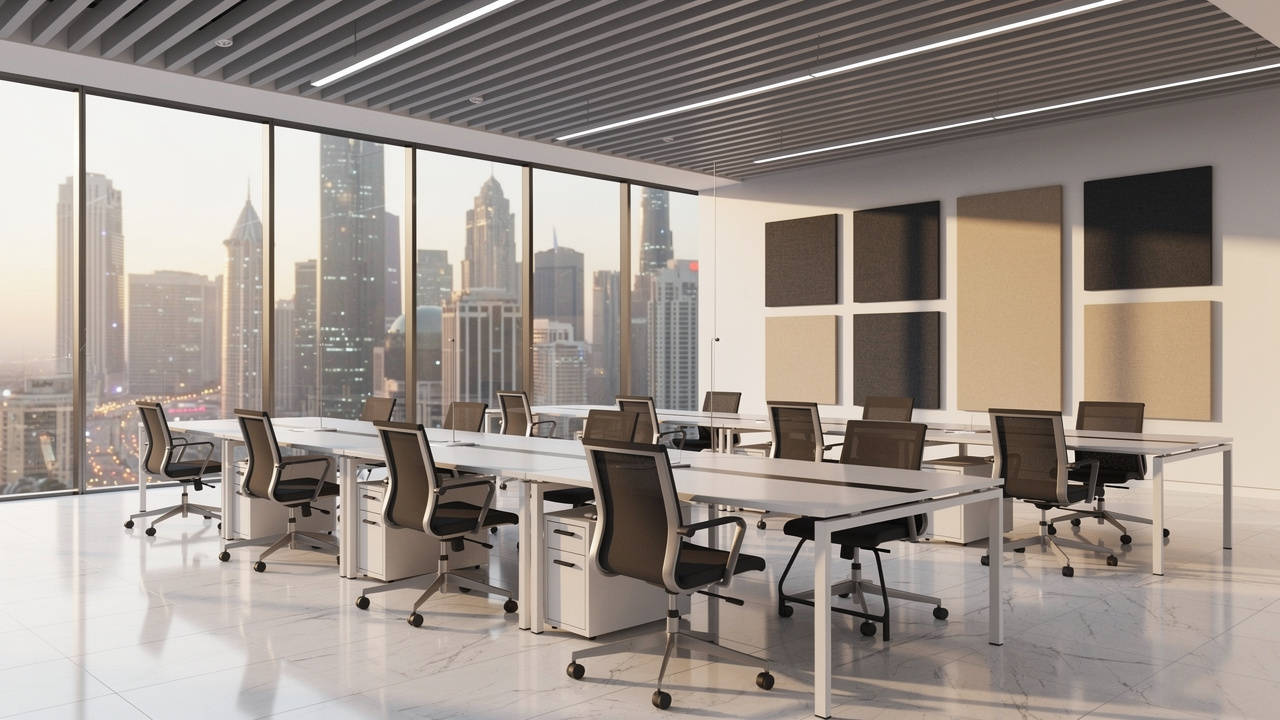
Dubai office design often amplifies noise. Open plans, glass partitions, and marble floors in towers like DIFC look impressive, yet they bounce sound around and spread every conversation. Without a plan, that constant noise slowly wears down focus, energy, and client confidence.
Sound absorption and sound blocking do different jobs. Across Business Bay, JLT, and beyond, absorption calms echo inside a room with soft materials. Blocking stops sound moving between rooms with mass and airtight construction. Mixing them up leads to wasted money and poor acoustic results.
Finding sound leaks is the smartest first move. Gaps around doors, windows, and ceiling penetrations often let most of the noise through. Simple sealing work in a Dubai office can bring more quiet than much pricier decorative changes.
Surface treatments suit leased spaces; structural upgrades suit full fit-outs. Wall and ceiling panels, carpets, and curtains improve clarity and comfort. Extra mass, decoupling, and mineral wool create real privacy. Matching these layers to budget and building limits keeps projects realistic.
Shaheen Acoustic brings on-the-ground UAE experience. We understand Dubai Municipality rules, tower management limits, and harsh climate conditions. That mix lets us design acoustic plans that work technically and also match high-end interiors across homes, schools, and commercial spaces.
Why Dubai Offices Struggle With Noise (And Why It Costs You More Than Comfort)

Dubai offices struggle with noise because glass-heavy fit-outs, open plans, and hard finishes reflect sound instead of calming it. That noise costs companies focus, staff wellbeing, and even client trust every single day.
Modern towers in Business Bay, DIFC, and Jumeirah Lake Towers often mix floor-to-ceiling glazing, gypsum partitions, and polished stone or vinyl floors. Each of those surfaces bounces sound back into the space. When dozens of people talk, type, and move chairs at once, reflections build into a constant background roar that never quite fades.
Research from the World Health Organization links long-term exposure to high noise levels with higher stress and cardiovascular risk. In an office, that shows up as fatigue, irritability, and headaches by midafternoon. According to Leesman, noise and lack of privacy sit among the lowest-rated aspects of workplaces worldwide, dragging down satisfaction scores.
Interruptions are another hidden cost. Work by University of California, Irvine shows that after an interruption, people need around 23 minutes to regain full focus. In an echoey open office, those interruptions never stop. For client-facing teams in Downtown Dubai or on Sheikh Zayed Road, this hurts preparation, clarity on calls, and the way the office feels to visitors — an issue documented in research on Frontiers | Evaluating workplace performance through post-occupancy evaluation.
“Office noise rarely feels dramatic, but it chips away at performance hour after hour.” — Shaheen Acoustic consultant
For us, that is why a serious approach to sound belongs beside lighting, air quality, and furniture in any modern fit-out.
Sound Absorption Vs. Sound Blocking: What’s The Difference?
Sound absorption and sound blocking describe two different acoustic tools that we combine in almost every Dubai project. Understanding this difference helps you choose the right products instead of guessing.
Sound absorption controls echo inside a room. Soft, porous materials such as acoustic wall panels, ceiling baffles, thick rugs, and upholstered furniture soak up sound that would otherwise bounce off glass and concrete. This improves speech clarity on Zoom calls, in meeting rooms, and in open collaboration zones, yet it does not stop noise leaking into the corridor next door.
Sound blocking, sometimes called transmission loss, keeps sound from passing between spaces. Here we depend on mass, airtight layers, and smarter wall details. Solid-core doors, double layers of drywall, and mineral wool inside partitions all raise the Sound Transmission Class (STC), which tells us how well a wall blocks sound.
Noise Reduction Coefficient (NRC) tells us how strongly a material absorbs sound on a scale from 0 to 1. For offices, we usually aim for a reverberation time (RT60) between 0.5 and 0.75 seconds, which feels controlled yet not “dead”.
Keeping these terms straight – absorption (NRC) for echo, blocking (STC) for privacy – is the foundation of any good acoustic plan.
How To Identify And Seal Sound Leaks In Your Dubai Office

To soundproof an office in Dubai in a smart way, we start by finding and sealing the main sound leaks. Without that step, even expensive walls and panels cannot perform as they should.
Doors are often the weakest point in commercial towers from Deira to Dubai Marina. Many fit-outs use hollow-core doors with clear gaps at the sides and under the leaf. If you see light around a closed door, sound has a direct path as well. Even the best acoustic panel on the wall cannot fix that open path.
Windows are another big leak, especially along noisy corridors like Sheikh Zayed Road or Al Khail Road. Single glazing and loose frames let traffic, construction, and even aircraft noise drift into meeting rooms and private offices. In tall towers, wind pressure can also rattle frames, adding a constant low-level hum.
Ceiling plenums cause problems that many teams never spot, and addressing them is central to the Technical, Legal, and Health frameworks recommended for noise mitigation in human-centric environments. When partitions stop at the suspended ceiling instead of the concrete slab above, sound floats over the top of the wall through shared air space, ductwork, and cable trays. That is why HR or legal teams in one suite sometimes hear conversations from a neighbour with no shared wall. Guidance from occupational health bodies such as OSHA treats 85 decibels over an eight-hour day as a level where hearing protection plans become important, and leaky ceilings make peak levels much harder to control.
We also look for smaller penetrations, such as cable cutouts, pipe chases, and gaps around electrical boxes. Each opening might seem minor, yet together they create a network of “holes” that carry speech between rooms.
“If you can see a gap, sound can almost always use it.” — Shaheen Acoustic tip
Practical Sealing Methods By Entry Point
Once we map the main leaks, we can apply simple, targeted fixes that bring strong value for money.
Doors:
Upgrading hollow doors to solid-core models adds weight and cuts transmission straight away. We then add perimeter weather stripping along the frame to close side and top gaps. An automatic door bottom drops a seal against the floor each time the door shuts and lifts when it opens, so people do not trip yet sound loses its path. In high-sensitivity rooms, full door sealing kits with compression gaskets give even tighter closure.Windows:
For leased offices in towers across Business Bay or JLT, secondary acrylic or glass inserts fit inside existing frames without heavy building work. These add an extra air gap, which raises the STC rating of the whole assembly. Where budget is limited, thick acoustic curtains add another layer of absorption and a bit of extra mass. In owned spaces, high-performance double-glazed units with proper seals bring the biggest long-term gain.Ceiling plenums and penetrations:
In new fit-outs, we push for walls that extend right up to the structural slab instead of stopping at tiles. In existing spaces, acoustic barriers above ceilings and around ductwork block the shared air paths that carry sound. We also seal every cable and pipe opening with acoustic sealant or putty pads so noise cannot sneak through small gaps and undermine the rest of the work.
By tackling these leaks first, later spending on panels or new partitions delivers much better results.
The Best Surface Treatments And Structural Upgrades For Dubai Offices

The best mix of surface treatments and structural upgrades for a Dubai office depends on whether you lease, own, or plan a full refurbishment. We normally start with reversible treatments, then add heavier measures where privacy needs are high.
Acoustic wall panels are one of the fastest ways to calm echo in meeting rooms, boardrooms, and open office zones. Fabric-wrapped or PET felt panels mounted on key walls absorb reflections from glass facades and gypsum partitions. That reduces the “hollow” feeling many teams complain about in towers around Dubai Silicon Oasis and Media City. Research from Leesman indicates that rooms with better acoustic treatment score much higher on perceived productivity and comfort.
Ceiling systems carry a lot of weight in open plans:
High-NRC tiles, baffles, or suspended “cloud” panels catch sound that would normally bounce off concrete slabs and spread across the floor.
This helps call centres, trading floors, and co-working hubs keep day-to-day chatter at a comfortable level.
Flooring matters more than many people expect. Carpets with quality underlays, or at least thick area rugs in circulation paths, soften footfall, rolling chairs, and dropped items. That holds especially true in spaces with marble or ceramic tiles, which are common from Downtown Dubai to Emirates Towers.
When speech privacy is non-negotiable, we move to structural upgrades. We raise wall performance by:
Adding extra layers of drywall with staggered joints
Using dense boards
Filling cavities with mineral wool
Decoupling methods such as double stud rows or isolation clips interrupt vibration paths through framing so less energy passes into adjacent rooms. The result is higher STC ratings and far better control of confidential conversations.
“Good surfaces calm the room; good structure keeps your words in the room.” — Shaheen Acoustic design team
Shaheen Acoustic’s Services For Every Office Type
At Shaheen Acoustic, we design complete acoustic packages that match Dubai offices of every size, from co-working suites to full corporate floors. Our focus is to blend strong acoustic performance with the clean, modern interiors that local clients expect.
Acoustic wall panels
We supply and install panels that calm echo in meeting rooms, open plans, and reception areas. Options include PET felt and fabric finishes that sit comfortably alongside glass and metal. We plan placement based on room dimensions and furniture instead of random layouts. That way each square metre of material earns its keep and looks intentional.Acoustic ceiling panels and baffles
Many towers have high ceilings or exposed services, which can sound harsh. We use suspended clouds, baffles, and upgraded tiles to control overhead noise without closing in the space visually. This approach suits creative studios in Dubai Design District as well as more formal offices in DIFC.Soundproof partitions and sealing systems
For private offices, boardrooms, and medical consultation spaces, we install high-performance partitions with mineral wool cores and solid-core doors. At the same time, we upgrade door and window seals so there are no weak links. Our custom acoustic design and installation service brings all these pieces together into one coordinated plan instead of a patchwork of separate products.
How To Plan Your Office Acoustic Zones (And When To Call A Professional)

Planning office acoustic zones in Dubai means matching noise levels to activities instead of treating the whole floor the same way. When we get this right, many sound issues fade before they start.
We begin by mapping different zones on the floor plan:
Focus zones:
Private offices, quiet workrooms, and high-stakes meeting spaces for legal, financial, or HR work. These need strong sound blocking and some absorption, because both privacy and clarity matter.Collaborative zones:
Project rooms, team benches, and lounges can accept more buzz, yet still benefit from ceiling and wall treatment so voices do not carry too far.Transition and support areas:
Corridors, copy rooms, pantry spaces, and storage act as buffers between loud and quiet rooms. Placing them between open collaboration zones and focus areas gives sound another layer to pass through before it reaches people who need silence.
Surveys from Steelcase show that noise and privacy are consistently among the top complaints in open-plan offices, which is why this kind of smart zoning pays off.
Furniture helps fine-tune zones without major construction. High-backed sofas, semi-enclosed booths, and fabric-covered desk screens interrupt sound paths, creating small pockets of calm even in large open spaces. Bookshelves, planters, and freestanding acoustic panels can separate teams that work very differently, like sales and software engineering, inside the same footprint.
For very open floors with many staff, sound masking systems add a low, even background noise that makes speech less intelligible at a distance. Combined with the steps above, this extra layer makes conversations feel private at a few metres instead of echoing across the office.
“Treat zoning, furniture, and materials as one system, not three separate decisions.” — Shaheen Acoustic planner
When To Engage Shaheen Acoustic For A Professional Assessment

Some offices benefit from do-it-yourself upgrades, yet certain signs point to the need for specialist help from Shaheen Acoustic. When we see these patterns, a structured acoustic study usually saves time and money.
Confidentiality or comfort issues that never seem to improve
If clients hear conversations from the next meeting room in DIFC, or staff complain about noise across multiple teams, the root problem is rarely simple. We can measure actual reverberation times and transmission paths, then design targeted fixes. This avoids the cycle of buying random panels and hoping for the best, which often disappoints.Large open-plan spaces with twenty or more staff
The bigger the floor, the more complex the sound paths become. Offices in towers across Business Bay, JAFZA, or Internet City often mix different ceiling heights, glass lines, and mechanical systems. Our team can model how sound behaves across the whole zone and suggest a staged plan that fits budget phases. That approach gives reliable results and avoids surprises during fit-out.New build or major refurbishment projects
When architects and interior designers bring us in early, we can shape partitions, door specs, and finishes from the start — an approach validated by Frontiers | Evaluating workplace research showing that early acoustic planning significantly improves post-occupancy outcomes. That usually costs less than retrofitting, because the right products go in during base build. If any of these situations sound familiar, you can contact us through shaheenacoustic.com to discuss an acoustic strategy for your office.
Laat Uw Kantoor Niet Langer Wachten On Better Acoustics
Dubai offices face a tough mix of noise sources, from busy roads to echoey open plans and glass meeting rooms. Left alone, that noise drains productivity, harms wellbeing, and puts client privacy at risk.
The smartest path follows a clear order:
Find and seal sound leaks.
Add wall, ceiling, and floor treatments.
Only then look at heavier structural upgrades where needed.
Along the way, we plan acoustic zones so the layout itself supports quiet work and lively collaboration where each belongs.
Shaheen Acoustic has spent years solving these problems across the UAE, always with an eye on both performance and design. If you are ready to turn a noisy floor into a calm, confident workplace, visit shaheenacoustic.com and talk with our team about your next steps.
Frequently Asked Questions
Question: What is the most cost-effective first step to soundproofing an office in Dubai?
The most cost-effective first step is sealing sound leaks around doors, windows, and ceiling penetrations. Upgrading hollow-core doors to solid-core models and adding simple weather stripping or door bottoms often brings an immediate drop in noise. This kind of low-cost work protects later investment in panels or partitions.
Question: Can I soundproof a leased office in Dubai without permanent modifications?
Yes, you can improve a leased office a lot without permanent changes. Removable acoustic wall panels, freestanding dividers, acoustic curtains, area rugs, and door seal kits all reduce echo and transmission. These options suit tenants in towers across Business Bay, JLT, and DIFC where landlords limit structural work.
Question: What is the difference between NRC and STC ratings?
NRC and STC measure two different acoustic behaviours. NRC shows how much sound a material absorbs inside a room on a 0 to 1 scale. STC shows how well a wall, floor, door, or window blocks sound between spaces. Picking products by the right rating avoids poor results and wasted budget.
Question: How much does office soundproofing cost in Dubai?
Office soundproofing in Dubai ranges widely by size and specification:
Budget-friendly retrofits with rugs, curtains, and a few panels may cost between AED 2,000 and 15,000.
Mid-range packages with more panels, baffles, and door sealing can sit between AED 15,000 and 60,000.
Full structural upgrades for whole floors often reach AED 60,000 to 200,000 or higher.
A quick site visit from Shaheen Acoustic can narrow down which level fits your space and goals.
Question: Why is the ceiling plenum a soundproofing problem in Dubai offices?
The ceiling plenum is a problem because many partitions stop at the suspended ceiling instead of reaching the concrete slab. Sound then travels freely over the top of walls through the shared air space, ducts, and cable trays. Extending walls to the slab and sealing penetrations blocks this hidden path and sharply improves privacy.