
Introduction
Noise from neighbors, traffic, and busy corridors is a daily issue in many UAE homes and workplaces. Thick concrete walls and double glazing help, but sound still slips through tiny gaps, joints, and service openings.
Small openings around pipes, sockets, and door frames act like hidden speakers between rooms. Even a well-built wall can underperform if these weak spots stay open. Acoustic sealant fills these joints with a flexible, dense material that absorbs vibration instead of passing it through.
In this article, you will see what acoustic sealant is, why it matters so much in UAE buildings, where it should be applied, how it differs from regular caulk, and how Shaheen Acoustic uses it inside complete noise control systems.
Key Takeaways
This short section sets up the main points you can keep in mind while you read the rest of the article.
Acoustic sealant is a flexible, sound-blocking compound that stays soft instead of curing hard. It fills joints, cracks, and edges where air and noise can move, helping walls perform closer to their design sound insulation rating.
Small gaps cause big acoustic failures because sound follows the easiest path. A tiny opening around a pipe or frame can let a surprising amount of noise pass. Acoustic sealant closes these weak spots so the whole soundproofing system works as intended.
Key locations in UAE buildings include partition perimeters, service penetrations, electrical outlets, and door or window frames. Treating these areas with acoustic sealant is one of the fastest ways to improve privacy between rooms.
Acoustic sealant is different from standard silicone or acrylic caulk, which tend to harden and crack. The soft, dense body of acoustic sealant absorbs vibration instead of transmitting it and holds up better under UAE temperature swings.
Within a complete soundproofing system, acoustic sealant protects your investment in items like Mass Loaded Vinyl, acoustic doors, and PET panels. Without proper sealing, even premium acoustic products cannot reach their rated performance.
What Is Acoustic Sealant And How Does It Work?

Acoustic sealant is a soft, flexible caulk formulated to block sound moving through joints, gaps, and small openings. Unlike regular silicone or acrylic caulk, it never fully hardens, so it can absorb vibration instead of passing it into the next room.
Sound travels very easily through rigid paths, especially when air can move with it. When standard caulk cures to a stiff or brittle line, it behaves like a tiny bridge that carries vibration. Acoustic sealant behaves more like a cushion that soaks up part of that energy and reduces the noise that gets through.
Acoustic engineers use the term flanking path for these side routes. Research cited by National Research Council Canada shows that a gap equal to only one percent of a wall area can reduce its sound insulation by up to half. In practice, that means a single unsealed joint can ruin an otherwise high‑performance wall.
“Even a gap you can barely see can control how a whole wall sounds.” — common rule of thumb in building acoustics
Acoustic sealant targets those flanking paths. Most products are water based, easy to apply with a standard caulking gun, and stick well to concrete, gypsum board, blockwork, metal, and wood, which are common in Dubai and Abu Dhabi projects. Once cured, the material stays slightly tacky and rubbery, so it keeps contact with both sides of the joint even when the building moves.
This flexible, viscoelastic behavior turns part of the mechanical vibration into a very small amount of heat inside the sealant body. Over long joints and multiple rooms, that effect adds up. Tests on partition systems show that well-sealed walls can perform 5 to 10 decibels better than similar walls with open gaps, and a 10 dB drop is heard as roughly half as loud by the human ear (Acoustical Society of America). For a bedroom, meeting room, or hotel suite, that difference is very noticeable.
Most modern acoustic sealants also have low volatile organic compound (VOC) content. Guidance from the World Health Organization stresses the health impact of indoor pollutants, so low‑VOC sealants matter in sealed, air‑conditioned UAE interiors. This makes acoustic sealant suitable for homes, offices, schools, and hospitals across the region.
Why Acoustic Sealant Is Essential In UAE Buildings

Acoustic sealant is especially important in UAE buildings because of dense urban layouts, concrete construction, and harsh climate. Dubai Marina towers, offices in Business Bay and DIFC, and hotels along Sheikh Zayed Road all face heavy noise from neighbors, traffic, and building services.
Concrete provides good mass, but every pipe, conduit, and duct that passes through a slab or wall creates a direct sound path. In apartments at Jumeirah Lake Towers or Downtown Dubai, noise often leaks through gaps around plumbing stacks, electrical risers, and cable trays. Without acoustic sealant around these entries, sound can travel from floor to floor almost as if the wall were not there.
Open‑plan offices face similar issues. Meeting rooms in towers such as Emirates Towers or Dubai International Financial Centre need strong speech privacy. Even when walls use double layers of gypsum board, any unsealed joint at the floor, ceiling, or glass frame can let conversations travel into work areas and meeting spaces. That can hurt concentration and productivity. Research from the National Institute for Occupational Safety and Health links poor acoustic comfort with higher stress and fatigue at work.
Climate adds another challenge. Outdoor summer temperatures often exceed 45°C in the UAE, while indoor spaces stay cool under strong air conditioning. These swings make concrete, steel, and drywall expand and contract through the year. Standard acrylic caulk tends to shrink and crack under this movement, reopening gaps around frames and joints.
Acoustic sealant behaves differently. Its permanent flexibility lets it stretch and compress with building movement without pulling away from surfaces. Shaheen Acoustic uses water based acoustic sealant grades selected specifically for Gulf conditions so they hold their seal even after years of thermal cycling.
In hospitality and healthcare, the stakes are even higher. Hotel guest surveys summarized by J.D. Power regularly rank noise as a top complaint. Hospitals and clinics in Dubai Healthcare City and Abu Dhabi need quiet for patient recovery and privacy. In both cases, acoustic sealant around every penetration and partition perimeter is a small cost compared to the value of quiet, comfortable rooms.
Where To Apply Acoustic Sealant: Key Locations In UAE Properties

Acoustic sealant should be used anywhere air or light can slip through a wall, floor, or ceiling. In UAE apartments, villas, offices, and hotels, the same locations cause trouble again and again. Treating these points often brings a fast and clear drop in noise transfer.
Partition wall perimeters
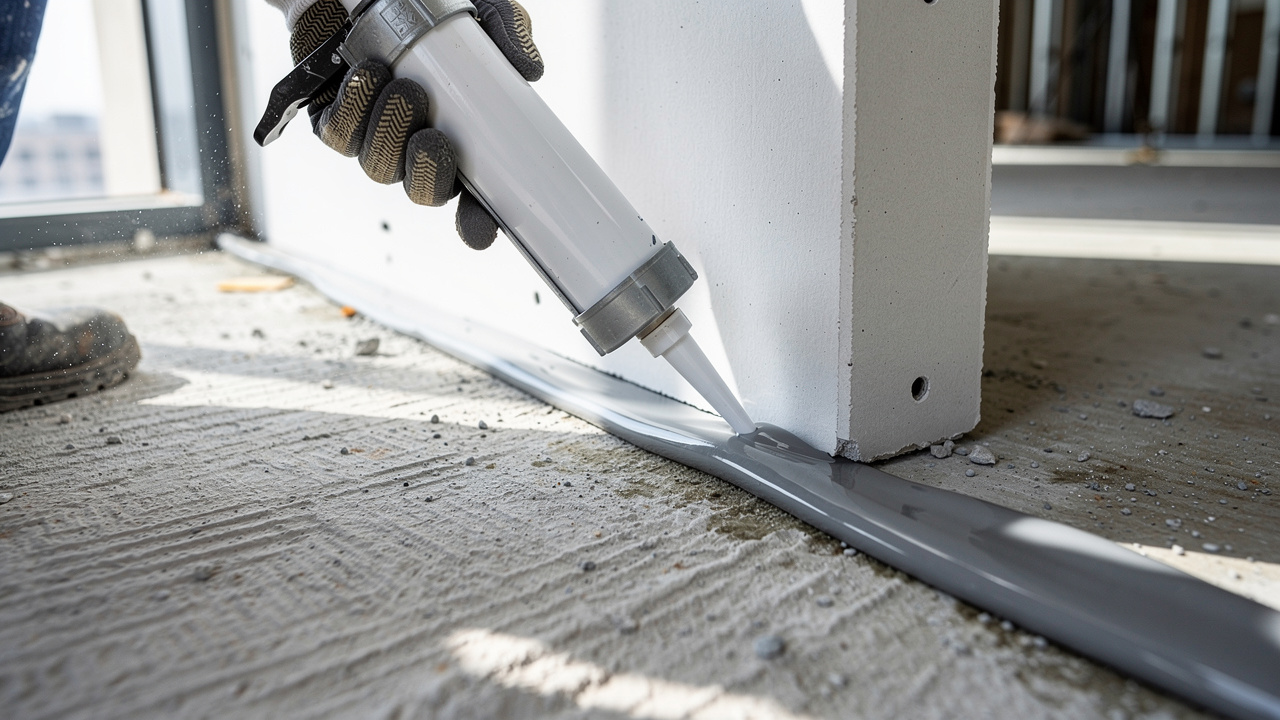
Every drywall or block partition should have a continuous bead of acoustic sealant where it meets the floor slab, the slab above, and adjoining walls. In high‑rise towers from Dubai Marina to Sharjah, the gap at the top of partitions under the slab soffit is especially important because it often looks small yet acts like an open slot for noise.Service penetrations
Pipes, electrical conduits, fire sprinkler lines, and HVAC ducts pass through many walls and slabs. The ring of space between the service and the structure forms a direct sound path. Filling that annular space with acoustic sealant on both sides of the wall or floor sharply reduces noise travel between bathrooms, shafts, and neighboring units.Electrical and data outlets
Back‑to‑back sockets in a party wall between apartments let sound cross through the box and wall cavity. Applying acoustic sealant around the box edges, and over the rear where possible, helps restore the rating of the wall. The same applies to floor boxes in raised access floors in offices across Abu Dhabi and Ras Al Khaimah.Door and window frames
The joint between a frame and the surrounding wall is often masked by trim, yet gaps behind that trim can leak a lot of sound. Using acoustic sealant at that junction, instead of standard decorator caulk, adds important decibels of isolation, especially in hotel corridors, lobbies, and meeting rooms.Floating floors and acoustic ceilings
In floating floor systems or acoustic ceiling islands, the seal at the perimeter controls both impact and airborne noise. A small rigid bridge between the floating layer and the wall can carry footsteps straight into the structure. Acoustic sealant at the edge of the floating floor or at expansion joints keeps the system separated while still sealing air paths.
Acoustic Sealant Vs Standard Sealants: A Side By Side Comparison

Many projects in Dubai and the wider Gulf still use standard silicone, painter’s caulk, or expanding foam where acoustic sealant is needed. At first glance the products look similar, but their behavior under sound and movement is very different.
| Property | Acoustic Sealant | Standard Silicone | Decorator Caulk | Expanding PU Foam |
|---|---|---|---|---|
| Flexibility After Cure | Stays flexible and slightly soft for long periods | Flexible but can stiffen over time | Tends to harden and lose movement capacity | Cures stiff and brittle in thin sections |
| Acoustic Damping | High damping of vibration across speech and mid frequencies | Low damping because body is more elastic than viscoelastic | Very low damping once fully cured | Very low damping despite good thermal insulation |
| Shrinkage | Low shrinkage so edges stay bonded | Low to moderate, depends on grade | Can shrink and pull from surfaces | Expands first, then can crack or pull back |
| Paintability | Readily paintable with common interior paints | Often hard to paint cleanly | Paintable | Usually paintable after trimming |
| Fire Rating Availability | Widely available in fire‑rated grades for partitions | Limited fire‑rated options | Rarely fire rated | Some specialist fire foams only |
| VOC Content | Usually low VOC and water based | Moderate to high VOC in many grades | Often low VOC | Moderate to high VOC in many cans |
The price difference per cartridge is usually small compared to the cost of fit‑out in areas like Downtown Dubai or Lusail. Yet the acoustic performance gap is large. Choosing true acoustic sealant at design stage helps contractors meet STC targets the first time instead of dealing with noisy rooms, complaints, and rework later.
How Shaheen Acoustic Uses Acoustic Sealant As Part Of A Complete Soundproofing System

Shaheen Acoustic treats acoustic sealant as a core element in every serious noise control project across the UAE. The company uses a water based sealant that adheres strongly to gypsum board, metal studs, concrete, wood, and PVC, so it fits typical local construction methods.
The sealant is paintable, low odor, and low in VOCs, which makes it suitable for bedrooms, schools, clinics, and offices that remain in use during upgrades. Because it is designed for high temperature and high humidity environments, it keeps its flexibility even after years in Dubai, Sharjah, or Doha buildings.
Most projects need more than just acoustic sealant. Shaheen Acoustic follows a four‑part method so every room works as one joined‑up acoustic system rather than a patchwork:
Mass and density
Mass comes from items such as double gypsum layers or heavy blockwork. These surfaces block a wide range of frequencies by making it harder for sound waves to move the wall. Adding Mass Loaded Vinyl (MLV) barriers behind drywall can increase weight without major structural changes.Decoupling
Decoupling is handled with products such as resilient channels, acoustic clips, and floating floors. These devices separate one side of a wall or ceiling from the structure, cutting the path for structure‑borne noise. This is very helpful in concrete‑framed high‑rises where impact noise from upper floors travels easily.Absorption
Absorption comes from materials inside cavities and on visible surfaces. Shaheen Acoustic often uses acoustic mineral wool inside partitions, PET acoustic panels on walls, and Sonoglass spray acoustic coating on ceilings. These materials reduce echo and cavity resonance so less sound energy reaches the barriers.Sealing
Sealing is where acoustic sealant shines. Every perimeter, joint, and penetration is treated so the other three parts can reach their design rating. Without this step, sound finds shortcuts around even the best walls and doors. Shaheen Acoustic applies sealant carefully and inspects joints before they are closed up.
“Acoustic performance is only as strong as the weakest point in a soundproofing system.” — Shaheen Acoustic
Shaheen Acoustic has completed more than 5,500 projects over 15 years across Dubai, Abu Dhabi, Sharjah, Ras Al Khaimah, Saudi Arabia, Qatar, Kuwait, and Bahrain. That experience helps the team quickly spot where acoustic sealant will bring the biggest gains, whether in a Palm Jumeirah villa cinema, a Business Bay office fit‑out, or a hotel near Abu Dhabi Corniche.
“We take pride in building lasting relationships with our clients through quality work and reliable service.” — Shaheen Acoustic
By combining acoustic sealant with door seals, floor underlays, MLV barriers, and PET panels, Shaheen Acoustic gives homeowners and property managers a clear, practical path to quieter rooms instead of guesswork and trial and error.
Wrapping Up
Acoustic sealant is not just a finishing touch. It is a foundation step that lets every other soundproofing layer in a UAE project perform closer to its rated level. Without it, sound simply slips through the tiny openings that regular construction leaves behind.
By closing flanking paths around partitions, penetrations, and frames, acoustic sealant protects the money you spend on thicker walls, acoustic doors, carpets, or panels. For apartments, offices, hotels, schools, and clinics across the Gulf, that can mean better sleep, better privacy, and better focus.
If you want to control noise in your property, you can reach out to Shaheen Acoustic for guidance or a site visit. The team can review your rooms, select the right acoustic sealant and supporting materials, and deliver a practical plan that fits both your space and your noise challenges.
Frequently Asked Questions.
Question: Is acoustic sealant the same as regular silicone caulk?
No, acoustic sealant and regular silicone caulk behave very differently. Acoustic sealant stays flexible and dense so it absorbs vibration and blocks sound. Standard silicone cures to a more rigid line that can transmit noise and does not handle UAE building movement as well over time.
Question: Can I apply acoustic sealant myself, or do I need a professional?
You can apply acoustic sealant yourself for small jobs, because it uses a normal caulking gun and can be painted. For full apartments, offices, or hotels, a professional team like Shaheen Acoustic checks every joint and penetration, which reduces the risk of missed gaps that keep noise problems alive.
Question: How long does acoustic sealant last in UAE conditions?
A good acoustic sealant is designed to last for many years in high heat and humidity. Shaheen Acoustic uses water based formulations that stay flexible through the thermal cycles seen in Dubai and other Gulf cities, and these products are backed by manufacturer warranties for peace of mind.
Question: Where can I buy acoustic sealant in Dubai?
You can buy acoustic sealant directly from Shaheen Acoustic in Dubai. The product is kept in stock for trade and residential clients, and you can contact the team through shaheenacoustic.com or by calling +971 50 209 7517 to arrange supply for your project.
Question: Does acoustic sealant work for soundproofing apartment walls?
Yes, acoustic sealant can make a clear difference in UAE apartment walls. Sealing partition edges, pipe entries, and electrical boxes often reduces neighbor noise without major rebuilding. Shaheen Acoustic usually combines sealant with items like PET acoustic panels or Mass Loaded Vinyl when a stronger level of soundproofing is needed.