
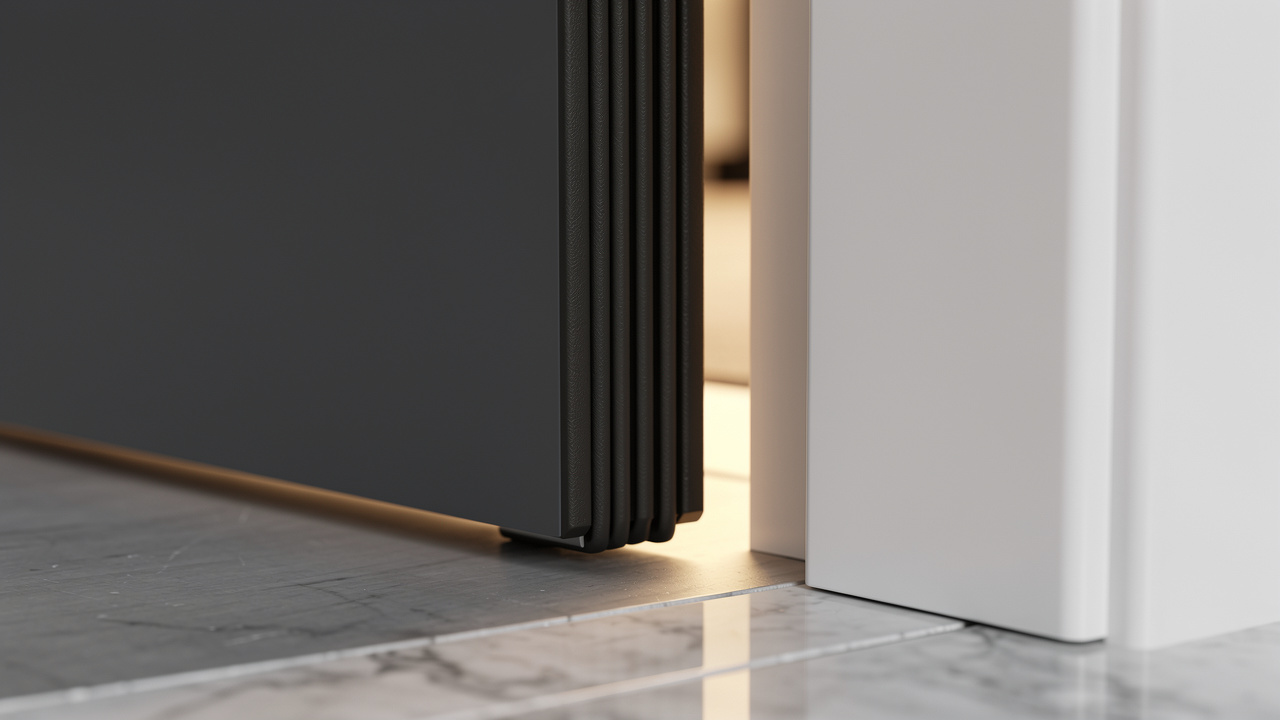
Many UAE properties spend heavily on soundproof walls while the door still leaks most of the noise.
Tiny gaps around the leaf let corridor and street noise in.
Acoustic door seals close these gaps with engineered rubber and silicone profiles so sound cannot slip through the sides, top, or bottom of the door. When all edges seal correctly, the door performs much closer to its rated Sound Transmission Class (STC) value, and the whole room feels quieter. This guide explains how these seals reduce noise leakage, which types exist, how to choose them for UAE conditions, and what installation and maintenance look like with a specialist such as Shaheen Acoustic.
Keep reading to see how small changes at the door can bring a big drop in noise.
Key Takeaways
Acoustic door seals reduce noise leakage by blocking the tiny gaps that normal doors leave around the frame. When those gaps stay open, traffic, conversation, and corridor sounds move freely between rooms. Sealing the full perimeter gives much better privacy in homes, offices, and hotels across Dubai and the wider UAE.
Doors are often the weakest acoustic link in a room, even when walls and ceilings already have soundproofing. A few millimeters of open space around the leaf can cut noise isolation by 10 to 15 decibels. Closing those small paths with proper acoustic door seals often brings a bigger improvement than adding more wall material.
All four edges of a door need attention if you want strong results. Sealing only the bottom or only the sides still leaves easy paths for sound to escape. A complete system covers the head, both jambs, and the threshold at the same time so sound has no simple route through.
Shaheen Acoustic supplies a full range of perimeter seals, door bottom profiles, automatic drop seals, and matching thresholds in custom sizes. The team cuts lengths from about 380 millimeters up to 1,900 millimeters to suit almost any door in UAE apartments, villas, or commercial projects. This avoids weak spots that appear when installers try to force standard sizes to fit.
Materials are chosen for UAE heat and humidity, with silicone, EPDM, TPE, and PVC designed to handle temperatures above 45 degrees Celsius. These compounds keep their shape under compression, so the seal stays effective over years of air conditioning and heat cycles. This durability is especially helpful for frequently used doors in hotels and offices.
Professional installation has a direct impact on the noise reduction you hear in real life. Poorly aligned frames, loose screws, and gaps at the corners can waste the performance promised on paper. Using Shaheen Acoustic’s trained installers gives you correctly prepared frames, finely adjusted drop seals, and tested closing force so the system works as specified.
“Environmental noise is an important public health issue.” — World Health Organization
What Are Acoustic Door Seals And Why Do Doors Leak Noise?

Acoustic door seals are purpose‑made strips and profiles that close the small air gaps around a door so noise cannot leak through. They work with the door leaf and frame as one system rather than sitting on the surface like simple draft stoppers. By sealing the sides, head, and threshold, they help the door assembly reach the Sound Transmission Class performance it was designed for in the first place.
Normal doors leak sound because airborne noise follows the path of least resistance. Instead of pushing through a solid timber or metal core, sound waves slide through the open space at the bottom or along the jambs. Even a one millimeter gap at the threshold can reduce effective isolation by more than 10 decibels — a finding supported by research on the influence of gaps under doors on acoustic performance of wall and door assemblies. According to the U.S. Environmental Protection Agency, a 10 decibel drop is heard as roughly half as loud, so losing that benefit at the door is a big setback.
This problem feels sharper in busy districts of Dubai, Abu Dhabi, and Sharjah, where traffic, lift shafts, and corridor voices are constant. The World Health Organization links long term exposure to environmental noise with sleep problems and heart related risks across cities worldwide (World Health Organization). For a bedroom, clinic, or boardroom in the UAE, leaving the door gaps open means paying for good walls while still living with disruptive sound. Acoustic door seals turn that weak point into a proper barrier.
Shaheen Acoustic focuses on these weak spots by supplying tested seal systems that match modern wooden, metal, and acoustic doors used across the Emirates.
Types Of Acoustic Door Seals: Which One Does What

The main types of acoustic door seals each handle a different gap around the door and play a clear role in blocking noise. A good design uses several of these products together so the full perimeter is closed when the leaf is shut. Shaheen Acoustic groups its range into four main families that cover almost every project in the UAE.
Here is a simple comparison.
| Seal Type | Typical Location | Main Job | Common UAE Uses |
|---|---|---|---|
| Perimeter or compression | Sides and top of the frame | Seal between frame and door face when closed | Bedrooms, offices, hotel rooms |
| Door bottom | Fixed on lower door edge | Close constant gap to hard floor surface | Light use residential and storage rooms |
| Automatic drop down | Inside lower door edge | Drop to the floor on closing, lift when door opens | High traffic offices, hotels, clinics |
| Threshold | On floor under the leaf | Give flat contact line and extra barrier at the base | Executive suites, studios, high noise zones |
Perimeter or compression seals sit along the jambs and head. When the door closes, a soft but firm rubber edge compresses to remove any open space. Shaheen Acoustic uses silicone, EPDM, and foam‑backed profiles that keep their shape despite repeated closing cycles and air conditioning. These seals are especially handy in apartments and villas where corridor noise pushes through around the latch side.
Fixed door bottom seals mount directly to the underside or face of the leaf. They work best where the floor is smooth and level, such as marble and tile common in Dubai towers. For heavier use, many clients prefer automatic drop down seals because they pull back up as the door opens, so they do not scrape the floor or trip people.
Automatic drop down seals hide inside an aluminum housing at the door bottom. A small plunger at the hinge or latch side activates when the door touches the stop, pushing a rubber blade down to meet the floor or threshold. When the door opens, the blade lifts again. This design gives a firm seal without wearing the floor finish. Many Shaheen Acoustic automatic models help doors reach tested ratings of more than 40 STC when used with matching perimeter seals — a balance explored in detail by a numerical investigation of the trade-off between sound insulation and air ventilation for partially open doors.
Threshold seals mount on the floor and work together with the drop down bar. They provide a flat contact line and create a double barrier at the noisiest point of the door. In executive suites at places such as DIFC or Business Bay towers, this pairing greatly reduces speech leaking into corridors.
Sound does not negotiate. Leave one gap open and it will find it.
By mixing perimeter, drop, and threshold seals correctly, Shaheen Acoustic builds a full frame around the door so sound has no weak corner to slip through.
How To Choose The Right Acoustic Door Seal For Your Space

Choosing the right acoustic door seal for your space means matching the seal system to how the room is used, how often the door moves, and how much privacy you need. The same product that works for a quiet bedroom in a villa may not suit a busy boardroom in Dubai Media City. A short review of room type, floor finish, and door size is the best starting point.
For most projects, it helps to think in terms of room type — and research on numerical analysis on the improvement of sound insulation performance of plenum doors highlights how material choices such as sound absorption and MPPs influence outcomes across different space configurations.
Residential apartments and villas
Most noise problems center on entrance doors and bedroom doors. In these cases, a good setup is a solid leaf with perimeter compression seals and either a fixed bottom seal or a light duty automatic drop seal. The combination can cut corridor noise and neighbor voices by 15 to 25 decibels compared with an unsealed door, based on typical lab tests shared by many acoustic suppliers. Research from the Sleep Foundation notes that even modest night time noise reduction helps people fall asleep faster and wake less often.Corporate offices, law firms, and clinics
In areas such as DIFC, Business Bay, and Abu Dhabi Global Market, clients usually care most about speech privacy. These doors open many times a day, so durable automatic drop seals together with thresholds and perimeter gaskets are recommended. Shaheen Acoustic cuts seals from about 10 millimeters up to 62 millimeters wide and from 380 millimeters up to 1,900 millimeters long, which fits standard and oversized office doors used across the UAE.Hotels, studios, and home cinemas
Hotels on Palm Jumeirah or in Ras Al Khaimah resorts often specify full perimeter systems at guest room doors to stop corridor trolleys and voices from disturbing guests. Recording studios, podcast rooms, and home cinemas in Dubai and Sharjah usually go further with double seals and heavier drop mechanisms for deeper low frequency control.
Material choice matters under Gulf conditions. Cheap plastic strips harden and crack when exposed to heat, humidity, and strong air conditioning. Shaheen Acoustic relies on silicone, EPDM, TPE, and PVC profiles that resist these stresses and stay flexible. Fire rated and smoke rated models with acoustic properties are also available, which helps architects meet civil defense and building code requirements in towers and public buildings.
“Even modest reductions in night‑time noise can improve sleep quality.” — Sleep Foundation
Installation And Long Term Performance: What To Expect

Installation and long term performance of acoustic door seals depend strongly on how well the products are fitted on day one. Even high grade components will disappoint if the frame is twisted or the seal does not touch the floor evenly. A proper installation brings the door, hinges, closer, and seals together as one tuned system.
During a Shaheen Acoustic installation, technicians typically:
Check the door leaf and frame for warping or sagging.
Tighten any loose hinges and measure the undercut so the correct travel range for the drop seal is chosen.
Fix perimeter seals with adhesive or screws in straight, continuous lines with tight, clean corners.
Fit and adjust automatic drop seals so the blade meets the floor or threshold evenly.
Test the door several times, adjusting the closer so it shuts with enough force to compress the seals without slamming.
Guidance from the Building Research Establishment highlights how small gaps at corners can seriously cut acoustic ratings, so careful finishing here matters.
Noise control does not stop after installation because seals see daily wear, dust, and temperature swings. Regular checks keep performance close to the original rating. Facility managers in busy hotels or clinics across Dubai and Abu Dhabi often schedule visual inspections every six months for heavy use doors.
Look along the full length of each seal for crushed spots, cracks, or peeling edges. These flaws create local air paths that let noise sneak through even if the rest of the frame looks solid. Early replacement of small sections is cheaper than waiting for full failure of the strip.
Test automatic drop seals by opening and closing the door slowly while watching the blade touch the floor — proper seal compression is critical to NVH performance, as demonstrated by the analysis of door seal compression and its influence on acoustic performance in heavy-duty applications. The seal should lower smoothly and make firm contact from hinge side to latch side without dragging. If only one end moves or the bar sticks, a quick adjustment or cleaning usually restores the proper action.
The Bottom Line

The bottom line is that acoustic door seals are one of the simplest ways to reduce noise leakage in UAE homes and workplaces. Instead of adding more layers to walls, you close the weakest point around the door so traffic, corridor sounds, and neighbor voices have no easy route inside. For many Dubai apartments and offices, this single step makes the difference between a distracting space and a calm one.
Treating the door as a full system is the key. When perimeter seals, automatic drop seals, and thresholds work together, they recover much of the 10 to 15 decibels that small gaps would otherwise waste. That means better sleep, clearer meetings, and happier hotel guests for a modest share of your project budget.
If you want help choosing and installing the right setup, Shaheen Acoustic offers specification advice, custom cutting, and professional fitting across the UAE. Call +971 50 209 7517 or visit shaheenacoustic.com to request a site visit or supply and install quote.
Frequently Asked Questions
Question: Can acoustic door seals be installed on any type of door?
Answer: Acoustic door seals can fit most wooden, metal, and purpose‑made acoustic doors. Shaheen Acoustic supplies profiles in widths from about 10 millimeters to 62 millimeters and lengths from 380 millimeters to 1,900 millimeters, so even non standard doors are covered. Both adhesive‑backed and screw‑fixed options are available.
Question: How much noise reduction can I realistically expect from acoustic door seals?
Answer: A properly sealed door often regains 15 to 25 decibels of isolation that open gaps would lose. Small gaps at the bottom alone can remove 10 decibels or more. Real results depend on the door leaf’s own STC rating and how carefully the seals are installed and adjusted.
Question: Are acoustic door seals suitable for UAE climate conditions?
Answer: High quality acoustic door seals are suitable for UAE heat and humidity when they use the right materials. Shaheen Acoustic relies on silicone, EPDM, TPE, and PVC compounds that handle temperatures above 45 degrees Celsius and constant air conditioning without turning brittle or losing their shape.
Question: Do acoustic door seals also help with fire and smoke containment?
Answer: Certain acoustic door seals also protect against fire and smoke spread. Shaheen Acoustic offers fire rated and smoke rated models that combine compression sealing with intumescent materials. Test certificates and data sheets are available for consultants and authorities on projects where formal approval is needed.
Question: How long do acoustic door seals last, and when should they be replaced?
Answer: Lifespan depends on door traffic, but good seals usually last several years in normal use. Inspect them about every six months, checking for cracks, permanent flattening, or poor contact with the floor. Many perimeter systems from Shaheen Acoustic use replaceable inserts so you swap only the worn strip, not the whole profile.