
When a Wall Looks Solid but Still Lets Noise Through
A thick wall does not automatically mean a quiet room.
In offices, apartments, studios, meeting rooms, hotels, cinemas, and commercial spaces, unwanted sound can travel through walls, ceilings, floors, doors, and service openings even when the construction appears substantial. The problem is often not the visible finish — it is what happens inside the building assembly.
This is where Mass Loaded Vinyl (MLV) can become an important part of a professionally designed soundproofing system.
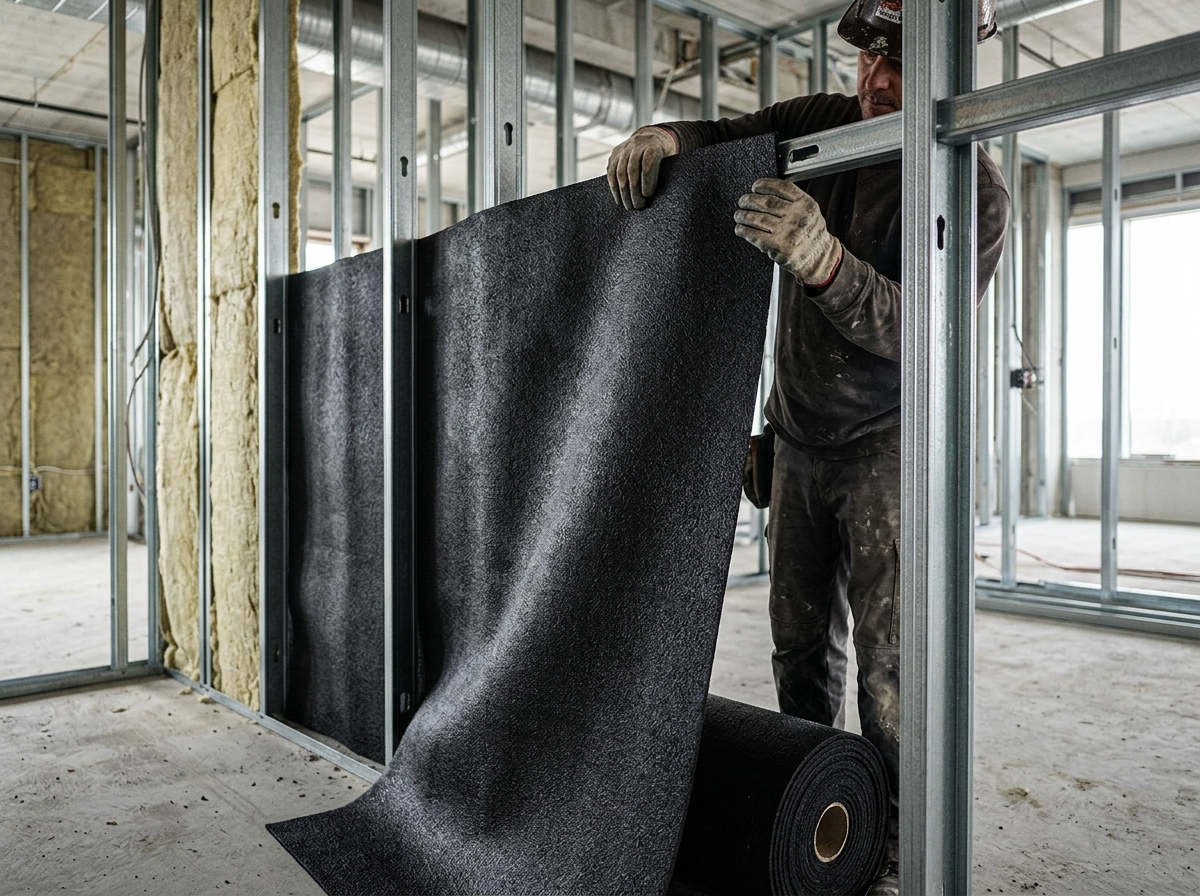
MLV is a dense, flexible sound barrier designed to add mass to building assemblies and reduce airborne sound transmission. It can be incorporated into walls, floors, ceilings, doors, equipment enclosures, and other assemblies where additional sound isolation is required.
For projects in Dubai, where residential towers, offices, hospitality spaces, entertainment venues, and mixed-use buildings frequently operate close to one another, controlling unwanted noise requires more than simply adding an acoustic panel to a wall.
The real solution begins with understanding where the sound is travelling and how the construction assembly can interrupt that path.
What Makes Mass Loaded Vinyl Different?
Many acoustic materials are designed to absorb sound inside a room.
MLV serves a different purpose.
Rather than primarily treating reverberation, Mass Loaded Vinyl is used as a sound-blocking layer. Its high mass relative to its thickness allows it to contribute additional weight to a wall, ceiling, floor, or other construction assembly without requiring an extremely thick barrier.
This makes MLV particularly useful when a project requires additional sound isolation while trying to preserve usable room space.
Depending on the specific product, MLV can be manufactured in different thicknesses and weights. Technical data for commercial MLV products commonly describes them as dense, flexible barriers used to reduce airborne sound transmission through walls, floors, and ceilings.
The important point is that MLV should not be viewed as a standalone magic sheet.
Its effectiveness comes from how it is incorporated into the complete soundproofing assembly.
The Sound May Not Be Coming Through the Surface You Think
Imagine an office meeting room beside a busy workspace.
The wall looks solid.
The doors are closed.
Yet conversations from the neighboring room remain audible.
The instinct may be to install decorative acoustic panels inside the meeting room.
Those panels can help reduce echo and improve speech clarity, but they do not necessarily stop sound from passing through the wall.
This distinction is critical.
Acoustic treatment controls sound inside a room. Sound isolation controls sound moving between rooms.
MLV belongs primarily to the second category.
A professional soundproofing design may therefore combine:
- Mass Loaded Vinyl
- Wall insulation
- Gypsum board
- Resilient isolation systems
- Acoustic sealants
- Door seals
- Acoustic glazing
- Floor isolation systems
- Ceiling treatments
- Absorptive acoustic panels
The correct combination depends on the construction and the source of the noise.
MLV Inside Walls: Creating a More Resistant Barrier
One of the most common applications for MLV is within wall assemblies.
Instead of simply placing the material somewhere in the finished room, MLV can be incorporated into the wall construction so that it becomes part of the overall sound-isolation system.
For new construction or renovation work, a typical assembly may involve:
Framing → insulation → MLV → gypsum board → finished surface
However, the exact configuration should be determined according to the project requirements.
Professional installation also needs to consider joints, penetrations, electrical boxes, plumbing, HVAC openings, and other areas where sound could bypass the main barrier. Installation specifications for MLV emphasize maintaining the acoustic integrity of the assembly through appropriate sealing around these openings.
This is one of the reasons professional soundproofing design matters.
A high-performance wall can still underperform if there are uncontrolled gaps around it.
Soundproofing Existing Walls Without Starting From Zero
Not every Dubai property is being constructed from scratch.
Many projects involve:
- Existing offices
- Apartments
- Recording rooms
- Conference rooms
- Restaurants
- Hotels
- Home theaters
- Commercial studios
In these situations, completely rebuilding a wall may not be practical.
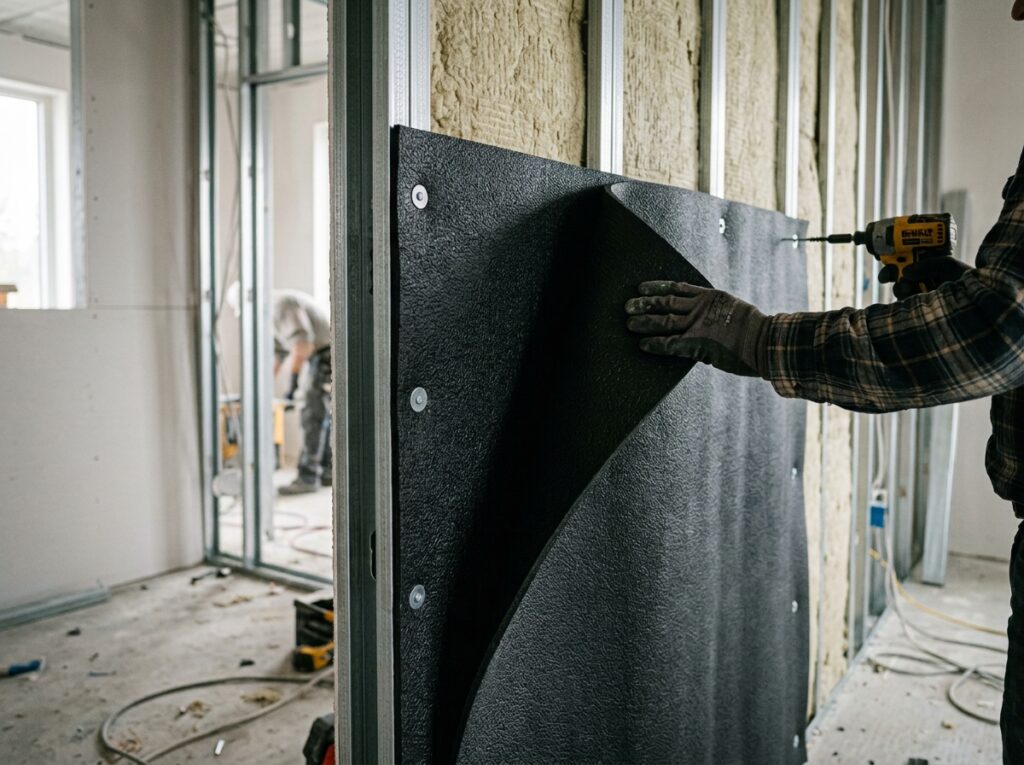
MLV can be incorporated into retrofit soundproofing assemblies where additional mass is required. Depending on the existing construction, a soundproofing system may involve installing the barrier over the existing wall and adding an additional finish layer or using another appropriate assembly.
The correct approach depends heavily on the existing wall construction, available space, and desired acoustic performance.
That is why simply purchasing MLV and attaching it to a wall does not guarantee the result a project needs.
Ceilings Are Another Important Sound Path
Noise does not always travel directly through a shared wall.
In commercial buildings, sound can travel above partition walls through ceiling voids and other connected building elements.
This can create a frustrating situation where a wall appears to separate two rooms, but conversations and equipment noise continue to pass between them.
MLV can be incorporated into ceiling sound-isolation systems to add mass and reduce airborne transmission.
In some applications, barrier materials are also used above suspended ceiling systems to help address sound-flanking paths. Case studies involving MLV have demonstrated its use in ceiling assemblies where sound was travelling above partition walls.
This makes ceiling design an important part of a complete Dubai soundproofing project.
Floors: When Noise Travels Downward
Sound isolation is not limited to vertical walls.
In multi-level buildings, noise can move through floor and ceiling assemblies.
Common complaints include:
- Footfall noise
- Furniture movement
- Equipment noise
- Music
- Loud conversations
- Home theater sound
- Mechanical noise
MLV may be incorporated into floor or ceiling assemblies where airborne sound transmission needs to be addressed.
However, impact noise and structure-borne vibration require additional consideration. A dense barrier alone is not necessarily the complete answer.
A professional acoustic design may combine barrier layers with resilient underlayments, isolation systems, floating floors, or other vibration-control methods depending on the source.
The Importance of Sealing Every Weak Point
One of the most overlooked aspects of soundproofing is the gap.
A soundproofing assembly can be compromised by small openings around:
- Electrical outlets
- Switch boxes
- Pipes
- HVAC ducts
- Door frames
- Ceiling penetrations
- Wall joints
- Service openings
- Cable routes
Sound will look for the easiest path.
That means installing a continuous MLV barrier but leaving poorly sealed penetrations can reduce the effectiveness of the overall system.
Professional specifications for MLV installations specifically address the use of acoustic sealants, tapes, putty, and isolation materials around penetrations and building services.
The barrier matters — but continuity matters just as much.
MLV for Offices and Confidential Meeting Rooms
Modern Dubai offices increasingly include private meeting spaces, executive rooms, boardrooms, consultation rooms, and phone booths.
In these environments, the goal isn’t always to eliminate every sound.
Sometimes the objective is privacy.
A conversation inside one room should remain difficult to hear from the neighboring workspace.
MLV can become one component of a wall or ceiling assembly designed to reduce airborne speech transmission.
However, doors, glazing, ventilation systems, ceiling voids, and other flanking paths must also be considered.
Treating only one surface may leave other transmission routes untouched.\
MLV for Home Theaters and Media Rooms
A powerful home theater creates an acoustic challenge.
The same low-frequency energy that makes a movie exciting can become a disturbance for people in adjacent rooms.
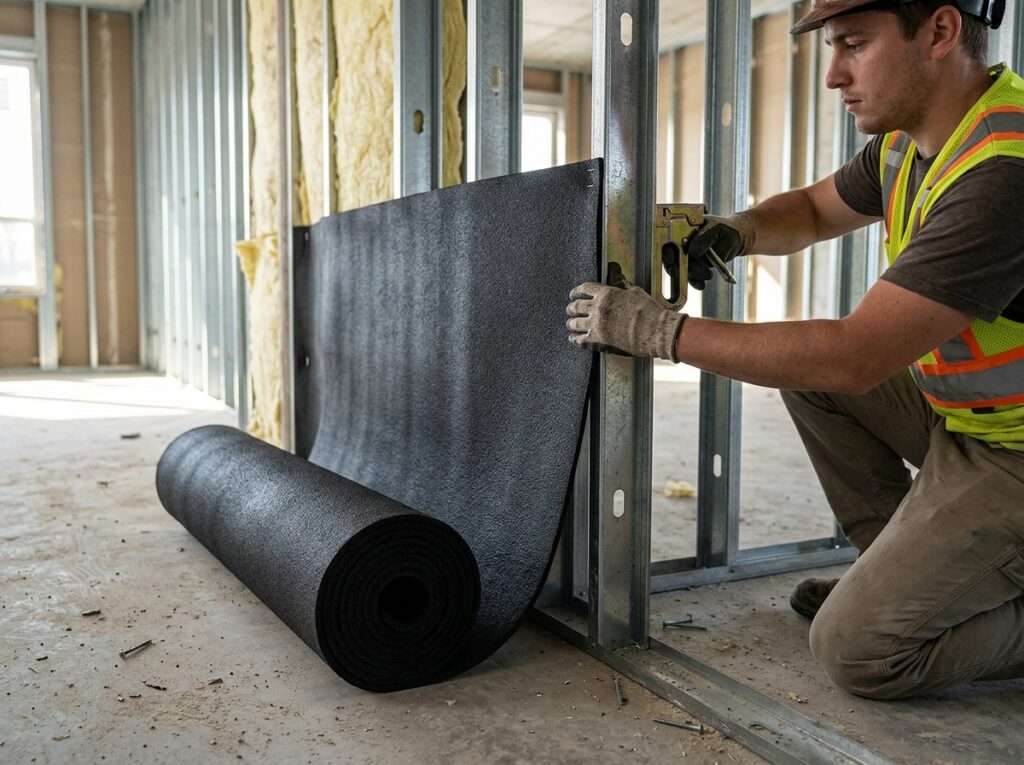
A complete home theater soundproofing design may use MLV within walls and ceilings to increase the mass of the room enclosure.
Other elements can then be introduced to address vibration, impact transmission, reflections, and reverberation.
In one documented home theater application, MLV was used around the room to address airborne sound transmission while other materials were used for floor isolation and internal acoustic treatment.
This illustrates an important principle:
Soundproofing the room and acoustically treating the room are two different jobs.
Commercial and Industrial Noise Control
MLV can also be incorporated into sound-control systems around noisy equipment.
Potential applications include:
- Machinery enclosures
- Generator areas
- Mechanical rooms
- HVAC equipment
- Industrial equipment
- Testing rooms
- Workshop areas
- Service spaces
For these applications, MLV may be combined with absorptive materials to create composite barriers or enclosures.
This combination can be particularly useful because one layer can contribute to sound blocking while another absorbs sound energy within the enclosure.
Commercial case studies have used MLV-based barriers together with absorptive materials to control machinery noise and prevent sound from spreading into occupied areas.
Why MLV Should Not Be Installed as an Isolated Product
One of the biggest misconceptions about Mass Loaded Vinyl is that simply placing it on a wall automatically creates a soundproof room.
It doesn’t work that way.
Sound isolation is an assembly problem.
For example, a wall might contain:
| Component | Main Purpose |
|---|---|
| MLV | Adds mass and helps reduce airborne transmission |
| Mineral wool insulation | Absorbs sound within the cavity |
| Gypsum board | Adds additional mass |
| Isolation clips | Helps decouple surfaces |
| Acoustic sealant | Seals sound leakage paths |
| Door seals | Reduce transmission around the door |
| Acoustic glazing | Helps control sound through windows |
| Absorptive panels | Controls internal reverberation |
The final result depends on how these components interact.
Even a well-designed wall can be undermined by sound travelling around it through doors, ceilings, windows, ducts, or other structural paths.
Where MLV Fits Into a Dubai Soundproofing Project
Every building has different acoustic challenges.
An apartment bedroom beside a living room does not require the same solution as:
- A recording studio
- A hotel room
- A boardroom
- A cinema
- A restaurant
- A mechanical room
- A commercial office
- An industrial workspace
Before selecting an MLV system, an acoustic professional can evaluate:
1. Noise source
What is producing the unwanted sound?
2. Transmission path
Is the sound travelling through a wall, ceiling, floor, door, glazing, ductwork, or structure?
3. Existing construction
What materials are already present?
4. Available space
How much additional wall or ceiling thickness can the project accommodate?
5. Required performance
How much sound reduction is actually required?
6. Secondary paths
Could sound bypass the main treated surface?
These factors determine whether MLV should be used — and what other components should accompany it.
MLV vs Acoustic Panels: They Are Not the Same Thing
This is an important distinction for property owners.
Mass Loaded Vinyl
Primarily used as a sound-blocking barrier within a construction assembly.
Acoustic Panels
Primarily used to absorb reflections and reduce reverberation inside a room.
For example, imagine a meeting room with excessive echo.
Acoustic panels may dramatically improve speech clarity.
But if the neighboring office can still hear the conversation, the problem may require sound isolation.
That could involve MLV and other construction-based soundproofing measures.
In many professional projects, both approaches are necessary.
Professional MLV Installation Matters
MLV is flexible, but installation still requires careful planning.
Installers need to consider:
- Correct overlaps
- Seams
- Fastening
- Penetrations
- Wall junctions
- Ceiling transitions
- Floor transitions
- Acoustic sealants
- Finish-layer installation
- HVAC and electrical services
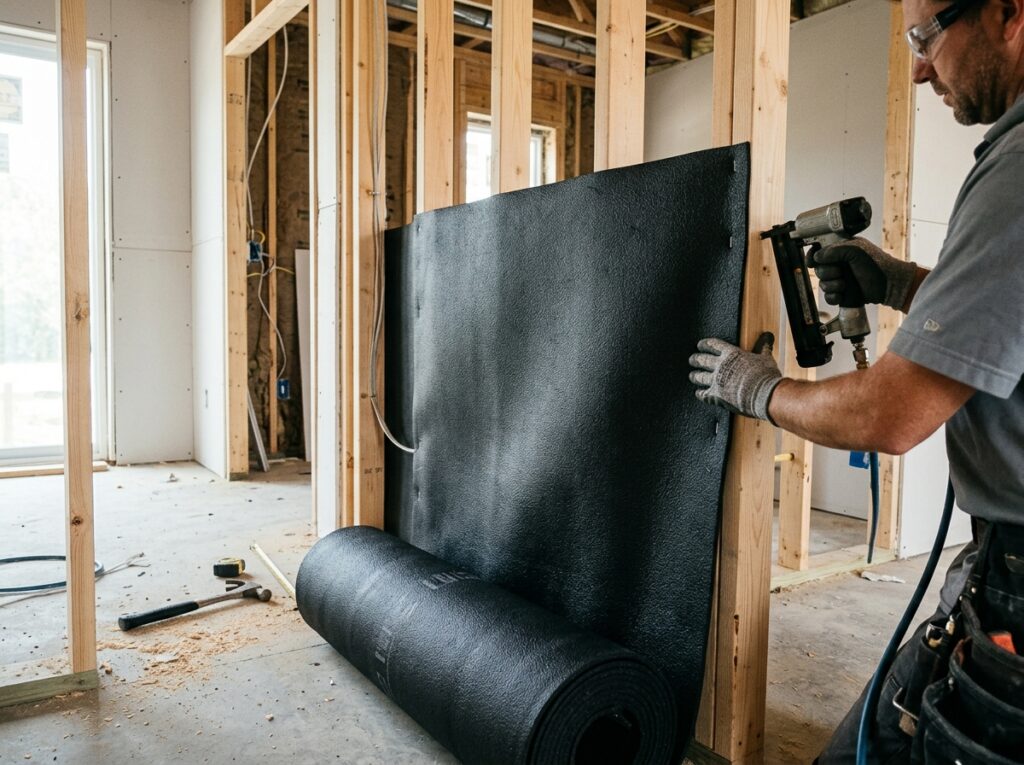
Manufacturer installation guidance commonly recommends installing MLV after framing, insulation, and electrical work are completed, while ensuring the finished barrier is properly integrated into the wall assembly.
Poor installation can create gaps and discontinuities that allow sound to bypass the intended barrier.
For this reason, MLV should be treated as part of a professionally designed soundproofing system rather than simply as a standalone material.
Building Quieter Spaces With the Right Strategy
Mass Loaded Vinyl has a specific role in acoustic construction.
It is dense.
It is flexible.
It can add substantial mass without requiring a very thick rigid barrier.
And it can be incorporated into walls, ceilings, floors, doors, equipment enclosures, and other sound-isolation assemblies.
But the best results come from understanding where the noise originates and how it travels.
A successful soundproofing project therefore isn’t simply about adding more material.
It is about creating a continuous, properly sealed and appropriately constructed acoustic barrier.
Professional Soundproofing Services in Dubai
For projects requiring Mass Loaded Vinyl in Dubai, professional assessment and installation can help determine where the material belongs within the overall soundproofing system.
From residential spaces and home theaters to offices, hotels, studios, restaurants, and commercial facilities, MLV can be incorporated into customized sound-isolation assemblies based on the project’s construction and noise-control requirements.
A complete service can include:
- Acoustic consultation
- Noise-source assessment
- Soundproofing design
- Wall and ceiling treatment planning
- MLV system installation
- Acoustic insulation
- Door and window soundproofing
- Sealing of acoustic leakage paths
- Floor and ceiling isolation
- Final acoustic coordination
The goal is not simply to cover a surface with MLV.
The goal is to create a better-performing sound-isolation system for the entire space.
Frequently Asked Questions
Is Mass Loaded Vinyl the same as acoustic foam?
No. MLV is primarily used as a sound-blocking barrier, while acoustic foam is generally used to absorb sound reflections within a room.
Can MLV completely soundproof a room?
MLV by itself should not be considered a complete soundproofing solution. Effective isolation normally depends on the complete wall, floor, ceiling, door, window, and penetration assemblies.
Can MLV be used on ceilings?
Yes. MLV can be incorporated into ceiling sound-isolation assemblies, depending on the construction and installation requirements.
Can MLV be used in existing buildings?
Yes. Retrofit applications are possible, although the appropriate installation method depends on the existing construction and available space.
Does MLV stop impact noise?
MLV primarily addresses airborne sound transmission. Impact and structure-borne noise may require additional isolation or resilient flooring systems.
Is MLV suitable for offices?
Yes. It can be incorporated into sound-isolation systems for offices, conference rooms, private rooms, and other spaces where reducing airborne sound transmission is important.
Does MLV need insulation behind it?
Not necessarily in every assembly, but insulation and other acoustic components can be used alongside MLV as part of a higher-performance soundproofing system. Manufacturer guidance recommends using insulation in addition to MLV for optimal performance in typical wall installations.
Conclusion
Mass Loaded Vinyl is most effective when it is treated as part of a complete soundproofing strategy rather than as an isolated product.
Its ability to add significant mass in a relatively flexible, space-efficient form makes it useful for walls, ceilings, floors, equipment enclosures, and other sound-isolation assemblies.
For Dubai properties dealing with speech transfer, entertainment noise, machinery, neighboring rooms, or other airborne noise problems, the right MLV system can become an important layer in a professionally engineered solution.
The key is not simply adding MLV.
It is identifying the transmission path, designing the correct assembly, sealing weak points, and combining barrier, absorption, isolation, and construction techniques where required.
Looking for professional Mass Loaded Vinyl and soundproofing solutions in Dubai? A properly assessed and installed system can help create quieter, more private, and more comfortable spaces.