
The Quietest Room Is Not Always the Best Soundproofed Room
A room can feel quiet when you are standing inside it and still allow a surprising amount of sound to escape.
A television may be clearly audible in the apartment next door. Music from a studio may travel into a corridor. Conversations from a conference room may reach an adjacent office. Mechanical equipment may create a persistent hum throughout a building.
These problems are often caused by sound transmission through the building structure.
This is where Acoustic Mass Loaded Vinyl (MLV) can become an important component of a sound-isolation system.
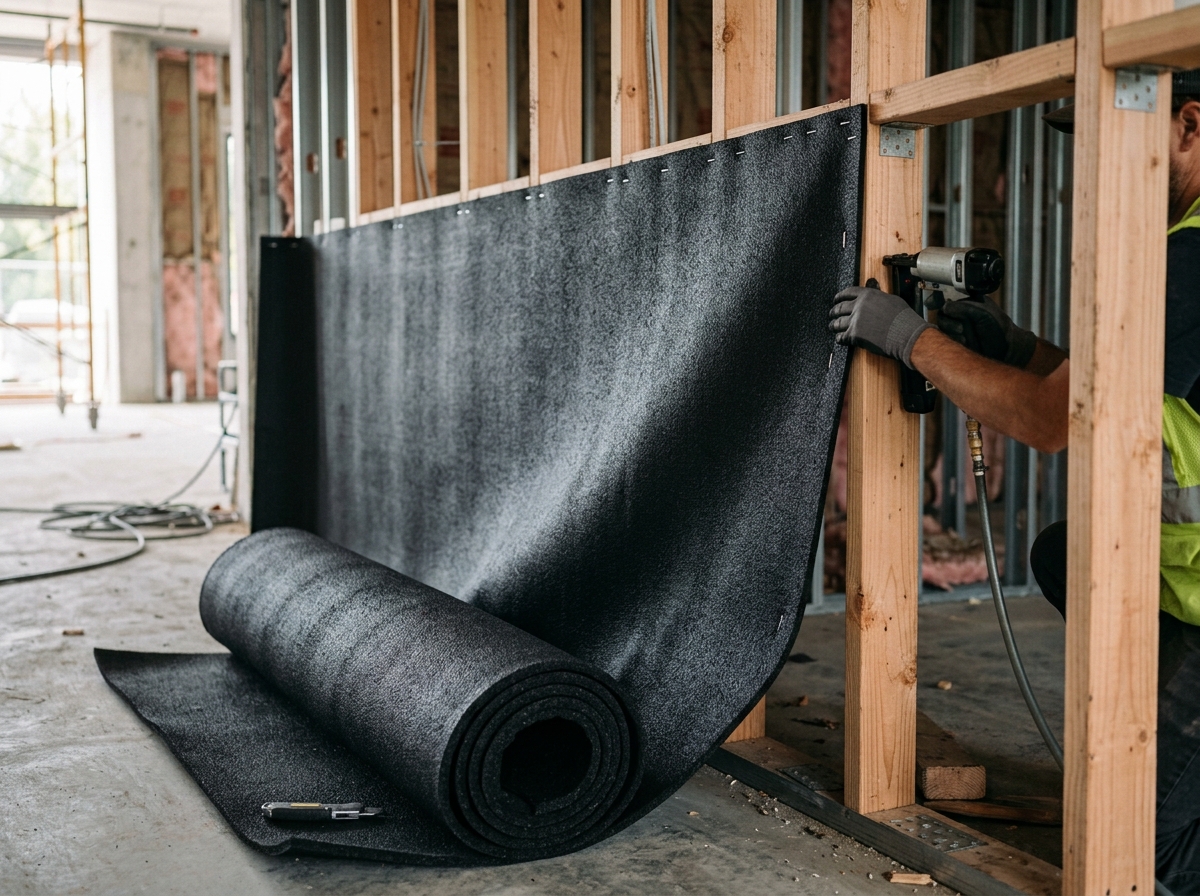
Mass Loaded Vinyl is a dense, flexible barrier designed to reduce airborne sound transmission through walls, floors, ceilings, partitions, machinery enclosures, and other building assemblies. Unlike conventional acoustic panels that primarily absorb reflections inside a room, MLV is used to create a barrier against sound travelling between spaces.
For commercial and residential developments across Ghana, MLV can be incorporated into new construction as well as retrofit soundproofing systems.
The key is understanding where the noise is travelling before deciding where the barrier should go.
Sound Doesn’t Stop at the Wall
Imagine two offices sharing a partition.
One room contains a busy team taking calls throughout the day.
The other is an executive meeting room.
The partition may appear substantial, but voices can still travel through it.
Why?
Because sound transmission is influenced by much more than the visible wall surface.
Noise can move through:
- Wall assemblies
- Ceiling voids
- Floor structures
- Doors
- Windows
- HVAC ducts
- Electrical penetrations
- Plumbing routes
- Structural connections
This is why soundproofing should be approached as a building-assembly problem rather than simply a wall-covering exercise.
MLV can provide the mass barrier, but the complete system needs to address other potential transmission routes as well.
What Makes Mass Loaded Vinyl Useful?
MLV combines two characteristics that are valuable in sound isolation:
High surface mass + flexibility
Unlike a thick concrete barrier, MLV can add substantial mass without requiring a rigid, bulky construction layer.
Commercial MLV products are available in different surface weights and thicknesses. For example, published specifications for one MLV range list options from 0.5 to 2 lb/ft², with higher surface weights providing greater transmission loss in the tested barrier itself.
The material can be incorporated into:
- Drywall partitions
- Stud walls
- Ceilings
- Floor assemblies
- Equipment enclosures
- Ductwork
- Mechanical spaces
- Sound-isolation retrofits
Its flexibility also makes it easier to integrate into irregular areas than some rigid barrier materials.
MLV in Ghana’s Multi-Storey Buildings
Modern apartments, hotels, offices, and mixed-use developments often contain multiple occupied spaces stacked directly above or beside one another.
This creates numerous opportunities for sound transmission.
A resident may hear:
- Footsteps from above
- Music from a neighboring apartment
- Conversations through a partition
- Mechanical equipment
- Plumbing noise
- Traffic-related noise
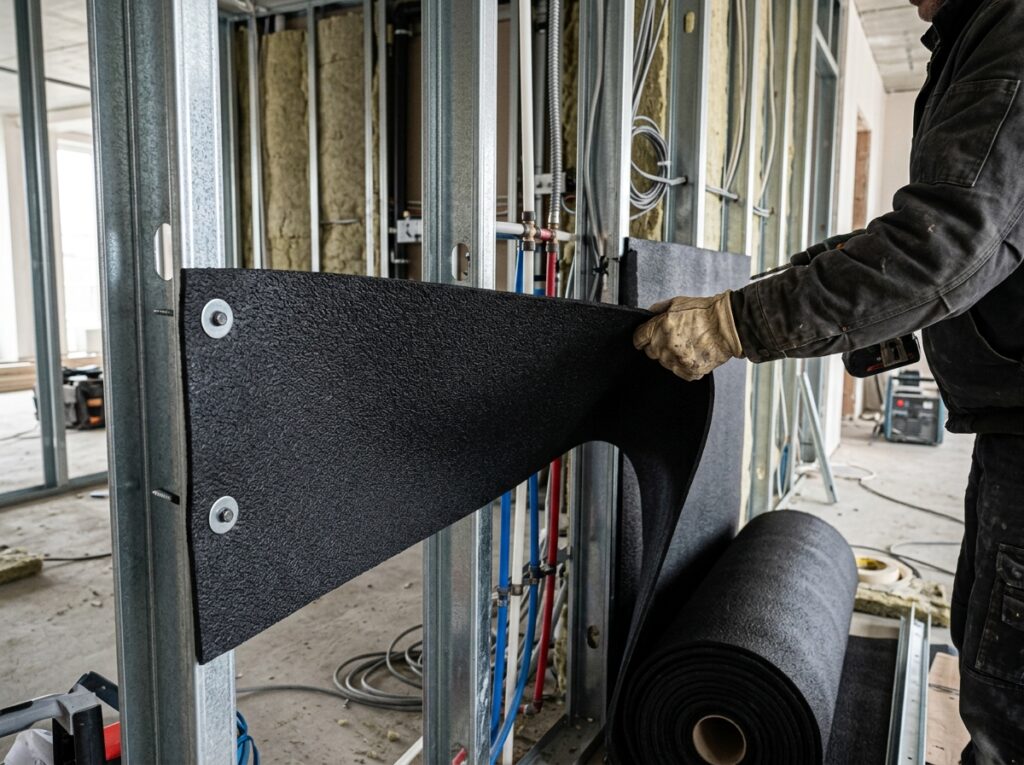
MLV can be incorporated into wall, floor, or ceiling assemblies where airborne sound transmission is a concern.
For example, it may be positioned between layers of drywall within a partition or beneath an appropriate floor finish as part of a larger acoustic assembly.
But different noise types require different solutions.
Airborne noise and impact noise are not the same problem.
That distinction should be established before selecting the soundproofing system.
The Difference Between Airborne and Impact Noise
This is one of the most important concepts in building acoustics.
Airborne Noise
The sound begins in the air.
Examples include:
- Speech
- Television
- Music
- Traffic
- Machinery noise
- Generator noise
MLV can contribute to reducing airborne transmission by adding mass to the separating assembly.
Impact Noise
The structure itself is excited by physical impact.
Examples include:
- Footsteps
- Furniture movement
- Objects dropping
- Structural vibration
Impact noise may require resilient underlayments, floating floors, isolation mounts, or other decoupling strategies.
MLV can be part of some floor assemblies, but it should not automatically be presented as a complete solution for impact noise.
Understanding this difference can prevent a project from spending money on the wrong acoustic treatment.
A Hidden Layer Inside Soundproof Walls
One reason MLV is popular for construction applications is that it can remain hidden.
A finished wall might look completely ordinary.
Behind the gypsum board, however, the assembly can contain several acoustic layers.
A simplified system could include:
Structural framing → cavity insulation → MLV → gypsum board → finished surface
Depending on the acoustic requirements, additional layers such as decoupling components, resilient channels, or another gypsum layer may be incorporated.
The MLV acts as the dense barrier layer.
The insulation helps control sound within the cavity.
The gypsum board adds additional mass.
The isolation components can reduce structural vibration transfer.
The sealant helps prevent sound leakage through gaps.
This is why a successful soundproofing wall is usually a combination of materials rather than a single product.
Why Acoustic Sealing Matters
A soundproofing membrane can be installed perfectly across a large wall and still underperform if there are uncontrolled openings around it.
Consider:
- Electrical outlets
- Switch boxes
- Pipes
- Cable penetrations
- HVAC openings
- Door frames
- Wall junctions
Every opening creates a potential path for sound.
Installation guidance for MLV systems emphasizes careful treatment of seams, edges, penetrations, and other areas where continuity of the barrier could be compromised.
The principle is simple:
A sound barrier works best when the barrier remains continuous.
This is one reason professional installation can make a significant difference.
MLV for Recording Studios in Ghana
Ghana’s creative and music industries create another environment where sound isolation can become important.
A recording studio has two acoustic objectives:
Inside the studio
The room needs controlled reflections, appropriate reverberation, and balanced acoustics.
Outside the studio
The building needs to prevent music from escaping into neighboring rooms and properties.
These are completely different requirements.
Acoustic panels can help with the first.
MLV and other construction-based soundproofing components can contribute to the second.
A typical studio isolation assembly may combine:
- MLV
- Mineral wool
- Multiple gypsum layers
- Decoupled framing
- Acoustic sealants
- Acoustic doors
- Floating floor systems
- Absorptive interior treatment
MLV is particularly useful as a barrier layer within such multi-layer assemblies. Manufacturers describe MLV as suitable for partitions, studios, home theaters, offices, and other spaces requiring sound isolation.
Hotels Need Privacy From Room to Room
Hotel guests expect a certain level of privacy.
A conversation inside one room should not easily become audible in the next.
Similarly, entertainment areas, corridors, conference facilities, and mechanical rooms should not unnecessarily disturb guestrooms.
MLV can be incorporated into selected wall, floor, and ceiling systems to help reduce airborne sound transmission.
A hotel soundproofing strategy may address:
Guestroom → Guestroom
Guestroom → Corridor
Restaurant → Guestroom
Mechanical Room → Guestroom
Conference Room → Guestroom
Each situation can require a different construction approach.
The correct solution depends on the transmission path rather than simply choosing the same MLV thickness everywhere.
Offices and Speech Privacy
An office does not necessarily need to be completely silent.
But certain rooms need privacy.
This is particularly relevant for:
- Executive offices
- Boardrooms
- HR rooms
- Consultation rooms
- Legal offices
- Financial offices
- Meeting rooms
If conversations can easily travel through a lightweight partition, the problem becomes more than an acoustic comfort issue.
It becomes a privacy issue.
MLV can be incorporated into partition systems to increase the mass of the assembly and reduce airborne transmission.
However, doors, glazing, ceiling voids, and ventilation paths also need to be considered.
Treating only the partition may not address the entire transmission route.
Generator and Mechanical Room Applications
Mechanical equipment can create persistent noise.
Generators, pumps, compressors, HVAC equipment, and other machinery can generate both airborne and structure-borne sound.
MLV can be used as part of barriers and enclosures designed to reduce airborne noise escaping from equipment areas.
Commercial acoustic barrier products are specifically used for applications such as machinery enclosures, ducts, ceilings, and walls.
However, machinery introduces an additional complication:
Vibration.
If equipment is physically connected to the building structure, vibration can travel through the structure even when the surrounding walls have been soundproofed.
That may require:
- Vibration isolation mounts
- Resilient connections
- Floating equipment bases
- Flexible connectors
- Decoupled construction
The MLV barrier should therefore be considered one part of the complete mechanical noise-control strategy.
MLV Beneath Floors
Floor assemblies provide another opportunity for sound isolation.
MLV can be incorporated into floor systems where additional mass is required to reduce airborne transmission.
A typical concept could involve:
Structural slab → MLV → resilient layer/screed → finished flooring
The exact arrangement depends on the building and flooring system.
This can be useful in:
- Apartments
- Hotels
- Home theaters
- Recording studios
- Offices
- Multi-level commercial buildings
However, if the main complaint is footsteps, simply adding a dense barrier may not be sufficient.
The floor may require a dedicated impact-isolation system.
Why Low-Frequency Noise Is Difficult
Low-frequency noise can be particularly frustrating.
It may be experienced as:
- Bass from music
- Generator hum
- HVAC vibration
- Machinery rumble
- Traffic vibration
Low-frequency sound can interact strongly with building structures.
This means simply installing thin decorative acoustic panels inside the affected room may have little effect on the transmission problem.
A sound-isolation assembly may instead require:
Mass + decoupling + cavity absorption + airtight construction
MLV contributes primarily to the mass/barrier side of this equation.
A complete system is still required.
MLV Is Not Acoustic Foam
The difference is easy to understand once their purposes are separated.
| Material | Main Role |
|---|---|
| Mass Loaded Vinyl | Sound isolation/barrier |
| Acoustic PET Panels | Internal sound absorption |
| Wood Wool Panels | Internal sound absorption |
| Acoustic Foam | Reflection and reverberation control |
| Mineral Wool | Cavity absorption |
| Resilient Channels | Structural decoupling |
| Acoustic Sealant | Sealing sound leakage paths |
| Floating Floor | Impact/structure-borne isolation |
This means an MLV system and an acoustic panel system can actually work together.
For example, a recording studio may use MLV within its walls to reduce sound transmission while PET or fabric acoustic panels are installed inside the room to control reflections.
Retrofitting Existing Ghanaian Buildings
Soundproofing does not always happen during the original construction.
Existing buildings may need acoustic upgrades because of:
- New office layouts
- Neighboring businesses
- Increased equipment noise
- Studio conversions
- Home theater installations
- Apartment privacy concerns
- Hotel renovations
- Mechanical equipment upgrades
MLV can be incorporated into selected retrofit assemblies without necessarily rebuilding the entire structure.
Its flexibility makes it useful where additional mass needs to be introduced without dramatically increasing wall thickness.
However, the available space and existing construction must be assessed first.
A retrofit solution should balance:
Acoustic performance + available space + structural requirements + finish requirements + budget.
How to Choose the Right MLV Specification
Not every project needs the same MLV.
The correct specification depends on the application.
Residential Wall
A moderate barrier system may be appropriate depending on the existing wall and noise source.
Recording Studio
A more comprehensive multi-layer isolation system may be necessary.
Hotel Partition
Speech privacy and room-to-room transmission should guide the design.
Generator Enclosure
A heavier barrier may be considered alongside vibration isolation.
Floor Assembly
MLV may need to work together with resilient layers and the final floor finish.
Industrial Application
The noise spectrum, equipment vibration, enclosure design, and fire requirements should all be evaluated.
Some Ghana-focused MLV specifications currently list different thicknesses and surface weights for residential, studio, industrial, floor, and ceiling applications.
The important lesson is:
Do not choose MLV solely because it is thicker. Choose the complete system according to the noise problem.
Installation Details Can Make or Break the System
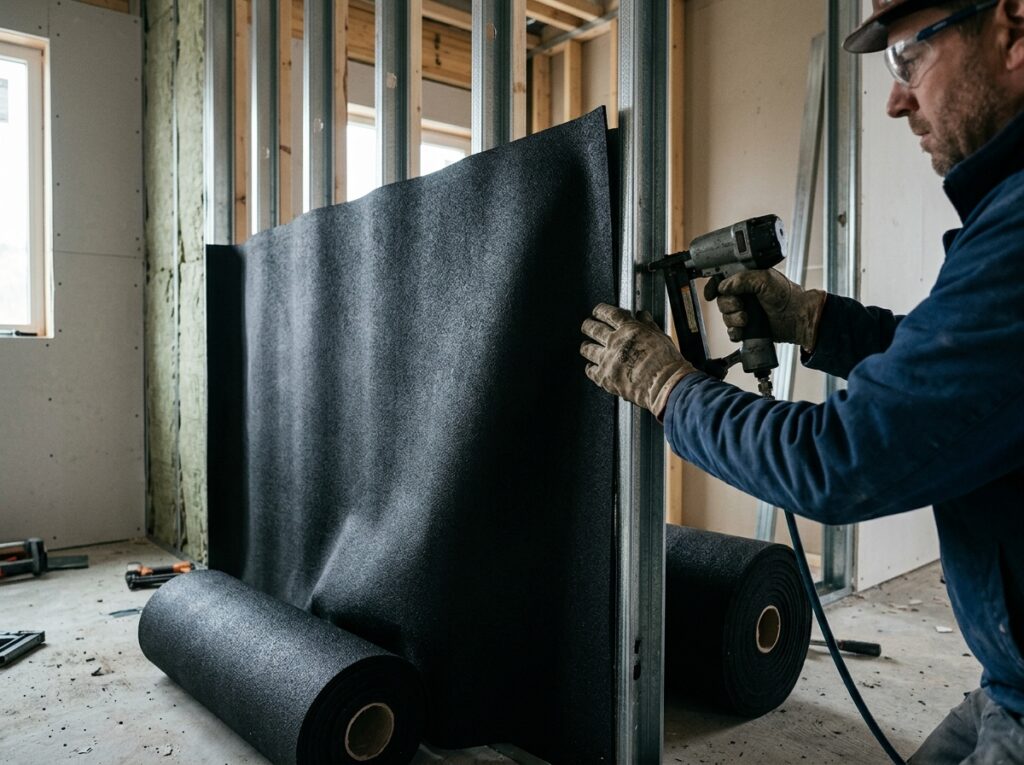
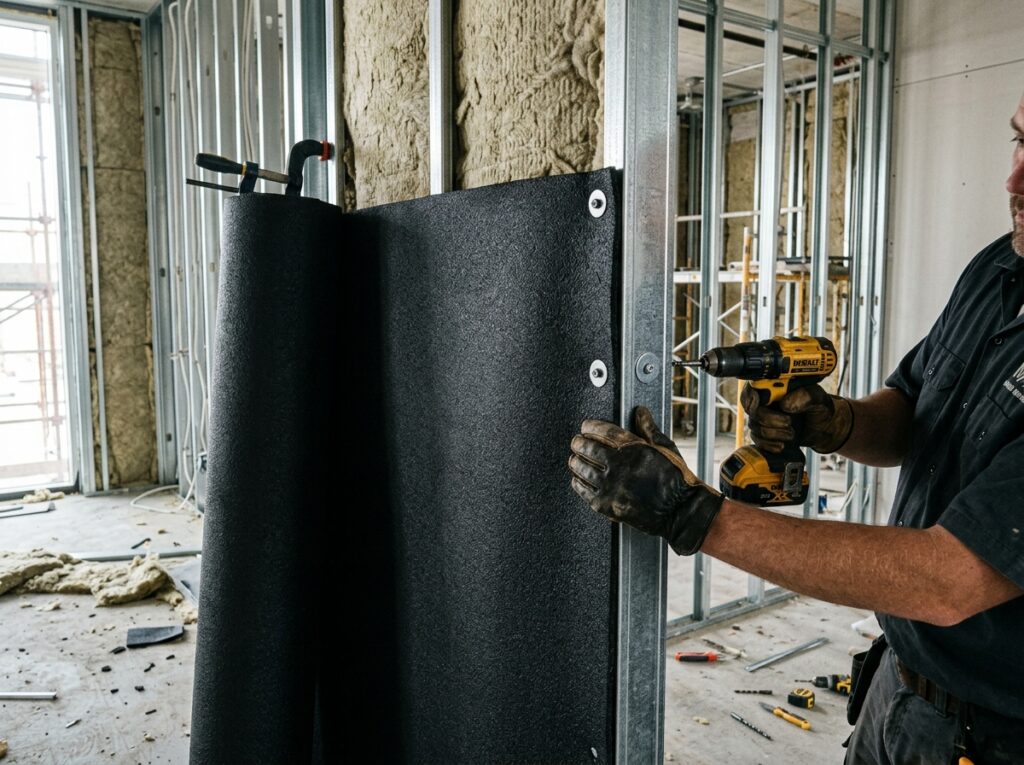
MLV may be supplied in large rolls, but installation requires careful attention.
Important considerations include:
Continuous Coverage
Avoid unnecessary breaks in the barrier.
Correct Seams
Joints should be treated according to the manufacturer’s installation requirements.
Edge Treatment
Perimeter connections need to maintain the acoustic continuity of the system.
Penetrations
Electrical and mechanical penetrations need appropriate sealing.
Overlaps
Where the specified system requires overlapping, the overlap should be installed correctly.
Fastening
The membrane needs appropriate mechanical or adhesive fixing depending on the assembly.
Published MLV installation guidance highlights fastening, seam management, and sealing around penetrations as important parts of creating an effective barrier.
Where Acoustic Mass Loaded Vinyl Can Be Used in Ghana
MLV can be considered for many types of projects.
Residential Buildings
Apartments, villas, bedrooms, media rooms, and home theaters.
Commercial Offices
Boardrooms, executive offices, conference rooms, and private spaces.
Hotels
Guestrooms, corridors, restaurants, entertainment areas, and mechanical spaces.
Recording Studios
Studio walls, ceilings, floors, and isolation structures.
Entertainment Venues
Clubs, cinemas, lounges, and event spaces.
Industrial Facilities
Machinery enclosures, mechanical rooms, generator spaces, and equipment areas.
Educational Buildings
Music rooms, lecture spaces, classrooms, and multipurpose areas.
A Better Way to Approach Soundproofing
Instead of asking:
“How much MLV do I need?”
a better starting point is:
“Where is the noise coming from, and how is it reaching the other space?”
That question changes the entire design process.
If sound is passing through a partition, the wall assembly needs attention.
If it is travelling through a ceiling void, the ceiling and flanking paths need to be addressed.
If it is coming through a door, the door assembly may be the weakest point.
If it is structure-borne vibration, adding more mass alone may not solve the problem.
The material should follow the acoustic diagnosis — not the other way around.
Professional Acoustic MLV Solutions in Ghana
A professionally designed MLV soundproofing project can begin with an assessment of the existing building and the specific noise complaint.
The service can include:
- Acoustic consultation
- Noise-source assessment
- Sound transmission analysis
- Wall soundproofing design
- Ceiling soundproofing
- Floor isolation
- MLV specification
- Studio sound isolation
- Generator-room treatment
- Mechanical-room soundproofing
- Acoustic sealing
- Door and glazing coordination
- MLV installation
For larger projects, the acoustic system can be coordinated with architectural, mechanical, electrical, and interior design requirements.
This is especially important in hotels, offices, studios, entertainment venues, and multi-storey developments.
Frequently Asked Questions
What is Acoustic Mass Loaded Vinyl?
Mass Loaded Vinyl is a dense, flexible acoustic barrier used to reduce airborne sound transmission through walls, floors, ceilings, partitions, and other assemblies.
Is MLV the same as an acoustic panel?
No. MLV is primarily used for sound isolation, while acoustic panels are generally designed to absorb reflections inside a room.
Can MLV be used in walls?
Yes. It can be incorporated into framed wall and drywall assemblies to add mass and reduce airborne sound transmission.
Can MLV be used under flooring?
Yes. MLV can be incorporated into floor assemblies, although the correct system depends on whether the project is primarily addressing airborne or impact noise.
Can MLV stop generator noise?
It can help reduce airborne noise from generators when correctly incorporated into an enclosure or building assembly. Generator vibration may require additional isolation.
Is thicker MLV always better?
Not necessarily. The appropriate thickness and surface weight depend on the complete assembly, available space, noise source, and required performance.
Can MLV be used in recording studios?
Yes. It is commonly incorporated into studio wall, ceiling, and floor assemblies as a sound-isolation barrier.
Does MLV eliminate echo?
No. Echo and reverberation are primarily internal acoustic-treatment issues. Absorptive materials such as PET, fabric, mineral wool, or wood wool may be used alongside MLV.
Can MLV be installed in an existing building?
Yes. Retrofit applications are possible, although the appropriate construction method depends on the existing wall, ceiling, or floor assembly.
Conclusion
Acoustic Mass Loaded Vinyl provides a practical way to introduce significant barrier mass into soundproofing assemblies without relying on extremely thick rigid construction.
For Ghanaian apartments, offices, hotels, studios, entertainment venues, and industrial spaces, it can contribute to reducing airborne sound transmission through walls, floors, ceilings, partitions, and equipment enclosures.
But MLV should never be treated as a standalone solution for every type of noise.
The strongest results come from combining the right elements:
Mass + absorption + decoupling + airtight construction + correct installation.
Once the actual transmission path has been identified, MLV can be positioned where its barrier properties provide the greatest value.
Whether the goal is improving speech privacy in an Accra office, isolating a recording studio, reducing noise between hotel rooms, controlling generator noise, or improving residential sound isolation, a properly designed MLV system can become an important hidden layer behind a quieter building.
For professional Acoustic Mass Loaded Vinyl solutions in Ghana, the right soundproofing assembly can help control unwanted noise while preserving the appearance and functionality of the finished space.