
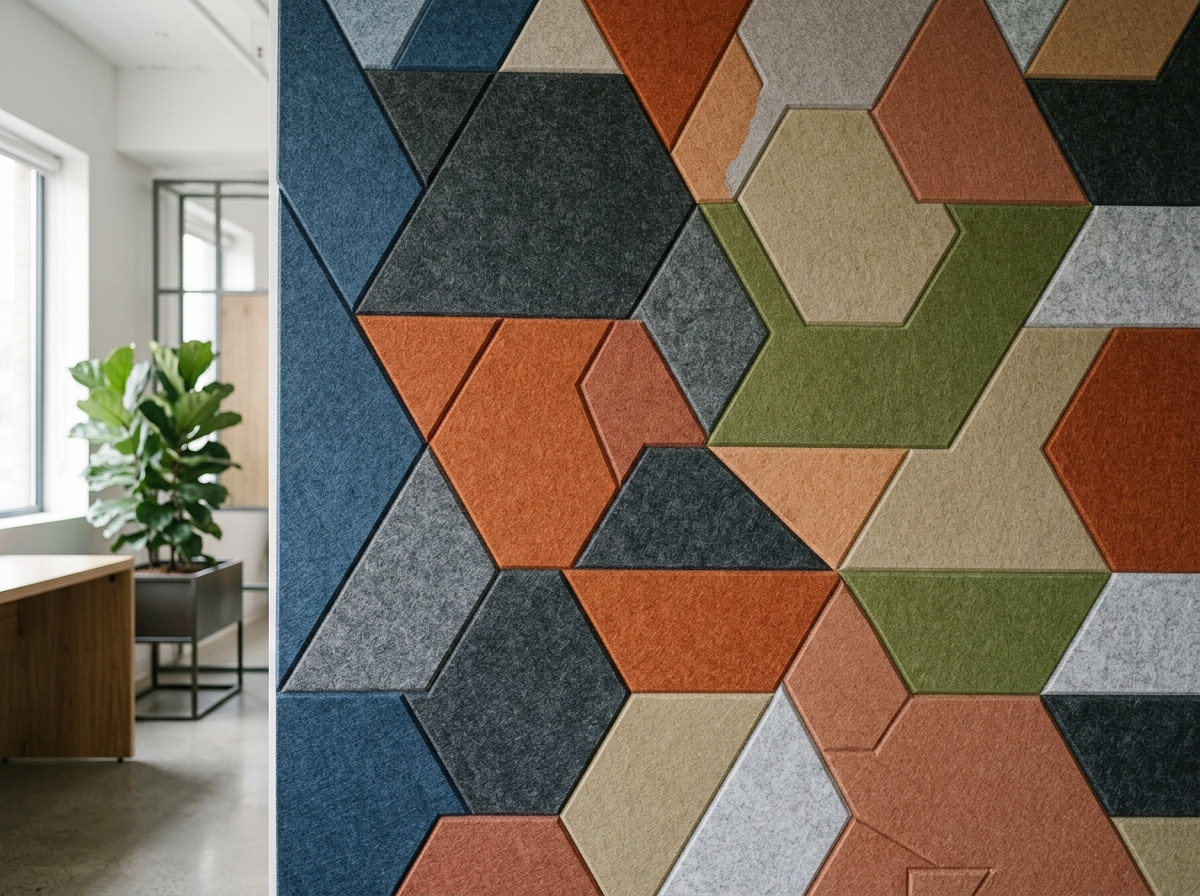
Modern interiors are becoming more open, functional, and visually sophisticated — but these design choices can also create an acoustic problem.
Large offices, conference rooms, restaurants, educational facilities, reception areas, coworking spaces, and commercial interiors often contain hard surfaces such as glass, concrete, tiles, metal, and exposed ceilings. These surfaces reflect sound instead of absorbing it, allowing conversations, footsteps, equipment noise, and general activity to continue bouncing around the room.
The result is familiar: echo, excessive reverberation, poor speech clarity, and an uncomfortable level of background noise.
For projects in Addis Ababa, Ethiopia, acoustic PET panels provide a flexible way to address these issues while becoming part of the interior design itself.
Made from polyester/PET fibre, these panels are designed primarily to absorb reflected sound and reduce reverberation. Depending on their thickness, density, mounting method, and overall room coverage, PET acoustic panels can significantly contribute to a more controlled acoustic environment.
But the real advantage is not simply that PET panels absorb sound.
It is that they allow architects, designers, contractors, and property owners to solve acoustic problems without making the interior look like a technical installation.
Why Acoustic Comfort Matters in Modern Addis Ababa Interiors
A room can look impressive and still sound uncomfortable.
Imagine entering a contemporary office with glass partitions, polished flooring, concrete surfaces, and a high ceiling. Visually, the space may feel spacious and premium. Acoustically, however, every conversation can reflect from one surface to another.
In an open-plan office, this can make it difficult for employees to concentrate.
In a meeting room, people may struggle to understand one another.
In a restaurant, multiple conversations can combine into a continuous background noise.
In a classroom or training room, excessive reverberation can reduce speech clarity.
This is why acoustic design needs to be considered alongside lighting, furniture, flooring, ceilings, and wall finishes.
PET panels offer one way to introduce additional sound absorption without completely changing the architectural character of a room.
What Are Acoustic PET Panels?
Acoustic PET panels are lightweight sound-absorbing panels manufactured from polyester fibre, commonly using recycled PET material.
The fibre is processed into a dense felt-like material that can be formed into flat panels, grooves, patterns, baffles, clouds, screens, partitions, and other architectural shapes.
Modern PET systems can also be CNC-cut into decorative designs, allowing acoustic treatment to become part of a wall feature rather than simply appearing as a conventional acoustic panel.
Different manufacturers offer different thicknesses, densities, colours, fire classifications, and acoustic performance levels.
For example, commercially available PET panels can be supplied in thicknesses such as 9 mm, 12 mm, 18 mm, and 24 mm, although specifications vary between manufacturers.
The important point is that there is no single PET panel specification suitable for every room.
The correct solution depends on the acoustic problem being addressed.
PET Panels Are About More Than Putting Panels on Walls
One of the biggest mistakes in acoustic treatment is assuming that installing panels randomly will automatically solve the room’s noise problem.
Effective acoustic design starts with understanding:
- Where sound is being generated
- Where reflections are occurring
- How much hard surface exists
- The ceiling height
- The room’s dimensions
- Furniture arrangement
- Occupancy levels
- The type of activities taking place
- Speech requirements
- Existing acoustic treatment
- Required visual appearance
PET panels can then be positioned strategically.
This could mean treating selected wall surfaces, introducing ceiling elements, creating acoustic partitions, or combining several approaches.
A professional acoustic treatment plan therefore focuses on how the room behaves acoustically, rather than simply calculating how many panels can fit onto a wall.
Acoustic PET Panels for Open-Plan Offices
Open-plan offices are one of the strongest applications for PET acoustic treatment.
Modern offices often replace traditional enclosed rooms with larger shared environments. While this improves flexibility and collaboration, it also creates more opportunities for sound to travel and reflect.
Employees may hear:
- Telephone conversations
- Video meetings
- Nearby discussions
- Keyboard and equipment noise
- Movement between workstations
- Conversations from reception areas
- General background activity
PET acoustic panels can be incorporated into the office using several approaches.
Wall Treatment
Large wall surfaces can be treated with PET panels to reduce reflected sound.
Acoustic Screens
Freestanding or workstation-mounted PET screens can create visual separation while also contributing to acoustic control.
Ceiling Baffles
Suspended PET baffles can introduce absorption into rooms where wall space is limited.
Decorative Feature Walls
CNC-cut PET panels can create geometric patterns, company branding, or architectural features while performing an acoustic function.
PET acoustic products are widely used for office environments, meeting rooms, education spaces, hospitality areas, and healthcare interiors.
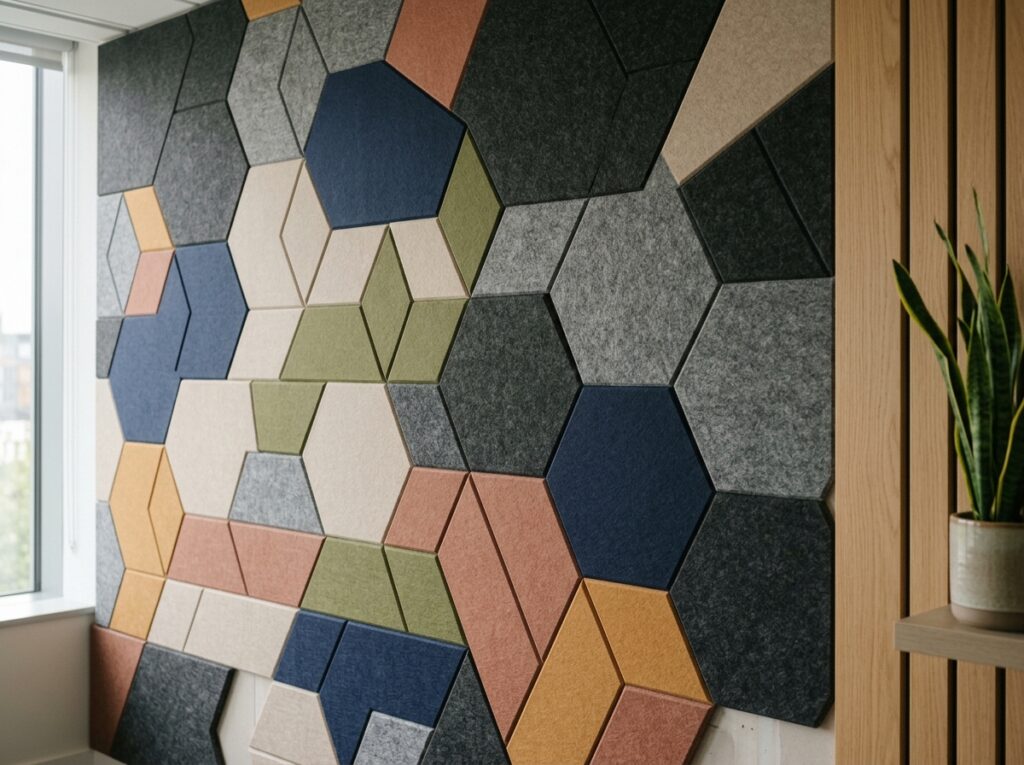
Meeting Rooms Where Every Word Matters
A meeting room does not necessarily need to be completely silent.
What it needs is clear speech.
When excessive reflections continue around a meeting room, voices can become harder to understand. Participants may find themselves asking others to repeat information, particularly during presentations, video conferences, or group discussions.
PET panels can be strategically placed on walls and ceilings to help control these reflections.
The design can also be coordinated with:
- Conference tables
- Screens
- Lighting
- Branding
- Feature walls
- Glass partitions
- Ceiling systems
This allows the acoustic treatment to look intentional rather than added after construction.
Turning Reception Areas Into More Comfortable Spaces
Reception areas often create an unexpected acoustic challenge.
They may contain:
- Hard flooring
- Glass
- Stone or tiled walls
- Decorative ceilings
- Large open areas
- Minimal upholstered furniture
These materials may create significant sound reflection.
A PET acoustic wall can introduce texture and colour while reducing some of the reflected sound within the reception area.
Instead of treating acoustic performance and visual design as separate objectives, the two can be combined.
For example, a company logo, geometric pattern, or branded colour scheme can be incorporated into a PET feature wall.
That makes the acoustic treatment part of the company’s interior identity.
Restaurants and Hospitality Spaces
Restaurants need to balance energy and comfort.
A completely silent restaurant would not necessarily feel natural, but excessive reverberation can make conversations difficult.
When multiple tables are occupied, voices accumulate. Hard ceilings, glass, stone, tiles, and other reflective surfaces can intensify the effect.
PET panels can be used as:
- Decorative wall panels
- Ceiling baffles
- Suspended acoustic elements
- Feature shapes
- Partition screens
- Custom architectural artwork
The objective is not to eliminate normal restaurant activity.
The objective is to make the acoustic environment more balanced and comfortable.
Acoustic PET Panels for Schools and Training Facilities
Education spaces depend heavily on speech communication.
Teachers need to be heard clearly.
Students need to understand instructions.
Training participants need to follow presentations.
Excessive reverberation can make this more difficult.
PET panels can be integrated into classrooms, training rooms, lecture areas, corridors, and shared educational spaces.
Their lightweight construction and ability to be cut into different shapes also give designers flexibility when working around existing architectural elements.
For educational projects, however, acoustic performance should always be considered alongside the appropriate fire and material requirements for the specific building.
PET Acoustic Panels for High-Ceiling Spaces
Large rooms with high ceilings can be particularly challenging acoustically.
A large volume combined with reflective surfaces can allow sound to remain active for longer.
Ceiling treatment becomes especially valuable when wall surfaces are already occupied by:
- Windows
- Displays
- Artwork
- Doors
- Furniture
- Screens
- Architectural features
Suspended PET baffles and acoustic clouds can introduce absorption into the ceiling zone.
This can be particularly useful in open offices, atriums, restaurants, educational facilities, and multipurpose spaces.
Why PET Is Popular for Modern Interior Design
Acoustic treatment does not have to look industrial.
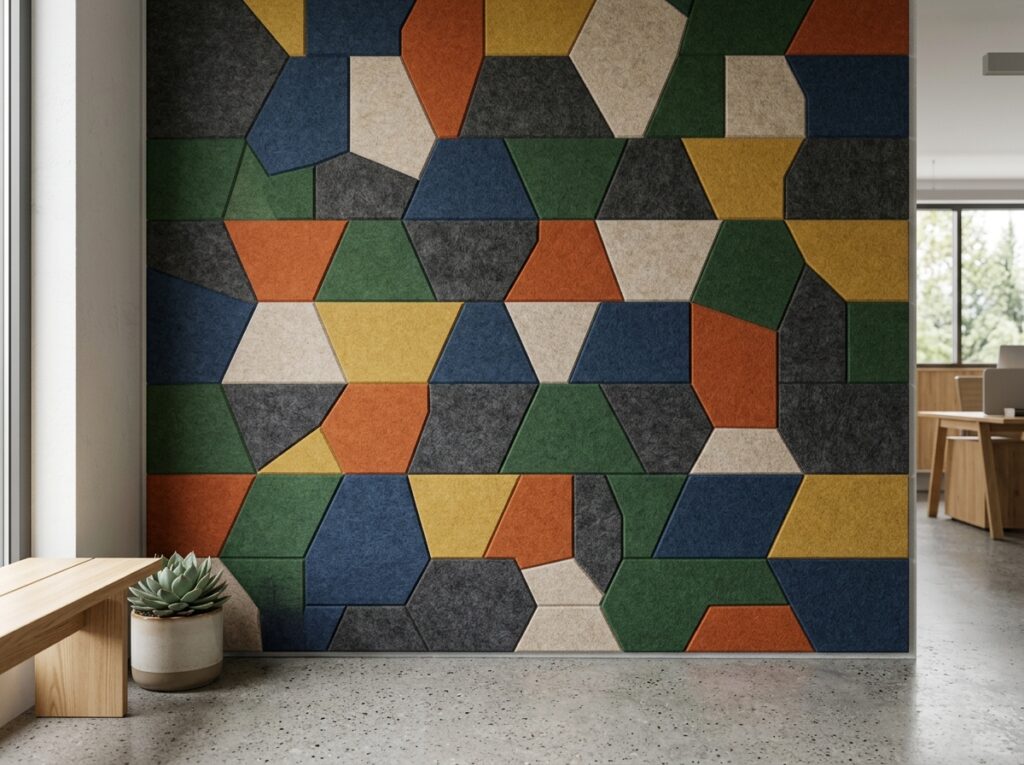
PET panels can be manufactured in multiple colours and can be cut into different shapes and patterns. Some commercial systems are available in dozens of colours and can be used for custom architectural designs.
This gives designers several possibilities.
Minimalist Design
Use neutral grey, black, white, beige, or similar tones for a subtle architectural finish.
Corporate Design
Use company colours to create branded acoustic walls.
Geometric Design
Combine triangles, circles, lines, curves, or custom patterns.
Layered Design
Use different panel depths to create a three-dimensional wall.
Artistic Design
Use CNC-cut PET to create decorative artwork that also contributes to acoustic treatment.
This combination of performance and aesthetics is one of the reasons PET has become increasingly popular in commercial interiors.
PET Acoustic Panels and Sustainability
Another reason PET acoustic systems attract attention is their use of recycled polyester.
Depending on the manufacturer, PET panels can contain significant amounts of recycled polyester derived from post-consumer PET material. Some commercial products advertise recycled content ranging from approximately 55% to 75% or more, but the exact percentage should always be confirmed against the selected product’s documentation.
This can make PET an attractive option for projects where material selection and environmental considerations are part of the design brief.
However, sustainability claims should always be evaluated using the actual manufacturer’s technical and environmental documentation rather than assuming every PET product has identical environmental credentials.
How PET Panels Actually Improve Room Acoustics
PET panels work primarily through sound absorption.
When sound reaches a porous fibre-based panel, some of the sound energy enters the material rather than being completely reflected back into the room.
This can help reduce:
- Echo
- Reverberation
- Excessive reflections
- Background noise buildup
- Speech interference
The amount of absorption depends on factors such as:
- Panel thickness
- Material density
- Surface area
- Mounting configuration
- Air gap behind the panel
- Frequency range
- Room geometry
Therefore, a panel’s acoustic rating should always be considered together with its installation method.
For example, different commercial PET products report different absorption values and testing methods, demonstrating why performance should be based on the specific product specification rather than a generic assumption about all PET panels.
Acoustic Treatment Is Not the Same as Soundproofing
This distinction is extremely important.
PET acoustic panels primarily control sound inside a room.
They help reduce reflected sound and reverberation.
They are not, by themselves, a complete solution for stopping sound from travelling through a wall into another room.
For example:
Problem: A conference room sounds echoey.
→ PET acoustic treatment may be appropriate.
Problem: Noise from an adjacent office is entering the conference room.
→ A sound isolation strategy may be required.
Problem: Traffic or mechanical noise is passing through a building structure.
→ The project may require a combination of mass, decoupling, sealing, absorption, glazing, doors, or other isolation measures.
Understanding the difference prevents property owners from choosing the wrong acoustic solution.
Where PET Panels Can Be Used in Addis Ababa
PET acoustic treatment can be considered for a wide variety of interior environments.
| Space | Potential PET Application |
|---|---|
| Open-plan offices | Wall panels, screens and ceiling baffles |
| Boardrooms | Decorative wall treatment |
| Meeting rooms | Wall and ceiling absorption |
| Restaurants | Ceiling baffles and feature walls |
| Hotels | Corridors, meeting rooms and public areas |
| Schools | Classrooms and training rooms |
| Universities | Lecture and learning spaces |
| Reception areas | Branded acoustic feature walls |
| Call centres | Wall treatment and workstation screens |
| Coworking spaces | Partitions and ceiling treatment |
| Creative studios | Wall and ceiling absorption |
| Retail interiors | Decorative acoustic surfaces |
The final configuration should be selected according to the room’s dimensions, use, existing surfaces, acoustic targets, and architectural requirements.
Designing a PET Acoustic Wall Instead of a Plain Panel Installation
A conventional acoustic panel can simply be mounted onto a wall.
But modern PET systems offer much more creative possibilities.
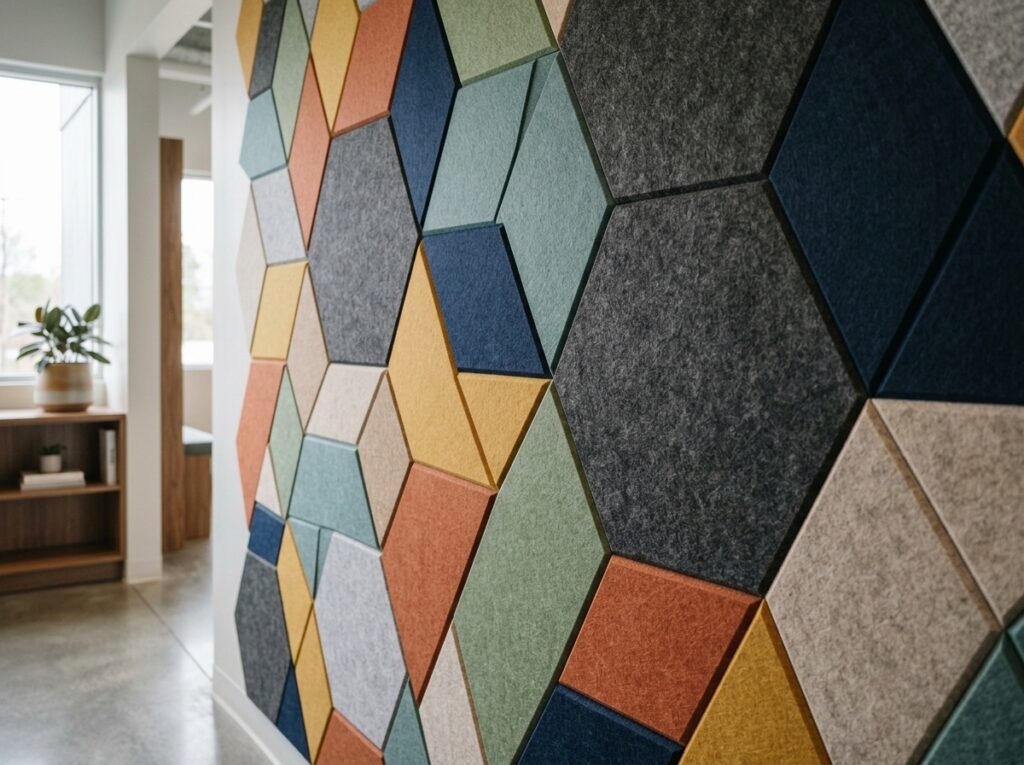
A large wall could be divided into multiple geometric sections.
Different colours can be layered together.
Patterns can be CNC-cut into the material.
Company branding can be incorporated.
Vertical grooves can create a visual rhythm.
Curved shapes can soften an otherwise rigid interior.
This makes PET especially interesting for architects and interior designers who want acoustic performance without sacrificing visual character.
The result can look more like architectural artwork than acoustic equipment.
Professional Acoustic Planning Makes the Difference
Choosing the material is only one part of an acoustic project.
A successful installation also requires attention to:
- Room dimensions
- Existing reverberation
- Surface materials
- Occupancy
- Noise sources
- Panel thickness
- Coverage percentage
- Wall versus ceiling placement
- Mounting method
- Fire and building requirements
- Interior design
- Future maintenance
Simply covering one wall may not provide the same result as a properly distributed acoustic treatment strategy.
For larger commercial projects in Addis Ababa, acoustic consultation can help determine where treatment will have the greatest effect before materials are supplied and installed.
Choosing the Right PET Acoustic Panel System
Before selecting a product, ask several important questions.
What thickness is required?
Thicker PET panels can generally provide different acoustic performance from thinner decorative products, but the actual performance must be confirmed using the manufacturer’s test data.
Is wall or ceiling treatment more appropriate?
The answer depends on the room geometry and available surfaces.
What colour is required?
PET panels are available in numerous colours, allowing the treatment to coordinate with the interior.
Does the project require fire certification?
Commercial and public projects may have specific requirements. Always request documentation for the exact product being specified.
Does the panel need to be custom cut?
CNC cutting can create logos, patterns, curves, and decorative designs.
Is the goal absorption or sound isolation?
If the problem is sound travelling between rooms, PET panels alone may not address the underlying issue.
Acoustic PET Panel Installation in Addis Ababa
Professional installation should begin with a review of the room and the intended acoustic strategy.
The installation process can involve:
Site Assessment → Acoustic Planning → Design Development → Material Selection → Panel Fabrication → Surface Preparation → Installation → Final Inspection
Depending on the selected system, PET panels may be installed directly onto walls, suspended from ceilings, incorporated into partitions, or fabricated into custom architectural elements.
The installation method should match the manufacturer’s recommendations and the substrate conditions.
A clean installation is particularly important when PET panels are being used as a visible feature wall.
The Future of Acoustic Interior Design
The role of acoustic treatment is changing.
It is no longer necessary to choose between a room that looks good and a room that sounds good.
Modern PET acoustic systems allow acoustic performance to become part of the architecture.
In Addis Ababa, this approach can be particularly valuable for offices, hospitality environments, educational facilities, restaurants, corporate interiors, and other spaces where people need to communicate comfortably.
The strongest projects do not treat acoustics as an afterthought.
They consider sound alongside lighting, colour, furniture, ceiling design, flooring, branding, and spatial planning from the beginning.
Frequently Asked Questions
Are acoustic PET panels suitable for offices in Addis Ababa?
Yes. PET panels can be used in offices to reduce reflected sound and reverberation, particularly in open-plan workspaces, meeting rooms, reception areas, and collaborative spaces.
Do PET panels completely soundproof a room?
No. PET panels are primarily designed for sound absorption and reverberation control. Complete sound isolation requires a different construction strategy.
Can PET panels be installed on ceilings?
Yes. PET can be fabricated into suspended baffles, clouds, and other ceiling treatments, depending on the selected system.
Can PET acoustic panels be customised?
Many PET systems can be cut into custom shapes, patterns, colours, and designs. Some products can also be printed or CNC-cut for branding and architectural features.
Are PET acoustic panels made from recycled material?
Many commercial PET acoustic products use recycled polyester derived from post-consumer PET material. The exact recycled content varies by manufacturer and product.
Are thicker PET panels always better?
Not necessarily. Acoustic performance depends on thickness, density, mounting, air gap, frequency, coverage, and the specific product design. The manufacturer’s test data should be reviewed before specification.
Where can PET acoustic panels be used?
They can be used in offices, boardrooms, classrooms, restaurants, hotels, reception areas, coworking spaces, studios, retail environments, and other interiors where reverberation and reflected sound are concerns.
Create Better-Sounding Interiors With Acoustic PET Panels
A successful acoustic environment is not simply a room with fewer sounds.
It is a space where people can communicate more clearly, concentrate more easily, and feel more comfortable.
Acoustic PET panels provide a practical way to introduce sound absorption while maintaining a contemporary architectural appearance. Their lightweight construction, design flexibility, colour options, and potential use of recycled polyester make them suitable for a wide range of modern interiors.
For offices, hospitality venues, schools, meeting spaces, restaurants, and commercial interiors in Addis Ababa, Ethiopia, the right PET acoustic solution can turn an overly reflective room into a more balanced and comfortable environment.
The key is not simply installing more panels.
It is designing the right acoustic treatment for the space.