
A room does not have to be completely silent to feel comfortable.
What matters is how sound behaves once it enters the space.
In a large office, classroom, restaurant, auditorium, sports facility, hotel lobby, or multipurpose hall, sound can repeatedly bounce between walls, ceilings, floors, glass, and other hard surfaces. As occupancy increases, these reflections can build into a continuous background of noise.
People begin speaking louder.
Conversations become harder to follow.
Presentations require more effort.
And spaces that look impressive can become acoustically exhausting.
For modern interiors in Cairo, Egypt, acoustic wood wool panels offer a way to address this challenge while also providing a durable and visually distinctive architectural finish.
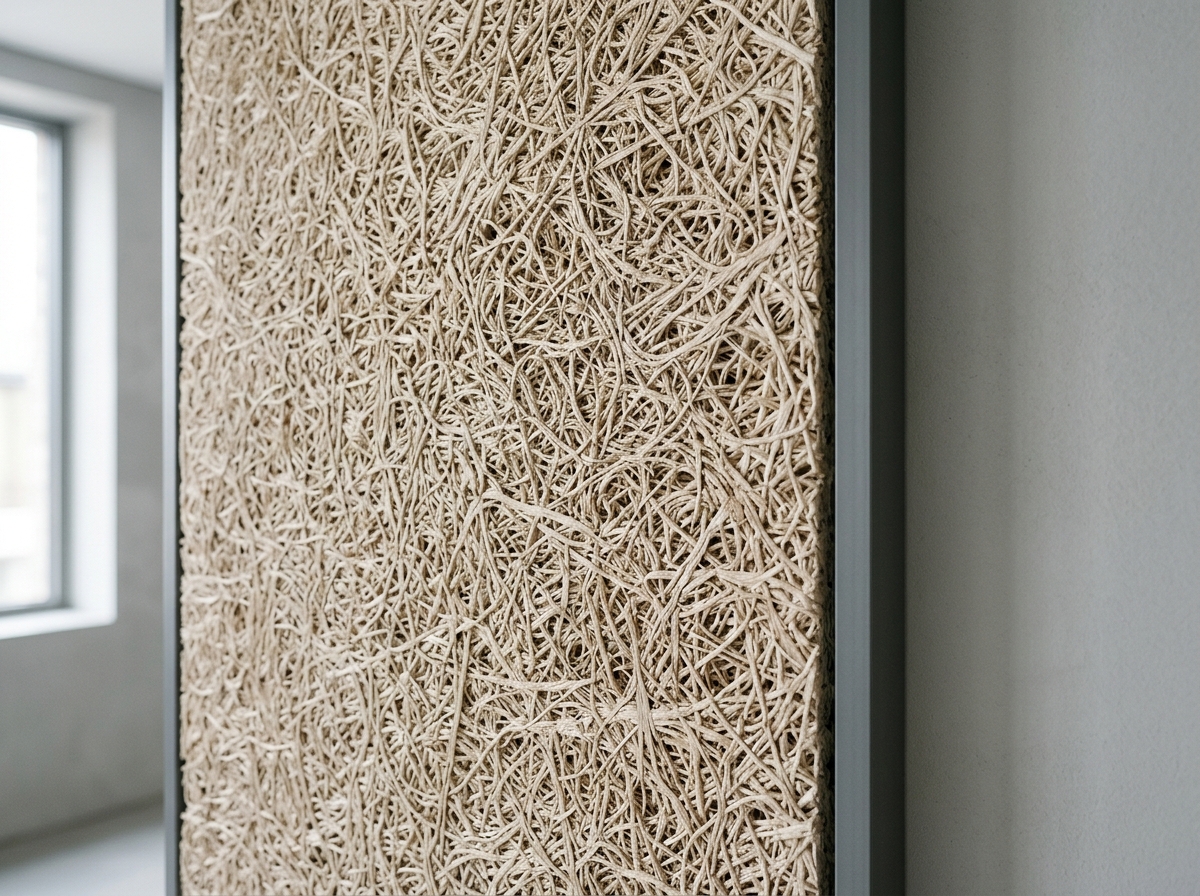
Wood wool acoustic panels are manufactured from wood fibres bonded with a mineral or cementitious binder. Their textured, porous structure is designed to absorb reflected sound, while their rigid construction makes them suitable for both wall and ceiling applications. Commercial wood wool systems are used across offices, education, sports, hospitality, retail, and other building types.
The result is a material that can do more than simply sit on a wall.
It can become part of the building’s acoustic and architectural design.
Why Acoustics Become Difficult in Large Cairo Interiors
Many contemporary interiors rely heavily on hard finishes.
Glass creates openness.
Stone and tile provide durability.
Concrete creates an industrial aesthetic.
Painted drywall provides a clean appearance.
Metal adds a modern touch.
But acoustically, many of these materials are reflective.
When several reflective surfaces are combined, sound can continue travelling around the room rather than being absorbed.
This becomes particularly noticeable in spaces with:
- High ceilings
- Large floor areas
- Glass partitions
- Concrete surfaces
- Stone or tiled flooring
- Minimal soft furnishings
- Large occupant numbers
The problem is not necessarily the volume of one individual sound.
It is the accumulation of reflected sound.
That is where strategically placed acoustic absorption can make a major difference.
What Exactly Are Wood Wool Acoustic Panels?
Wood wool panels are different from conventional timber wall cladding.
The material is typically formed from elongated wood fibres that are bonded together using a mineral-based binder, producing a rigid acoustic board with a visibly textured surface.
The panel can then be used as a wall or ceiling finish.
Different products are available in different:
- Thicknesses
- Fibre sizes
- Densities
- Colours
- Edge details
- Mounting systems
- Backing configurations
For example, Knauf’s HERADESIGN range includes wood wool panels in 15 mm, 25 mm, and 35 mm configurations, with acoustic performance varying by product and assembly.
This variety allows wood wool to be specified according to both the acoustic requirement and the visual concept of the project.
The Texture Is Part of the Solution
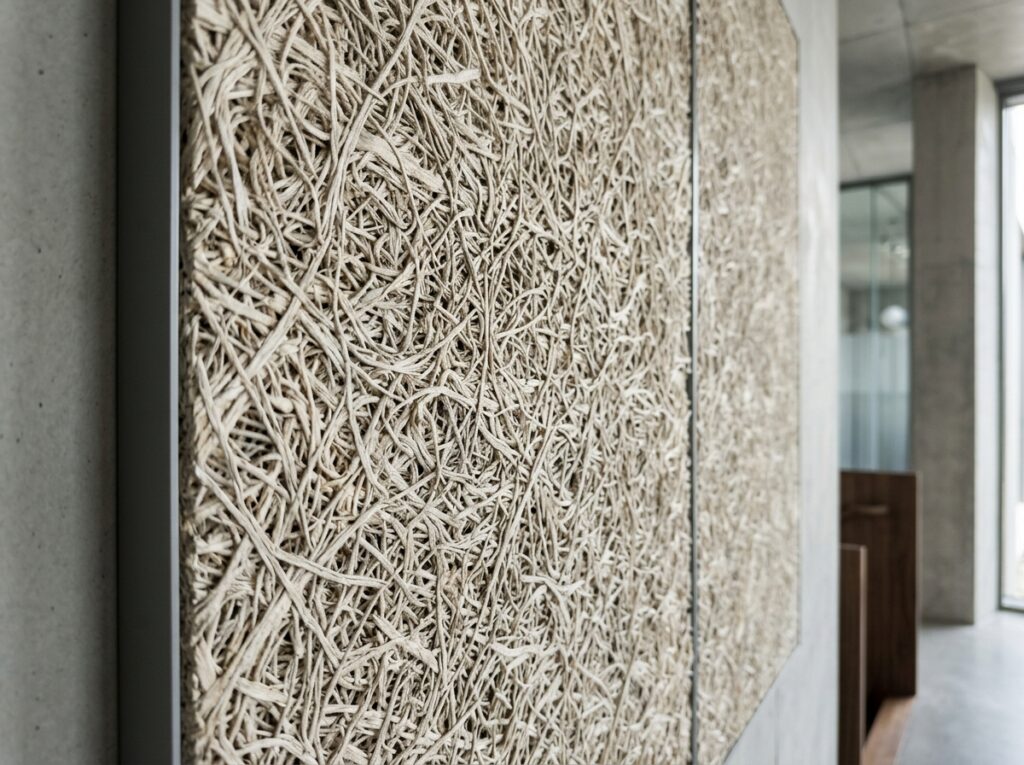
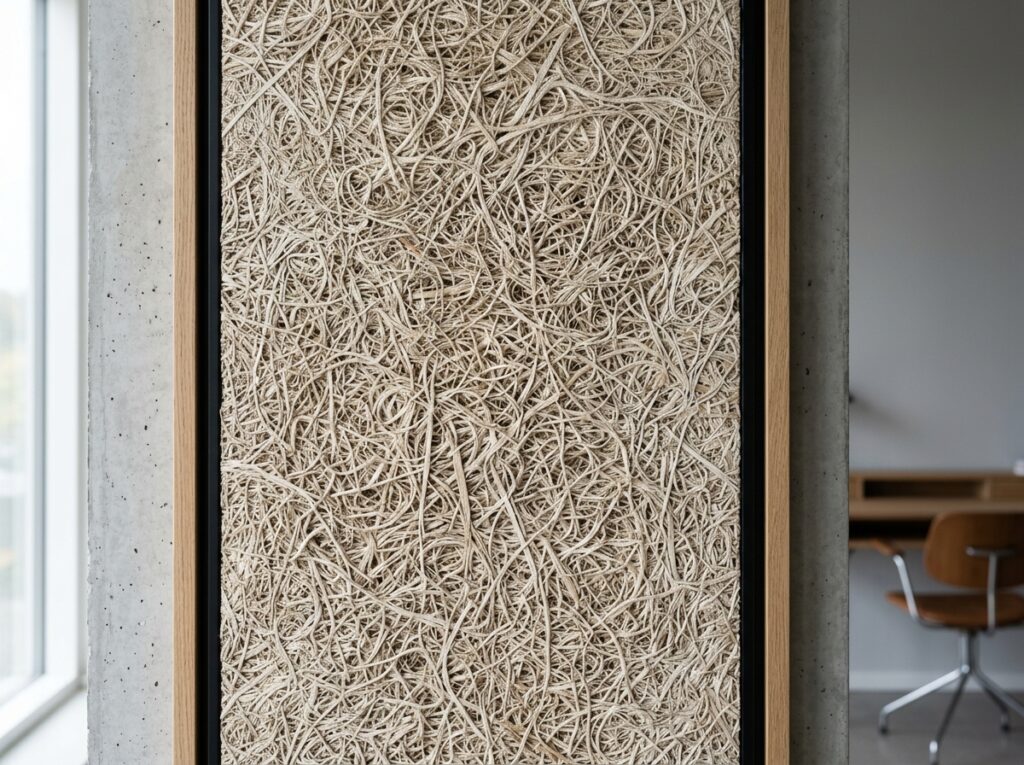
One of the defining characteristics of wood wool panels is their visible fibre texture.
Instead of creating a perfectly smooth surface, the panel provides a slightly three-dimensional finish.
That texture gives the material a distinctive architectural identity.
It can work particularly well in interiors that already use:
- Natural timber
- Concrete
- Stone
- Metal
- Exposed services
- Minimalist furniture
- Industrial finishes
Rather than attempting to hide the acoustic treatment, designers can make it a visible part of the space.
This creates an important design opportunity:
The acoustic surface becomes an architectural surface.
Wood Wool for High-Traffic Commercial Interiors
Not every acoustic material is ideal for environments where people and equipment are constantly moving.
Schools, sports facilities, public buildings, corridors, multipurpose spaces, and other high-use environments need acoustic materials that can withstand everyday activity.
Some wood wool systems are specifically designed with impact resistance in mind. For example, Knauf lists Class 1A ball-impact resistance for certain HERADESIGN products used on walls and ceilings.
That makes the material particularly interesting for spaces where acoustic treatment also needs to remain physically robust.
Potential applications include:
- School corridors
- Sports halls
- Community facilities
- Multipurpose rooms
- Auditoriums
- Large meeting spaces
- Public buildings
The exact suitability should always be confirmed against the specific product’s technical documentation.
Acoustic Wood Wool for Cairo Offices
An office can be visually modern while still having poor acoustics.
Open-plan layouts often contain multiple simultaneous conversations.
Meeting rooms may use glass.
Workstations may have hard desks and flooring.
Large ceilings can create additional reflective surfaces.
The result can be speech crosstalk throughout the workspace.
Wood wool panels can be introduced to selected walls and ceilings to increase sound absorption.
Open-Plan Work Areas
Ceiling treatment can help reduce the overall reverberant character of the room.
Meeting Rooms
Wall treatment can help control speech reflections.
Reception Areas
Wood wool can become a feature surface while contributing to acoustic comfort.
Breakout Areas
Panels can help balance the acoustic environment in collaborative spaces.
The objective isn’t to eliminate workplace activity.
It is to prevent that activity from turning into excessive acoustic buildup.
Meeting Rooms Need Clear Speech, Not Complete Silence
A successful meeting room should allow people to hear one another without unnecessary acoustic effort.
When sound repeatedly reflects between hard surfaces, speech can become less distinct.
This can be particularly noticeable during:
- Presentations
- Video conferences
- Training sessions
- Group discussions
- Client meetings
Wood wool panels can be used on selected wall surfaces or ceilings to reduce reflected sound.
A typical acoustic strategy might combine:
Wood Wool Panels + Acoustic Ceiling Treatment + Soft Furniture + Appropriate Flooring
No single material needs to solve the entire acoustic problem.
The goal is to create a balanced room.
Classrooms and Educational Facilities
Education spaces are heavily dependent on speech.
A teacher needs to be understood.
Students need to hear instructions.
Group discussions need to remain intelligible.
Excessive reverberation can make all of these activities more difficult.
Wood wool acoustic panels are used in educational environments because they can combine sound absorption with a durable architectural surface. Knauf lists classrooms and education among the applications for several of its wood wool acoustic systems.
Panels can be used on:
- Classroom walls
- Ceilings
- Corridors
- Lecture rooms
- Assembly halls
- Music rooms
- Multipurpose spaces
The treatment should be distributed according to the room’s size, shape, occupancy, and speech requirements.
Auditoriums and Multipurpose Halls
Large gathering spaces can be acoustically challenging.
A high ceiling and large reflective walls can produce long reverberation times.
If the room is used for speeches, presentations, performances, or community events, excessive reverberation can affect speech intelligibility.
Wood wool panels can become part of a broader acoustic design for these spaces.
They can be installed across selected wall areas or integrated into ceiling systems.
Egypt-specific acoustic guidance also identifies wood wool among the material options used for auditoriums, schools, universities, and performance environments.
For larger venues, however, acoustic treatment should be designed around measurable targets rather than simply covering surfaces randomly.
Wood Wool Ceiling Systems
The ceiling can be one of the most valuable locations for acoustic treatment.
Why?
Because ceilings often provide large uninterrupted areas.
A hard ceiling can reflect sound directly back toward the occupied area.
Wood wool panels can be installed as:
Continuous Ceiling Panels
Large areas of the ceiling are treated for broad acoustic coverage.
Suspended Elements
Panels are suspended below the structural ceiling.
Acoustic Clouds
Individual panels are positioned over key activity areas.
Decorative Ceiling Patterns
Different shapes and colours are combined to create an architectural composition.
Commercial wood wool canopy systems are available specifically for suspended ceiling applications, including modular designs with different shapes and dimensions.
This allows acoustic treatment to become part of the ceiling architecture instead of appearing as an afterthought.
When Ceiling Clouds Make More Sense
Full ceiling coverage is not always necessary.
In some interiors, the ceiling contains:
- Lighting
- HVAC diffusers
- Sprinklers
- Cable trays
- Access panels
- Structural elements
Suspended wood wool clouds can provide targeted absorption while preserving access to building services.
They can also create visual zoning.
For example, a restaurant could use acoustic clouds above dining areas.
An office could use them above collaborative zones.
A school could use them above classroom activity areas.
A lobby could use suspended elements to create a visual focal point.
Restaurants in Cairo
Restaurants have a very specific acoustic challenge.
They need energy.
They need conversation.
They need music and activity.
But when too much sound reflects around the room, conversation becomes difficult.
Customers may start speaking louder simply because they cannot hear one another.
Wood wool panels can help introduce sound absorption while maintaining a warm architectural appearance.
They can be incorporated into:
- Ceiling designs
- Feature walls
- Dining areas
- Private dining rooms
- Reception spaces
- Lounge areas
The visible fibre texture can also complement wood furniture, stone, concrete, metal, and decorative lighting.
This makes wood wool a useful option when acoustic treatment needs to feel like part of the restaurant’s design.
Hotels and Hospitality Spaces
Hotels need to create a sense of comfort from the moment a guest enters.
A large lobby can look luxurious while sounding excessively reflective.
Conference areas need speech clarity.
Restaurants need acoustic balance.
Lounges need a controlled background sound environment.
Wood wool panels can be used selectively throughout these spaces.
For example:
Lobby: decorative ceiling treatment
Conference Room: wall and ceiling absorption
Restaurant: acoustic ceiling elements
Lounge: feature wall
This can create a consistent material language while addressing different acoustic requirements in different areas.
Sports Halls and Activity Spaces
Sports halls are particularly challenging.
They combine:
- Large volumes
- Hard floors
- Hard walls
- High ceilings
- Continuous movement
- Large groups of people
- Ball impacts
The acoustic environment can quickly become harsh.
Wood wool systems designed for high-impact environments can be useful in these situations.
Certain commercial wood wool panels are specifically tested for ball impact resistance, making them suitable for sports-related applications when the exact product is correctly specified.
Panels can be installed on suitable wall and ceiling surfaces to help control reverberation.
Wood Wool Is Not Just About Absorption
Although acoustic absorption is the primary reason for specifying wood wool, the material can also contribute to the overall architectural character of a project.
It can provide:
Texture
The visible fibre structure creates depth.
Colour
Many commercial systems offer multiple colour options.
Geometry
Panels can be arranged into patterns and layouts.
Material Contrast
Wood wool can be combined with glass, concrete, metal, and timber.
Visual Continuity
The same material can be used across selected walls and ceilings.
Knauf’s HERADESIGN systems, for example, offer standard colours as well as additional colour options such as RAL and NCS for certain products.
How Acoustic Performance Changes With Installation
Not all wood wool installations perform the same way.
A panel installed directly against a wall can have different acoustic performance from the same panel installed with an air cavity or additional acoustic layer.
This is an important consideration when planning a project.
For example, one Knauf HERADESIGN Fine 35 mm product lists an NRC of 0.65 in its basic configuration, while the manufacturer reports 0.90 NRC with an additional 25 mm mineral acoustic layer.
Another HERADESIGN Superfine Alpha+ 35 mm product lists an NRC of 0.90 with an acoustic fleece backing.
These are product-specific figures, not universal performance values for every wood wool panel.
The lesson is simple:
The panel, backing, cavity, thickness, and mounting method should be considered as one acoustic assembly.
Wood Wool vs Decorative Wood
It is easy to confuse acoustic wood wool with conventional wood finishes.
They serve different purposes.
| Feature | Decorative Wood Finish | Wood Wool Acoustic Panel |
|---|---|---|
| Primary purpose | Interior appearance | Acoustic absorption + appearance |
| Surface | Timber/veneer/etc. | Textured wood fibre |
| Sound absorption | Usually limited | Designed for absorption |
| Wall application | Yes | Yes |
| Ceiling application | Yes | Yes |
| Impact-resistant options | Product dependent | Available in specific systems |
| Soundproofing | No | No |
| Acoustic performance data | Not always available | Typically specified/tested |
The distinction is important when developing an acoustic specification.
A beautiful wood wall does not automatically provide meaningful sound absorption.
Wood Wool vs Wood Slatted Panels
Both materials can create strong architectural finishes, but they work differently.
Wood slatted systems typically combine wood slats with an acoustic backing.
Wood wool panels provide a more continuous textured fibre surface.
Slatted Wood
- Linear visual appearance
- Strong timber aesthetic
- Excellent for feature walls
- Can combine absorption and diffusion
- Often used in premium interiors
Wood Wool
- Textured fibre appearance
- Strong architectural character
- Available in many colours
- Suitable for walls and ceilings
- Durable options for high-traffic environments
The choice depends on the project’s design language as well as the acoustic requirements.
Fire Performance Should Be Part of the Specification
Fire performance should never be assumed simply because a panel is described as acoustic.
Different wood wool products and assemblies have different classifications.
For example, Knauf lists B-s1,d0 fire reaction for several HERADESIGN products, while its product range also includes specific A2 variants for applications with stricter fire requirements.
For a commercial project, the correct approach is to confirm:
- Exact product
- Thickness
- Backing
- Mounting assembly
- Fire classification
- Relevant test standard
- Local building requirements
This becomes particularly important in schools, hotels, auditoriums, public buildings, and large commercial projects.
A Material for Renovation as Well as New Construction
Acoustic problems are not limited to new buildings.
Existing spaces can develop acoustic complaints after:
- Office renovations
- Furniture changes
- Layout changes
- Removing partitions
- Increasing occupancy
- Installing more glass
- Changing flooring
- Converting a room to a different use
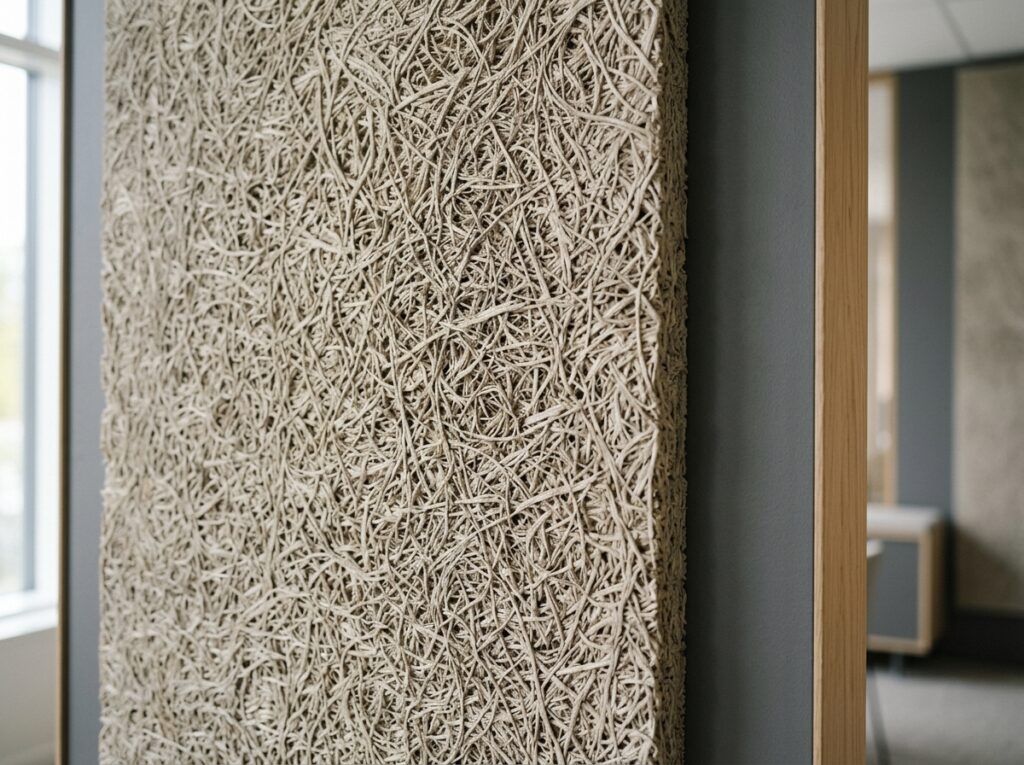
Wood wool panels can be introduced during renovation without completely redesigning the interior.
A wall can become an acoustic feature.
A ceiling can receive suspended panels.
An existing room can be treated without replacing every architectural surface.
This makes wood wool worth considering for both new construction and acoustic upgrades.
Designing a Wood Wool Acoustic System
A successful installation starts with the room rather than the product.
Step 1: Identify the Problem
Is the room echoing?
Is speech unclear?
Is background noise accumulating?
Is the problem airborne sound transmission instead?
Step 2: Study the Surfaces
Identify glass, concrete, tile, drywall, metal, flooring, and other reflective materials.
Step 3: Determine Treatment Areas
Decide whether walls, ceilings, or both need treatment.
Step 4: Select the Panel
Consider thickness, texture, colour, fire performance, and acoustic data.
Step 5: Consider the Backing
Determine whether the system requires an acoustic fleece, mineral layer, cavity, or other backing.
Step 6: Coordinate With Services
Lighting, HVAC, sprinklers, electrical systems, and access requirements should be integrated into the layout.
Step 7: Install Correctly
Follow the manufacturer’s installation requirements.
Step 8: Evaluate the Finished Room
The completed environment should be reviewed against the original acoustic objective.
Acoustic Treatment Is Not Soundproofing
This distinction remains essential.
Wood wool panels are primarily used for sound absorption within a room.
They can help control:
- Echo
- Reverberation
- Reflections
- Speech clarity
They are not, by themselves, a complete soundproofing system.
If the problem is:
Noise from the neighbouring room is entering the space.
A sound-isolation assembly may be required.
If the problem is:
Footsteps are travelling through the floor.
Impact isolation may be needed.
If the problem is:
A generator is transmitting vibration into the building.
Vibration control and mechanical isolation may be necessary.
Wood wool can be an important acoustic treatment material, but it should be selected according to the actual problem.
Where Wood Wool Panels Can Be Used in Egypt
| Space | Potential Application |
|---|---|
| Offices | Walls and acoustic ceilings |
| Classrooms | Walls and ceilings |
| Auditoriums | Side walls, rear walls and ceilings |
| Sports halls | Impact-resistant wall and ceiling systems |
| Restaurants | Feature walls and ceiling treatment |
| Hotels | Lobbies, restaurants and conference rooms |
| Retail spaces | Decorative acoustic surfaces |
| Community centres | Multipurpose halls |
| Studios | Absorptive wall and ceiling treatment |
| Residential interiors | Living rooms, media rooms and home offices |
| Public buildings | Corridors, halls and gathering areas |
The final application should always be based on the actual acoustic and architectural requirements of the project.
Why Wood Wool Makes Sense for High-Use Interiors
A successful acoustic material needs to do more than absorb sound.
In many buildings, it also needs to survive daily use.
That is where wood wool can be particularly attractive.
It combines:
Acoustic Absorption
Textured Architectural Finish
Durability
Design Flexibility
Wall and Ceiling Applications
Certain products also provide tested fire and impact performance, giving architects and contractors additional specification options.
This combination makes wood wool especially interesting for spaces where acoustic performance and physical durability need to coexist.
Professional Acoustic Installation in Cairo
The installation of wood wool panels should be treated as an acoustic construction process rather than simply a decorative installation.
A professional project can follow:
Site Assessment
↓
Acoustic Requirement
↓
Panel Selection
↓
Layout & Design
↓
Backing / Cavity Planning
↓
Service Coordination
↓
Installation
↓
Final Inspection
This approach helps ensure that the finished installation looks clean while also performing according to the intended acoustic strategy.
Panel alignment, joints, edges, fixing methods, ceiling coordination, and service penetrations all matter.
Frequently Asked Questions
What are acoustic wood wool panels?
They are rigid acoustic panels made from wood fibres bonded with a mineral or cementitious binder. They are designed primarily to absorb reflected sound and can be used on walls and ceilings.
Do wood wool panels reduce echo?
Yes. They are designed to absorb reflected sound and can help reduce reverberation when properly specified and installed.
Are wood wool panels suitable for offices?
Yes. Commercial wood wool systems are used in offices, meeting spaces, and other workplaces where acoustic comfort is important.
Can wood wool panels be installed on ceilings?
Yes. They are available as ceiling tiles, suspended panels, and floating acoustic canopy systems.
Are wood wool panels suitable for schools?
Yes. They are used in classrooms and educational buildings where speech intelligibility and durability are important.
Do wood wool panels soundproof a room?
No. They primarily provide acoustic absorption inside the room. Sound isolation requires a separate construction strategy.
Can wood wool panels be used in sports halls?
Yes. Certain products are specifically tested for ball-impact resistance and are suitable for sports environments when correctly specified.
Are wood wool panels available in different colours?
Many commercial systems are available in multiple colours, with some offering RAL or NCS colour options.
Does thickness affect acoustic performance?
Yes. Acoustic performance can change with panel thickness, backing, air cavity, and mounting configuration. The manufacturer’s test data should be used for the selected system.
Turn Reflective Interiors Into Better-Sounding Spaces
Acoustic design does not have to compromise architectural design.
A ceiling can remain visually distinctive while controlling reverberation.
A wall can provide texture while absorbing reflected sound.
A school can have durable acoustic treatment.
A restaurant can retain its atmosphere while becoming easier to talk in.
An office can become more comfortable without covering every surface in fabric.
That is the value of acoustic wood wool panels.
For offices, educational facilities, restaurants, hotels, auditoriums, sports halls, public buildings, and residential interiors across Cairo, Egypt, wood wool can provide a practical combination of acoustic absorption, durability, and architectural character.
The best results come from treating the material as part of a complete acoustic system — selecting the appropriate thickness, backing, coverage, mounting method, and finish for the room.
Better acoustics don’t have to disappear behind the architecture. Sometimes, the acoustic solution can become one of the most distinctive parts of it.