
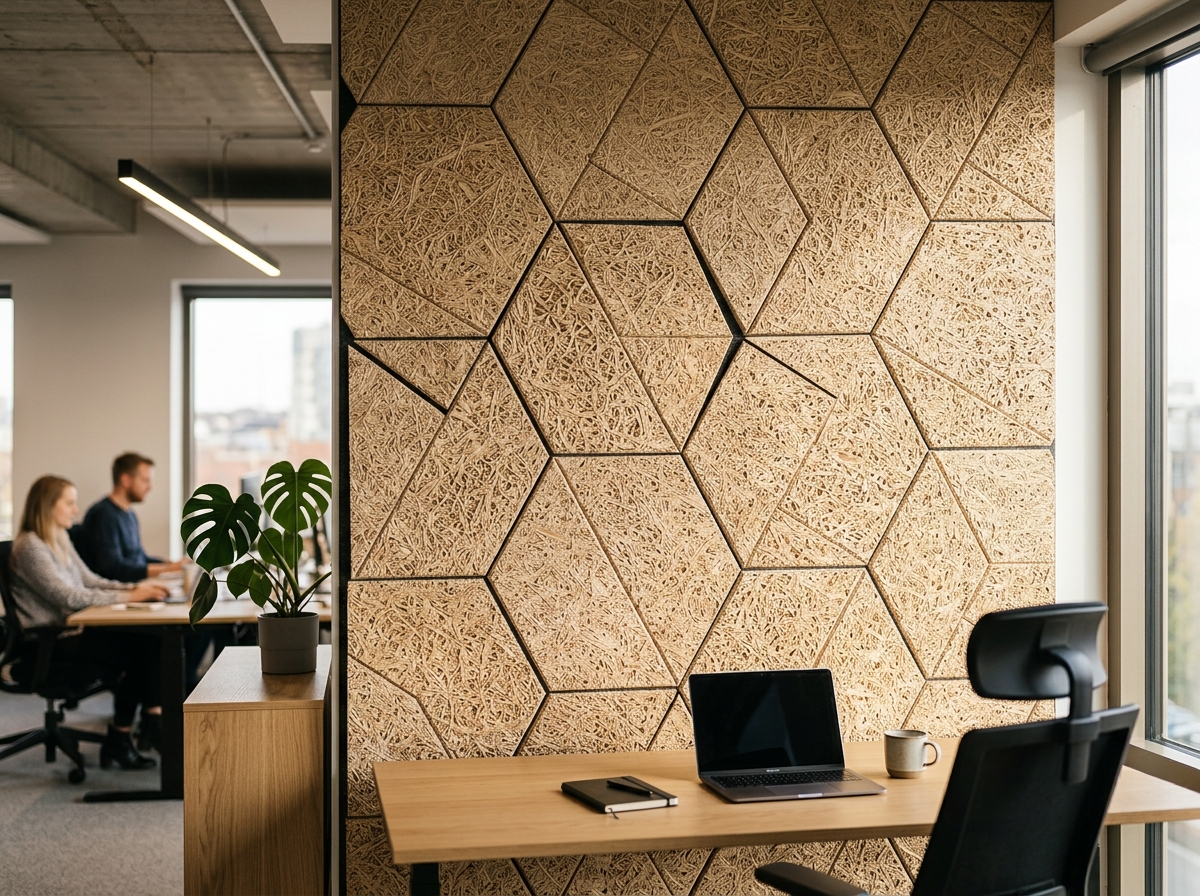
Modern interiors are expected to do more than simply look attractive. Offices need better speech clarity, restaurants need comfortable dining environments, classrooms need controlled reverberation, and public spaces need to remain usable even when they become busy.
In these environments, excessive reflected sound can quickly become a problem.
Acoustic wood wool panels offer a practical way to address this challenge while adding a distinctive architectural finish to walls and ceilings. Their textured appearance, structural composition, and acoustic properties make them suitable for spaces where interior design and acoustic performance need to work together.
For projects in Windhoek, Namibia, acoustic wood wool panels can be incorporated into professional acoustic treatment systems for offices, hospitality venues, educational facilities, meeting rooms, public interiors, and other spaces where excessive reverberation affects comfort.
What Are Acoustic Wood Wool Panels?
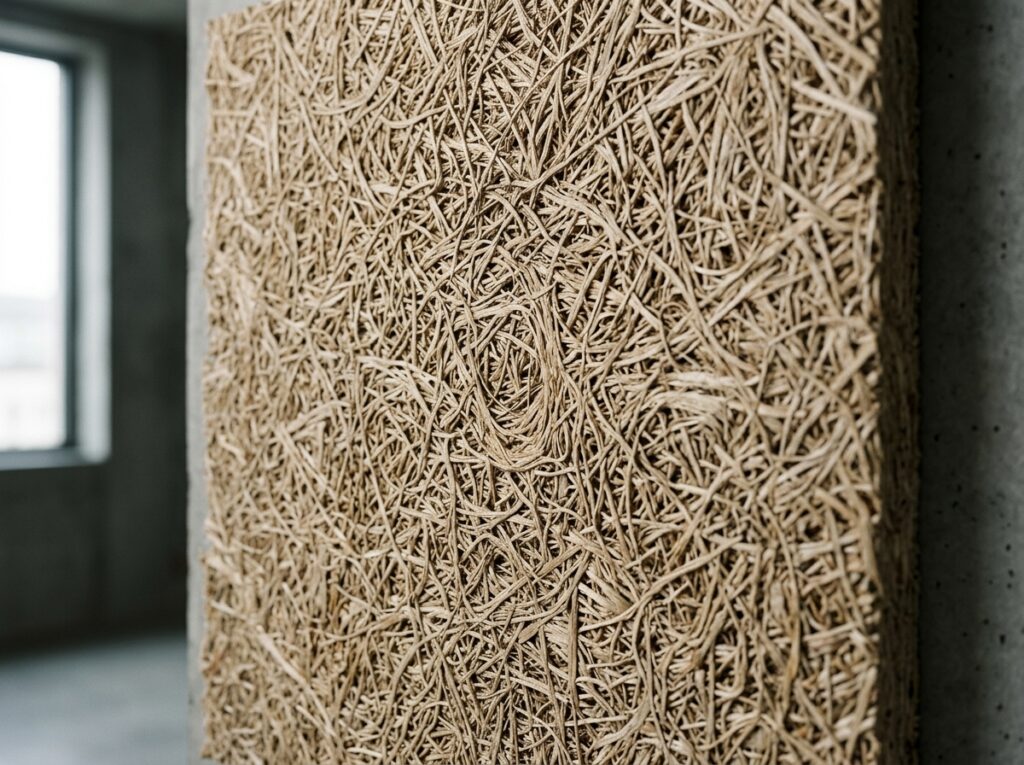
Acoustic wood wool panels are sound-absorbing panels manufactured from wood fibres combined with a mineral or cementitious binder. The resulting material has a fibrous, textured surface that helps interact with sound waves entering the panel.
Unlike a conventional smooth wall finish, the open textured structure provides a surface designed for acoustic absorption.
The exact acoustic performance depends on several factors, including:
- Panel thickness
- Fibre structure
- Surface texture
- Installation method
- Wall or ceiling location
- Air cavity behind the panel
- Additional acoustic insulation
- Percentage of surface coverage
For example, current technical information for HERADESIGN wood wool products shows that different panel constructions and thicknesses can produce substantially different absorption results. A 25 mm HERADESIGN Fine panel is listed at NRC 0.70 in its specified configuration, while certain Superfine Alpha+ configurations reach NRC 0.85–0.90.
This is why professional acoustic design should consider the complete installation rather than selecting a panel based on appearance alone.
Why Room Acoustics Matter in Modern Interiors
A room can look impressive and still sound uncomfortable.
Hard surfaces such as:
- Glass
- Concrete
- Ceramic flooring
- Metal
- Painted walls
- Stone
- Large glazed surfaces
can reflect sound strongly.
When several hard surfaces are present at the same time, speech and other sounds can continue bouncing around the room. The result may be noticeable echo, reduced speech intelligibility, and an environment that feels unnecessarily loud.
Acoustic treatment works by controlling these reflections.
Wood wool panels can become part of that treatment strategy by introducing sound-absorbing surfaces into areas where reflections need to be reduced.
Acoustic Treatment Is Not the Same as Soundproofing
This distinction is important when planning an acoustic project.
Acoustic treatment focuses primarily on improving the sound inside a room.
Soundproofing, on the other hand, focuses on reducing sound transmission from one space to another.
Wood wool acoustic panels are primarily designed for sound absorption and reverberation control. They should not automatically be considered a complete solution for preventing noise from passing through walls.
If a project involves noise travelling between rooms, a broader sound isolation system may be required. Depending on the building, that system could involve wall construction, additional mass, cavity insulation, decoupling, acoustic sealants, doors, glazing, and other components.
Understanding this difference helps ensure that the acoustic solution matches the actual problem.
Wood Wool Panels for Offices in Windhoek
Open-plan offices can create challenging acoustic conditions.
Employees may be working at desks while:
- Telephone conversations take place nearby
- Meetings occur in open areas
- Employees collaborate
- Printers and equipment generate background noise
- People move between work zones
Without sufficient acoustic absorption, conversations can travel across the room and contribute to a noisy environment.
Wood wool panels can be incorporated into:
- Feature walls
- Meeting-room walls
- Ceiling systems
- Collaboration areas
- Reception spaces
- Training rooms
- Breakout zones
Instead of treating acoustic control as something that needs to be hidden, designers can make the panels part of the interior architecture.
Meeting Rooms Need Speech Clarity
Meeting rooms have a different acoustic requirement from many other spaces.
The objective is not simply to make the room quieter. It is also to create conditions where people can understand one another clearly.
Long reverberation can make voices overlap and become less distinct, particularly when several people are speaking.
Wood wool panels can be positioned on selected wall and ceiling surfaces to help control reflected sound.
A professional acoustic design can determine:
- Where sound reflections are strongest.
- Which surfaces should receive treatment.
- How much coverage is appropriate.
- Whether ceiling treatment is necessary.
- Whether additional acoustic materials are required.
This creates a more deliberate solution than simply covering every available wall with panels.
Restaurants and Hospitality Spaces
Restaurants often combine several reflective surfaces within a relatively compact environment.
Tables, glass, hard flooring, decorative walls, ceilings, and furniture can all influence the way sound behaves.
As occupancy increases, conversations from different tables can add to the overall sound level.
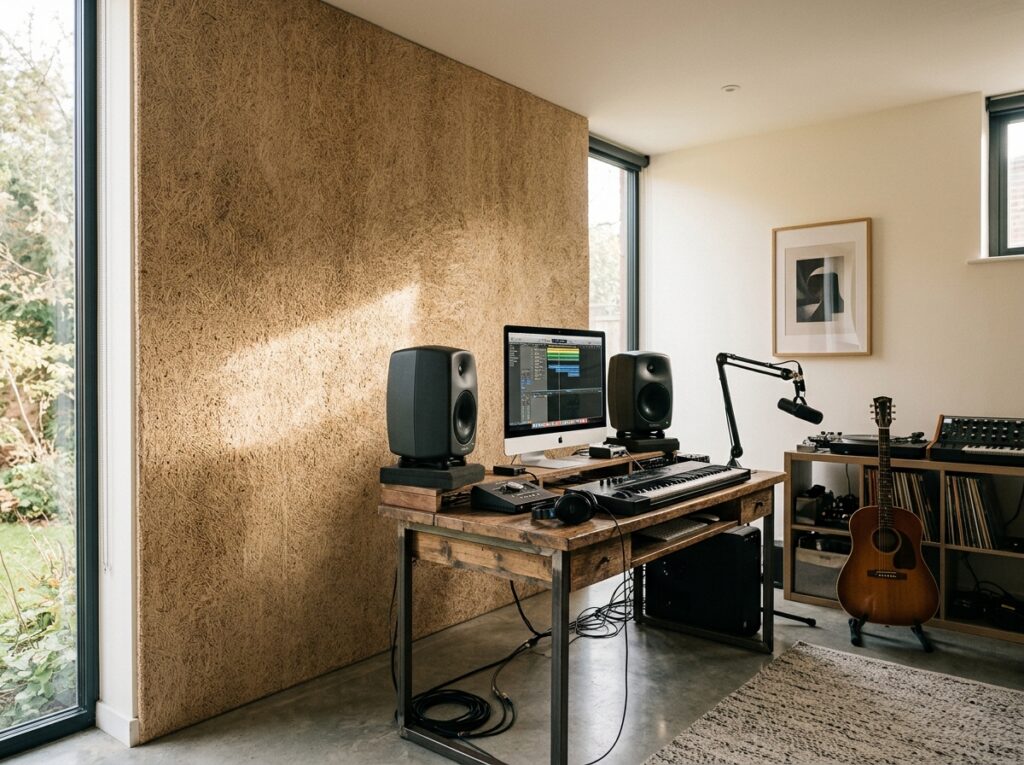
Wood wool panels can provide acoustic absorption while contributing to the visual character of the restaurant.
They can be used as:
- Ceiling features
- Decorative wall sections
- Background panels behind seating
- Reception features
- Feature strips
- Large acoustic ceiling fields
The textured appearance can also complement natural, contemporary, industrial, or minimalist interior concepts.
Acoustic Wood Wool for Educational Spaces
Classrooms and training rooms require clear communication.
When sound remains in a room for too long, students may find it harder to understand speech, especially from a teacher positioned at the front of the room.
Wood wool acoustic systems are used in educational environments because acoustic absorption can be combined with durable architectural surfaces.
Certain wood wool products are specifically marketed for classrooms, offices, sports halls, retail environments, and hospitality spaces.
For educational projects, the acoustic specification should also consider durability, fire requirements, cleaning expectations, impact resistance, and the intended installation method.
Ceiling Applications Can Be Highly Effective
Walls are not the only surfaces available for acoustic treatment.
In many modern interiors, the ceiling provides a large uninterrupted surface that can be used to control reflected sound.
Wood wool panels can be incorporated into:
- Suspended ceiling systems
- Continuous ceilings
- Floating acoustic features
- Ceiling islands
- Partial ceiling treatments
- Large acoustic fields
Ceiling treatment can be especially useful where the walls are already occupied by windows, furniture, displays, doors, or other architectural elements.
The final system should be designed around the room’s geometry rather than treating every ceiling as identical.
Choosing the Right Wood Wool Panel Thickness
Panel thickness is one of the factors that can influence acoustic performance.
Common thicknesses include options around:
- 15 mm
- 25 mm
- 35 mm
- 50 mm or more, depending on the system
However, thicker does not automatically mean that every installation will deliver the same improvement.
For example, Knauf’s published data shows different acoustic results for different HERADESIGN products and configurations. Its 35 mm Superfine Alpha+ product is listed with NRC 0.90, while a 25 mm Superfine product is listed with NRC 0.70 in its specified configuration.
Additional acoustic layers can also significantly alter performance. Certain HERADESIGN products achieve higher absorption when installed with an additional mineral acoustic layer behind the panel.
Therefore, thickness should be selected as part of the complete acoustic specification.
What Makes Wood Wool Different From Ordinary Decorative Panels?
A decorative timber panel may improve the appearance of a room without providing meaningful acoustic absorption.
Wood wool acoustic panels are different because their material structure is specifically designed to interact with sound.
This makes them suitable when the project requires both:
Architectural appearance + acoustic performance
The surface texture itself can also become an important design element.
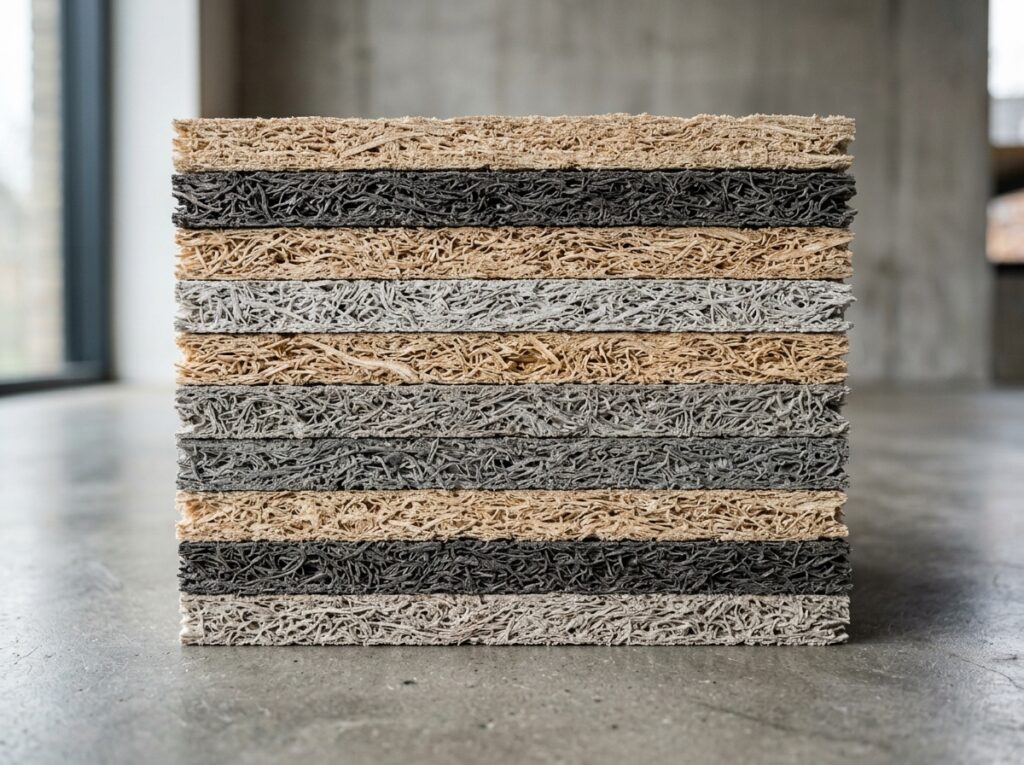
Depending on the product, wood wool panels may be available in different colours, textures, edge details, and formats. Some current systems provide extensive colour choices for architectural applications.
Acoustic Wood Wool Panels and Interior Design
Acoustic treatment does not have to look like an afterthought.
A well-planned wood wool installation can become part of the visual identity of a space.
Design possibilities include:
Feature Walls
A complete wall can become an acoustic architectural feature rather than a plain background.
Ceiling Patterns
Panels can be arranged in regular grids, zones, or continuous surfaces.
Colour Coordination
Some systems are available in multiple colours, allowing the acoustic treatment to coordinate with the wider interior palette.
Geometric Layouts
Different panel formats and edge details can be combined to create visual patterns.
Partial Coverage
Not every project requires complete wall coverage. Acoustic treatment can be concentrated where it provides the greatest benefit.
Acoustic Performance Depends on Installation
One of the most important aspects of an acoustic wood wool project is the installation configuration.
Two visually identical panels can perform differently when installed in different ways.
Factors include:
- Direct fixing
- Suspended installation
- Air gaps
- Acoustic backing
- Mineral insulation
- Panel thickness
- Ceiling height
- Surface coverage
For instance, published HERADESIGN data demonstrates that adding an acoustic mineral layer behind certain panels can increase their stated absorption performance.
This means the panel should be considered as part of an acoustic assembly, not as an isolated decorative object.
Durability for Busy Commercial Spaces
Commercial interiors need acoustic materials that can withstand everyday use.
Wood wool systems can be suitable for demanding environments where durability and acoustic performance are both important. Certain HERADESIGN products, for example, are listed with Class 1A ball impact resistance for wall and ceiling applications.
However, the exact durability characteristics should always be checked against the selected product and its intended application.
Sports halls, schools, public buildings, offices, and hospitality spaces can have very different requirements.
Fire Performance Should Be Specified Correctly
Fire performance is another consideration when selecting acoustic materials.
Different wood wool products can have different fire classifications.
For example, several HERADESIGN products are published with a B-s1,d0 reaction-to-fire classification, while dedicated variants are available with different fire-performance characteristics.
Therefore, fire performance should never be assumed simply because a material is called “wood wool.”
For commercial or public projects, the selected product should be checked against the applicable building requirements and project specifications.
Professional Acoustic Wood Wool Installation in Windhoek
A successful project starts before the panels reach the site.
A professional installation process can include:
1. Site Assessment
The room dimensions, surfaces, occupancy, existing finishes, and acoustic complaints are reviewed.
2. Acoustic Planning
The required treatment areas and approximate coverage are determined according to the room’s acoustic objectives.
3. Product Selection
Panel thickness, texture, colour, backing, edge detail, and installation method are selected.
4. Layout Planning
Panel positions are coordinated with:
- Lighting
- HVAC systems
- Sprinklers
- Electrical fixtures
- Doors
- Windows
- Ceiling elements
5. Installation
The panels are securely installed according to the manufacturer’s requirements and the project design.
6. Final Inspection
The finished installation is checked for alignment, joints, surface appearance, and coordination with surrounding architectural elements.
Where Can Wood Wool Acoustic Panels Be Used?
Wood wool panels can be considered for a wide range of interiors, including:
| Space | Potential Acoustic Objective |
|---|---|
| Offices | Reduce reverberation and improve speech comfort |
| Meeting rooms | Improve speech clarity |
| Classrooms | Control reflected speech |
| Restaurants | Reduce excessive room reverberation |
| Hotels | Improve acoustic comfort in shared spaces |
| Reception areas | Manage reflections in open interiors |
| Retail spaces | Improve acoustic atmosphere |
| Sports halls | Absorb reflected sound |
| Auditoriums | Support controlled room acoustics |
| Training rooms | Improve communication |
| Public buildings | Reduce excessive reverberation |
| Residential interiors | Improve room sound quality |
The correct system depends on the size, construction, occupancy, and acoustic objective of each space.
Why Professional Acoustic Planning Matters
Buying an acoustic panel is only one part of an acoustic project.
The bigger question is:
Where should the acoustic treatment go, and how should it be installed?
A room with untreated glass on one wall, a hard ceiling, stone flooring, and large reflective surfaces may require a different strategy from a carpeted office with a suspended ceiling.
Professional planning helps avoid:
- Over-treating the room
- Under-treating the room
- Choosing the wrong panel type
- Installing panels in ineffective locations
- Confusing sound absorption with sound isolation
- Ignoring fire or durability requirements
- Creating conflicts with lighting and HVAC
The result is a system designed around the room rather than a collection of panels placed randomly.
Acoustic Wood Wool Panels as Part of a Complete Solution
For many projects, wood wool panels are one component of a wider acoustic strategy.
Depending on the problem, a complete project may combine:
- Wood wool acoustic panels
- Ceiling treatment
- Wall absorbers
- Mineral acoustic insulation
- Acoustic doors
- Sound-rated glazing
- Acoustic seals
- Floating floors
- Decoupled wall systems
- Mass-loaded barriers
- Acoustic curtains
The correct combination depends on whether the objective is absorption, reverberation control, airborne sound isolation, impact-noise reduction, or a combination of these.
Final Thoughts
Acoustic wood wool panels provide an opportunity to address room acoustics without sacrificing architectural character.
For offices, classrooms, restaurants, hospitality venues, sports facilities, meeting rooms, and public interiors in Windhoek, they can become part of a carefully designed acoustic treatment system.
Their performance depends on more than the panel itself. Thickness, backing, air gaps, mounting method, surface coverage, room geometry, and the specific product specification all influence the final result.
For that reason, acoustic wood wool should be selected and installed as part of a properly planned acoustic solution rather than simply treated as a decorative wall finish.
When acoustic performance and interior design are considered together from the beginning, wood wool panels can help create spaces that not only look distinctive but also sound significantly more comfortable.
Frequently Asked Questions
Are wood wool panels used for soundproofing?
Wood wool panels are primarily sound-absorbing acoustic treatment. They help control reverberation and reflected sound inside a room. They are not, by themselves, a complete soundproofing system for stopping sound transmission between rooms.
Are acoustic wood wool panels suitable for offices?
Yes. Wood wool acoustic products are commonly specified for office environments, particularly where speech clarity and reverberation control are important.
Can wood wool panels be installed on ceilings?
Yes. Many wood wool acoustic systems are designed for both wall and ceiling applications.
Does thicker wood wool always provide better acoustic performance?
Not necessarily. Thickness is important, but the mounting method, air cavity, backing material, panel construction, and room conditions also influence performance.
Can wood wool panels be used in restaurants?
Yes. They can be incorporated into restaurant walls or ceilings to help control reflected sound and create a more comfortable acoustic environment.
Are wood wool panels available in different colours?
Many commercial wood wool systems offer multiple colour choices and architectural finishes. The available options depend on the manufacturer and product range.
Can wood wool panels improve speech clarity?
They can help by reducing excessive reverberation and reflected sound, which can make speech easier to understand in appropriately treated rooms.
Do wood wool panels need acoustic insulation behind them?
Not always. However, adding an acoustic layer or creating an appropriate air cavity can improve the performance of certain panel systems. The correct configuration should be based on the selected product’s tested data.