
Modern commercial interiors are becoming increasingly open, flexible, and visually engaging. Offices use collaborative layouts, restaurants create social dining environments, hotels combine multiple functions under one roof, and educational spaces are designed around interaction.
But there is one challenge that can easily be overlooked during the design process: sound.
A visually attractive room with hard floors, glass partitions, exposed ceilings, and large open areas can become uncomfortable when sound reflections accumulate. Conversations overlap, background noise becomes more noticeable, and speech clarity can suffer.
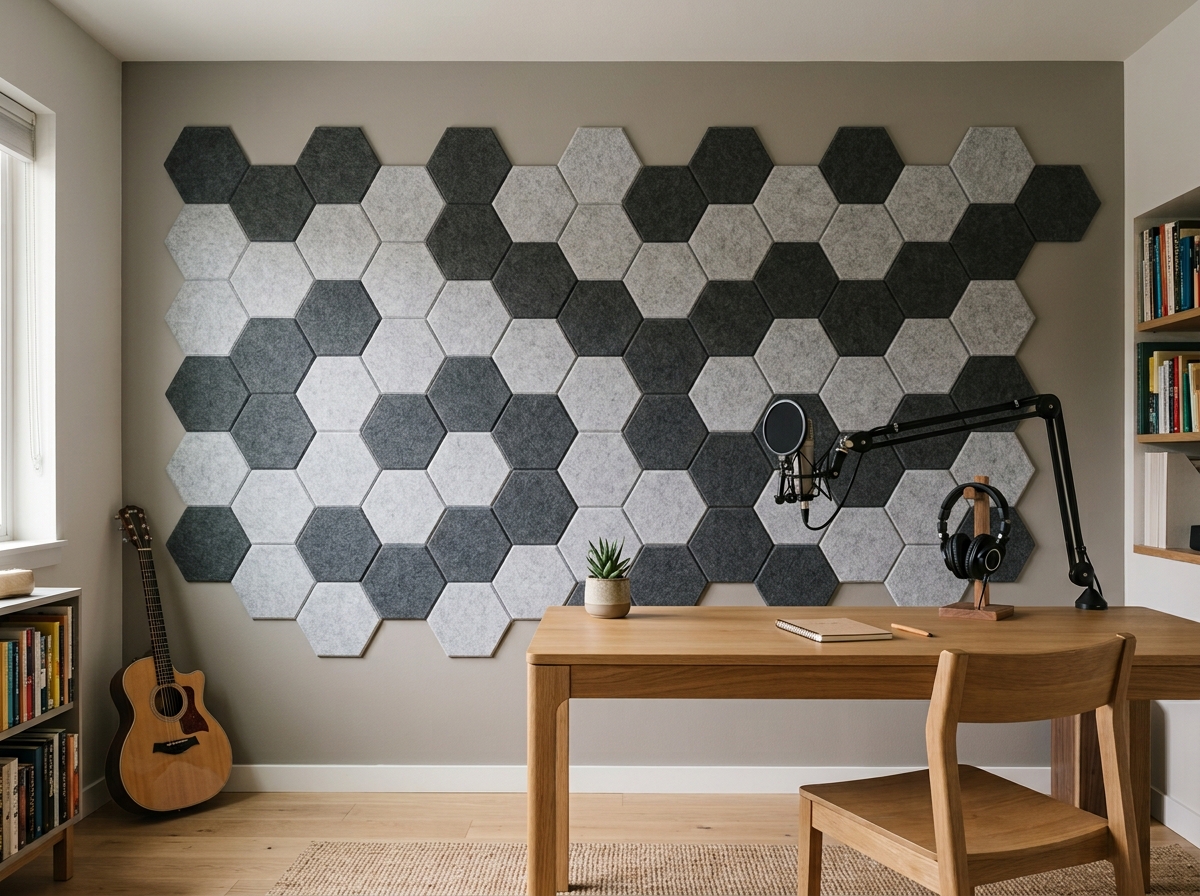
Acoustic PET panels provide a flexible way to introduce sound absorption into these environments without turning acoustic treatment into a purely technical-looking feature.
For commercial and interior projects in Kampala, Uganda, PET acoustic panels can be incorporated into walls, ceilings, meeting areas, reception spaces, restaurants, classrooms, studios, and other interiors where controlling reverberation is important.
What Are Acoustic PET Panels?
Acoustic PET panels are sound-absorbing panels manufactured primarily from polyethylene terephthalate (PET) polyester fibres.
Many products use recycled PET content as part of their material composition. For example, one commercially available polyester acoustic panel system uses 100% polyester fibre with 60% recycled fibre and is designed to be recyclable.
The material is generally lightweight and can be manufactured into different:
- Thicknesses
- Shapes
- Colours
- Sizes
- Wall panels
- Ceiling panels
- Baffles
- Clouds
- Decorative forms
This flexibility is one of the reasons PET has become an increasingly useful material for modern acoustic interiors.
PET Panels Are About More Than Noise Reduction
The phrase “noise reduction” can mean different things in acoustic design.
A PET panel installed inside a room primarily helps absorb reflected sound.
It does not automatically prevent sound from travelling through a wall into another room.
This distinction is essential.
If the problem is:
“The room sounds echoey and conversations are difficult to understand.”
Acoustic PET panels may form an important part of the solution.
If the problem is:
“Noise from the next room is coming through the wall.”
A sound isolation strategy may instead require construction-based measures such as additional mass, decoupling, cavity insulation, acoustic doors, sealed penetrations, or other soundproofing components.
PET panels and soundproofing systems therefore serve different purposes, although they can sometimes be used within the same overall project.
Why PET Is Suitable for Flexible Interior Design
One of the strongest advantages of PET acoustic panels is their design flexibility.
Traditional acoustic treatment can sometimes be visually restrictive. PET allows designers to treat acoustic surfaces as part of the interior concept.
Panels can be cut into:
- Rectangles
- Circles
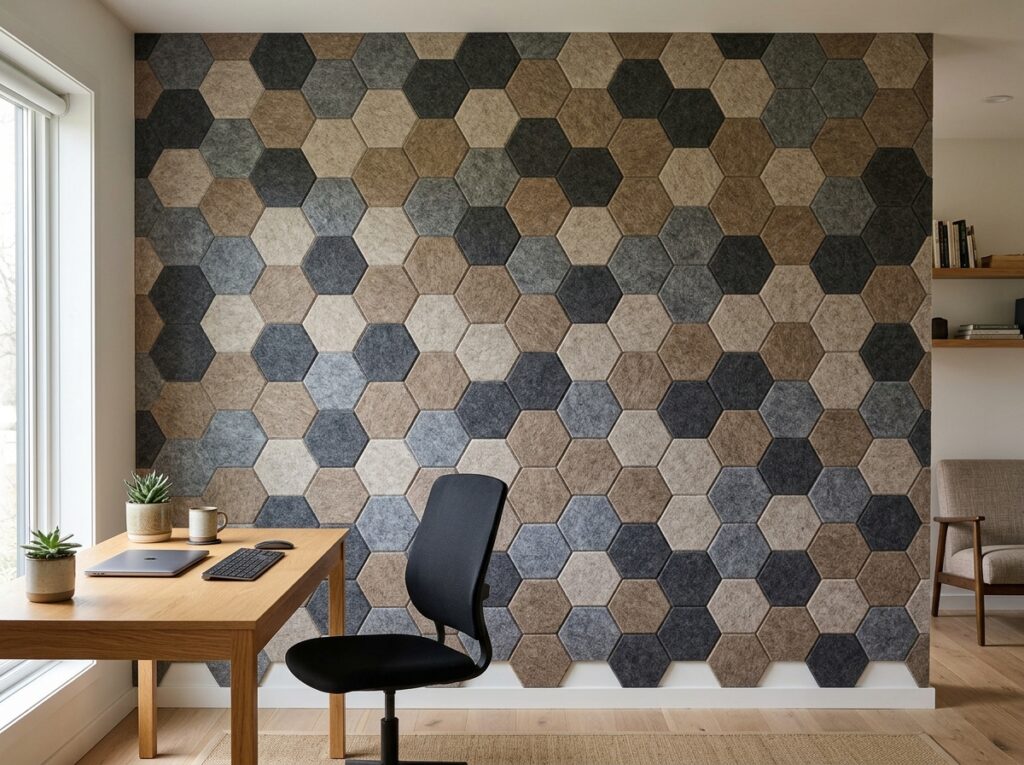
- Hexagons
- Strips
- Curved shapes
- Geometric patterns
- Custom decorative forms
This allows acoustic treatment to follow the design language of the room instead of appearing as an unrelated technical installation.
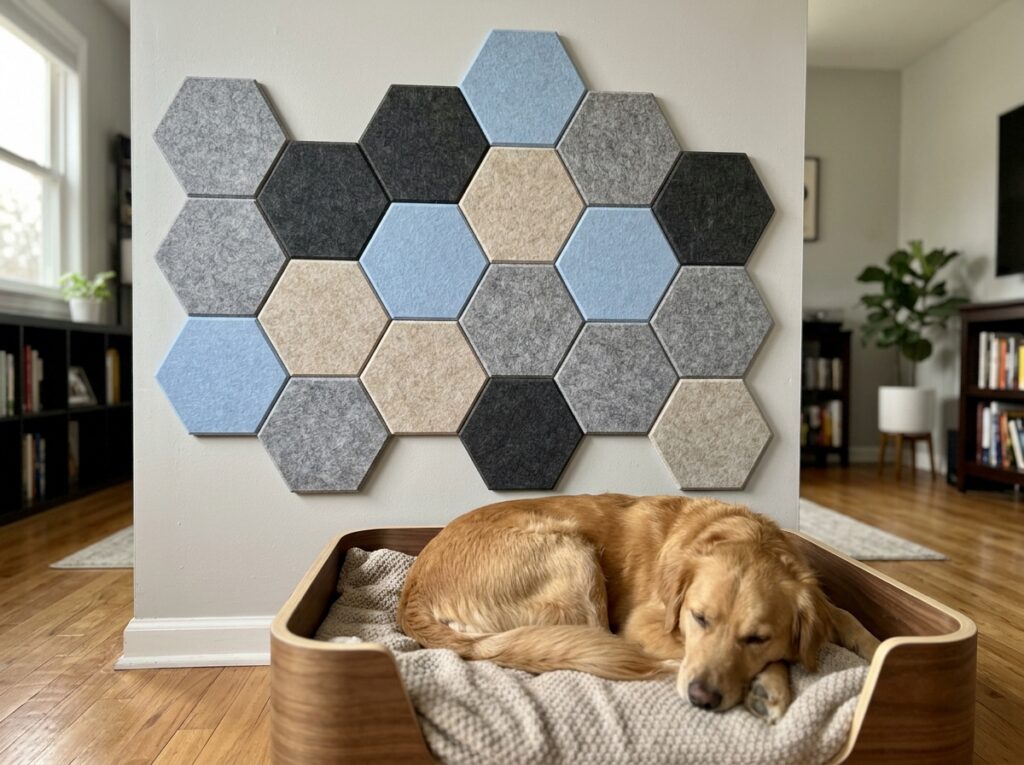
Some commercial PET felt systems are available in dozens of colours and can be arranged into customized geometric wall compositions.
Acoustic PET Panels for Open-Plan Offices
Open-plan offices are one of the environments where acoustic treatment can make a noticeable difference.
An office may contain dozens of simultaneous sound sources:
- Conversations
- Video meetings
- Telephone calls
- Keyboard activity
- Movement
- Printers
- Collaboration areas
- Background equipment
Because there are fewer physical walls separating employees, sound can spread across the space.
PET panels can be used to create acoustic zones without completely closing the office.
For example, panels can be positioned around:
Collaboration Areas
A collaborative zone can use acoustic wall panels to reduce reflections while remaining visually open.
Meeting Areas
Panels can be placed around small meeting spaces to help control reverberation.
Individual Workstations
Acoustic screens can provide both visual separation and acoustic absorption.
Reception Areas
Decorative PET installations can help control reflections in areas with hard architectural finishes.
Turning Acoustic Treatment Into a Design Feature
Acoustic products do not have to disappear into the background.
PET panels can become one of the most noticeable design elements in a room.
Imagine a reception wall featuring a combination of charcoal, grey, and natural-toned PET shapes. Instead of looking like conventional sound-control equipment, the wall becomes a visual feature.
The acoustic function remains important, but the installation also contributes to the identity of the space.
This approach is particularly useful for:
- Corporate offices
- Creative studios
- Hotels
- Restaurants
- Educational facilities
- Retail interiors
- Co-working spaces
- Reception areas
Restaurants and Cafés in Kampala
Restaurants create an interesting acoustic challenge.
A busy restaurant contains numerous simultaneous conversations. Hard surfaces can reflect these sounds throughout the dining area.
When reverberation becomes excessive, customers may need to speak louder to communicate.
That can contribute to an increasingly loud environment.
PET panels can be introduced through:
- Ceiling baffles
- Decorative wall panels
- Acoustic ceiling clouds
- Suspended elements
- Feature walls
- Acoustic partitions
The objective is not necessarily to make the restaurant silent.
Instead, the goal is to create a more controlled acoustic environment where conversations remain comfortable while the atmosphere of the venue is preserved.
PET Acoustic Panels for Hotels
Hotels contain multiple types of spaces, each with different acoustic requirements.
PET acoustic systems can be considered for:
- Reception areas
- Lounges
- Conference rooms
- Restaurants
- Business centres
- Meeting rooms
- Corridors
- Event spaces
For example, a hotel conference room may benefit from wall or ceiling absorption, while a large lobby may require strategically distributed acoustic elements.
The flexibility of PET allows different forms and colours to be coordinated with the hotel’s interior design.
Classrooms and Training Rooms
Speech clarity is especially important in educational environments.
A teacher speaking at the front of a classroom needs their voice to reach students without excessive reflected sound.
If the room contains hard walls, ceilings, flooring, and furniture, reverberation can become a problem.
PET acoustic panels can be positioned on selected walls or ceilings to introduce absorption.
They can also be useful in training rooms, where presentations, group discussions, and video conferencing may happen throughout the day.
Some polyester acoustic panel products are specifically marketed for schools, offices, athletic facilities, and multipurpose spaces because of their durability and sound absorption characteristics.
The Ceiling Is an Important Acoustic Surface
Many acoustic projects focus heavily on walls.
But ceilings can provide a large opportunity for acoustic treatment.
PET products can be manufactured as:
- Ceiling tiles
- Baffles
- Clouds
- Suspended panels
- Hanging geometric elements
Suspended PET baffles are particularly useful because they expose multiple surfaces to the room.
One current PET baffle system, for example, uses two layers of 9 mm PET board and incorporates an air cavity to increase acoustic performance. Its published data gives an NRC of 1.10 for the specified baffle configuration.
This illustrates why the installation configuration matters when evaluating acoustic performance.
PET Panels and Air Gaps
The way an acoustic panel is mounted can affect its performance.
A panel directly attached to a wall does not necessarily perform the same way as a panel mounted away from the wall.
An air cavity can change the acoustic behaviour of the assembly.
For example, one published 10 mm PET panel test shows an NRC of 0.35 under a Type A mounting but 0.90 when tested with a 50 mm air gap and polyester wadding behind the panel.
This is a useful example of why acoustic specifications should always be connected to the actual installation method.
The headline NRC number alone does not describe every possible installation.
Selecting the Right PET Panel Thickness
PET acoustic panels are available in different thicknesses.
Common options can include approximately:
- 9 mm
- 10 mm
- 12 mm
- 18 mm
- 24 mm
- 25 mm
- 50 mm and thicker constructions
The appropriate thickness depends on the acoustic objective and the installation.
Thicker panels can generally provide greater absorption, particularly when combined with an appropriate air gap or backing system.
For example, a published polyester panel test lists NRC values of 0.70 for a 1-inch panel and 0.95 for a 2-inch panel under the specified Type A mounting conditions.
However, product-to-product performance varies, so specifications should be checked for the exact panel being considered.
Acoustic PET Panels for Creative Workspaces
Creative studios, design offices, media rooms, and collaborative environments often benefit from flexible acoustic solutions.
These spaces can contain a mixture of:
- Open work areas
- Recording or media equipment
- Meeting zones
- Presentation areas
- Hard decorative finishes
- Large screens
- Glass partitions
PET panels can be shaped and positioned around these different functions.
A designer might use one colour family around the workstations and another around a meeting zone, creating visual zoning without constructing permanent walls.
PET Panels for Conference and Boardrooms
Boardrooms need a balance between privacy, communication, and visual presentation.
Inside the room, acoustic absorption can help reduce reverberation so that voices remain clearer during meetings.
PET panels can be installed on selected wall surfaces or integrated into ceiling treatments.
They can also be coordinated with:
- Display screens
- Lighting
- Video conferencing equipment
- Feature walls
- Branding
- Furniture
This makes it possible to create an acoustic environment without compromising the professional appearance of the room.
Colour Choices Create More Design Possibilities
One of the distinguishing features of PET acoustic materials is the availability of colour.
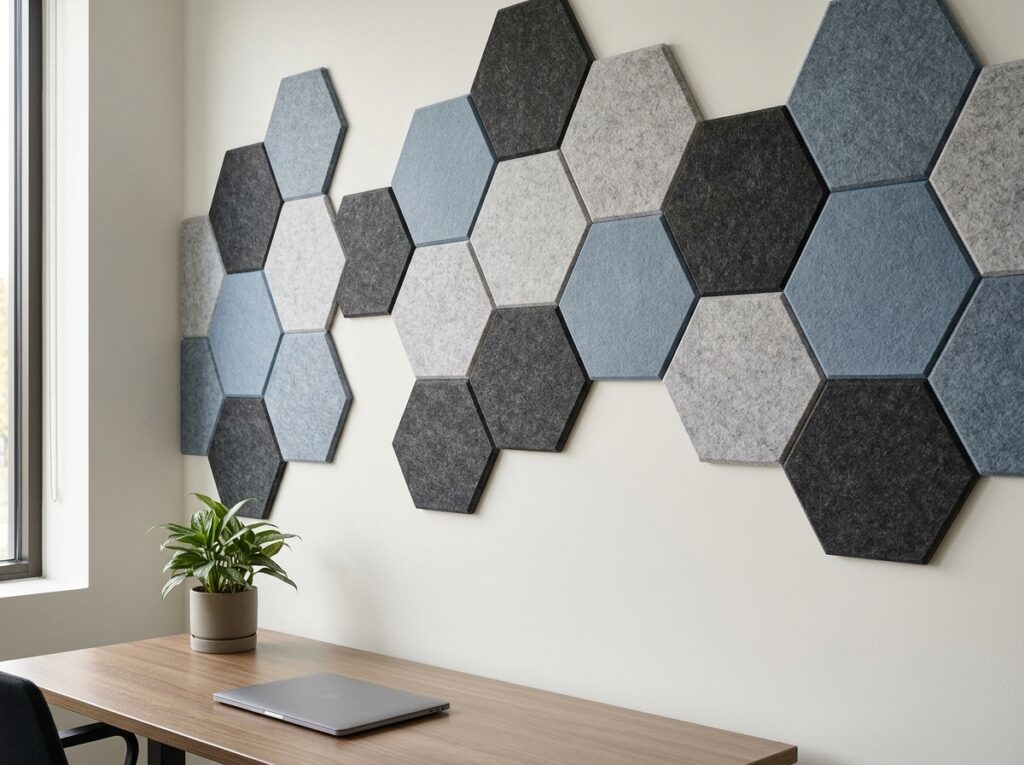
Instead of using only neutral acoustic surfaces, designers can create installations using:
- Charcoal
- Grey
- Blue
- Green
- Beige
- White
- Black
- Earth tones
- Custom colour combinations
Some PET felt product ranges offer more than 30 colour options.
This makes PET particularly suitable for interiors where branding and acoustic treatment need to coexist.
Sustainability Considerations
PET acoustic panels can also be selected with material sustainability in mind.
Many products incorporate recycled polyester fibres, and some are manufactured to be recyclable.
For example, a published polyester acoustic panel specification identifies 60% recycled PET fibre and 100% recyclability.
Other PET felt systems specify 55% recycled content and 100% recyclability.
However, sustainability claims should always be connected to the exact product specification rather than assumed for every PET panel available on the market.
Fire Performance Must Be Checked Product by Product
Acoustic materials used in commercial buildings may need to meet specific fire-performance requirements.
PET products can have different fire ratings depending on their construction.
For example, certain polyester acoustic products are published with Class A ratings under ASTM E84.
That does not mean every PET acoustic panel automatically carries the same rating.
Before specifying a panel for an office, school, hotel, restaurant, or public building, the relevant certification for the exact product should be reviewed.
Installation Options for PET Acoustic Panels
PET panels can be installed using different approaches depending on the product.
Possible methods include:
- Construction adhesive
- Mechanical fasteners
- Clips
- Suspended cables
- Threaded rods
- Ceiling grid systems
- Custom mounting systems
Wall panels can be installed individually to create geometric arrangements, while ceiling baffles and clouds generally require suspension hardware.
The substrate should be checked before installation, and the panel layout should be coordinated with electrical, HVAC, lighting, fire systems, and other architectural elements.
A Practical Acoustic Assessment Before Installation
Installing panels randomly is rarely the best approach.
A professional acoustic project should first identify the room’s actual problem.
Important questions include:
Where are the strongest reflections occurring?
How large is the room?
What materials cover the existing walls and floor?
How many people normally occupy the space?
Is the problem speech clarity, reverberation, or sound transmission?
Which surfaces can realistically receive treatment?
The answers help determine the appropriate panel type, thickness, quantity, placement, and mounting configuration.
PET Panels vs Traditional Fabric-Wrapped Panels
PET panels are often considered when designers want an alternative to conventional fabric-wrapped acoustic boards.
Fabric-wrapped systems can provide strong acoustic performance, but PET offers additional possibilities in terms of shape, colour, exposed surface, and visual geometry.
PET can also be lightweight and durable.
For example, one published polyester panel system describes its material as impact resistant and suitable for high-traffic spaces such as offices, schools, athletic facilities, and multipurpose rooms.
The right choice ultimately depends on the project’s acoustic requirements, appearance, durability, fire requirements, and budget.
Where Acoustic PET Panels Can Be Used in Kampala
| Application | Potential Acoustic Use |
|---|---|
| Corporate offices | Reduce reverberation in open workspaces |
| Meeting rooms | Improve speech clarity |
| Restaurants | Control reflected conversation |
| Hotels | Improve acoustic comfort in shared areas |
| Classrooms | Reduce excessive reverberation |
| Training rooms | Support clearer communication |
| Reception areas | Control reflections while creating a feature |
| Co-working spaces | Create acoustic zoning |
| Studios | Add sound absorption |
| Retail spaces | Improve the interior acoustic environment |
| Conference rooms | Support speech and presentation clarity |
| Creative spaces | Combine acoustic treatment with visual design |
Building an Acoustic Solution Around the Room
Every room behaves differently.
A small meeting room with glass walls may require a different treatment strategy from a large open-plan office.
Likewise, a restaurant with a low ceiling and hard flooring will behave differently from a hotel lobby with a high ceiling.
That is why PET panels should be selected as part of a complete acoustic plan.
A professional acoustic service can consider:
- Room dimensions
- Existing finishes
- Occupancy
- Acoustic complaints
- Desired reverberation characteristics
- Panel placement
- Mounting method
- Ceiling height
- Interior design requirements
- Fire and building requirements
The result is a more targeted installation rather than simply adding panels wherever wall space is available.
Final Thoughts
Acoustic PET panels provide a flexible way to introduce sound absorption into modern interiors while maintaining considerable freedom in design.
Their lightweight construction, range of shapes and colours, recycled-material options, and adaptable installation methods make them suitable for many commercial and architectural environments.
In Kampala, Uganda, they can be incorporated into offices, restaurants, hotels, classrooms, meeting rooms, reception areas, co-working spaces, and other interiors where excessive reverberation affects the experience of the space.
The key is to understand what the project actually needs.
PET panels are primarily an acoustic treatment solution for controlling reflected sound, not a standalone replacement for a complete soundproofing system.
When panel thickness, placement, air gaps, coverage, and installation are considered together, PET acoustic panels can become both a practical acoustic element and an important part of the interior design.
Frequently Asked Questions
What are acoustic PET panels made from?
They are primarily manufactured from polyester fibres made from polyethylene terephthalate, commonly known as PET. Some products incorporate recycled PET content.
Do PET acoustic panels soundproof a room?
PET panels primarily absorb reflected sound inside a room. They should not be treated as a complete soundproofing barrier for preventing sound transmission between rooms.
Are PET panels suitable for offices?
Yes. They can be used on walls, ceilings, partitions, and other surfaces to help control reverberation and improve acoustic comfort.
Can PET panels be installed on ceilings?
Yes. PET is available in ceiling tiles, clouds, and suspended baffle systems.
Does a thicker PET panel absorb more sound?
Thickness can influence absorption, but the final result also depends on the mounting method, air gap, backing, panel density, and room conditions.
Can PET acoustic panels be customized?
Many systems can be cut into different shapes and arranged into custom patterns. Product-specific cutting and fabrication capabilities should be confirmed with the manufacturer.
Are PET acoustic panels environmentally friendly?
Some PET acoustic products contain recycled polyester and are recyclable. However, recycled content varies by manufacturer and product, so the exact specification should be checked.
Can PET panels be used in restaurants?
Yes. They can be installed on walls or ceilings to help control reflected sound and reverberation in dining environments.
Are PET acoustic panels fire rated?
Some products carry specific fire ratings, but this is not universal across all PET panels. The certification for the exact product should always be verified before specification.
How should PET acoustic panels be installed?
Depending on the product, installation can involve adhesive, mechanical fasteners, clips, or suspension systems. The manufacturer’s installation requirements and the condition of the substrate should be followed.