
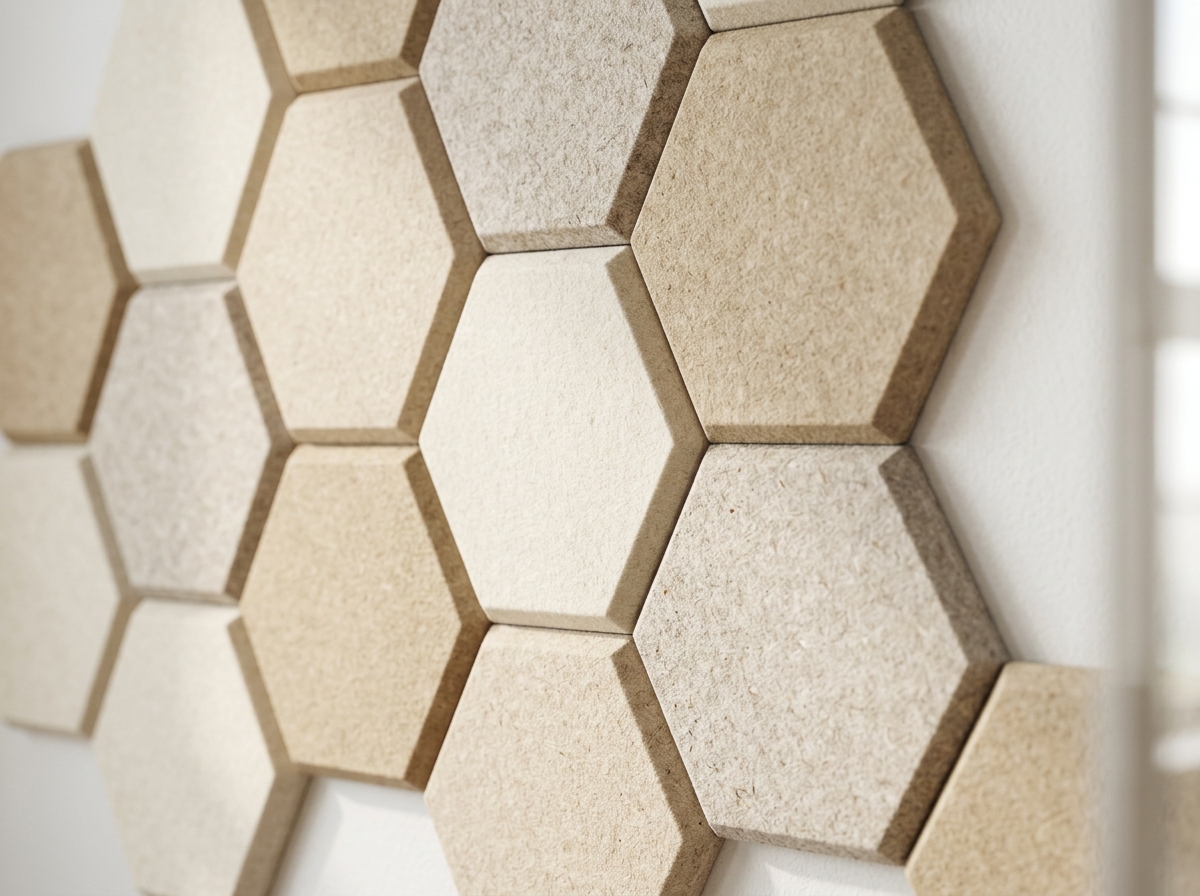
Creating a comfortable indoor environment requires more than attractive furniture, lighting, and wall finishes. The way sound behaves inside a building can significantly influence communication, concentration, and the overall experience of a space. In offices, schools, conference rooms, restaurants, and other busy environments, excessive echo can make conversations harder to understand and contribute to an uncomfortable atmosphere.
For architects, contractors, interior designers, and property developers in Nouakchott, Mauritania, PET acoustic panels offer a practical way to combine contemporary interior design with effective sound absorption.
Manufactured from polyester fibres, often incorporating recycled polyethylene terephthalate (PET), these panels can be used on walls, ceilings, and selected interior features to reduce sound reflections. Their lightweight construction, design flexibility, and availability in different colours and shapes make them suitable for a wide range of architectural applications.
Choosing the right panel system involves understanding how PET acoustic materials work, where they provide the greatest benefit, and how installation affects their performance.
What Are PET Acoustic Panels?
PET acoustic panels are sound-absorbing boards made from polyester fibres. Depending on the manufacturer and product specification, the fibres may include recycled PET from post-consumer plastic bottles.
During production, polyester fibres are processed into a felt-like or rigid panel with a porous structure. This structure allows sound energy to enter the material, where some of it is dissipated through friction within the fibres.
Unlike traditional decorative wall coverings, PET acoustic panels are designed to provide an acoustic function in addition to their visual appeal.
Common characteristics include:
- Lightweight construction for suitable wall and ceiling applications.
- Different thicknesses and densities for varying design requirements.
- A selection of colours, surface finishes, and geometric patterns.
- Options for cutting, shaping, grooving, and creating decorative features.
- Recycled content in products manufactured with recycled polyester.
- Potential use in offices, educational facilities, hospitality interiors, and residential spaces.
Specifications vary between products, so buyers should check the technical documentation for the particular panel they intend to use.
Why PET Acoustic Panels Are Relevant to Projects in Nouakchott
Nouakchott’s commercial and residential development creates opportunities for interior solutions that balance architectural appearance with practical performance.
Offices need spaces where employees can concentrate. Educational facilities require environments that support clear speech. Meeting rooms must accommodate conversations, presentations, and discussions without excessive reverberation.
However, many contemporary interiors use reflective materials such as glass, concrete, plaster, tile, and polished stone. When sound repeatedly reflects between these surfaces, a room may develop an uncomfortable level of echo.
PET acoustic panels can help address this issue by absorbing some of the sound that would otherwise reflect back into the room.
Their potential advantages include:
Improved speech comfort: Reducing reverberation can help people understand spoken communication more easily.
Contemporary design options: Coloured panels, geometric patterns, and custom-cut shapes can complement modern interiors.
Flexible placement: Depending on the product, panels may be installed on walls, ceilings, suspended systems, or selected partitions.
Potential recycled content: Certain products use recycled polyester fibres, which may support material-efficiency goals when their composition is documented.
Adaptability: Panels can be incorporated into feature walls, meeting-room interiors, learning spaces, and other areas where sound absorption is needed.
The most suitable application depends on the room’s acoustic requirements, its dimensions, and the panel’s tested performance.
How PET Acoustic Panels Reduce Echo
Understanding sound absorption helps explain why PET panels can improve the acoustic environment inside a building.
When someone speaks, sound travels through the air and reaches the surrounding surfaces. Hard, dense surfaces tend to reflect much of this sound, while porous materials can absorb a portion of the sound energy that reaches them.
PET acoustic panels use their fibrous structure to absorb some of that energy. As sound waves enter the material, air movement within the fibres produces friction, converting a portion of the sound energy into small amounts of heat.
This reduces some of the reflections returning to the room.
The amount of absorption depends on several factors:
- Panel thickness and fibre density.
- The frequencies being absorbed.
- The area of the room covered by panels.
- Panel positioning on walls or ceilings.
- Whether an air gap or additional backing is used.
- The acoustic characteristics of the surrounding construction.
For example, Kinetics Noise Control lists industrial PET panels with an NRC of 0.70 for its 1-inch product and 0.95 for its 2-inch product. These figures relate to that manufacturer’s specific panels and should not be assumed to apply to all PET acoustic materials.
When specifying panels for a project in Nouakchott, request relevant test reports and confirm that the tested mounting arrangement matches the proposed installation as closely as possible.
PET Acoustic Panels for Offices and Commercial Buildings
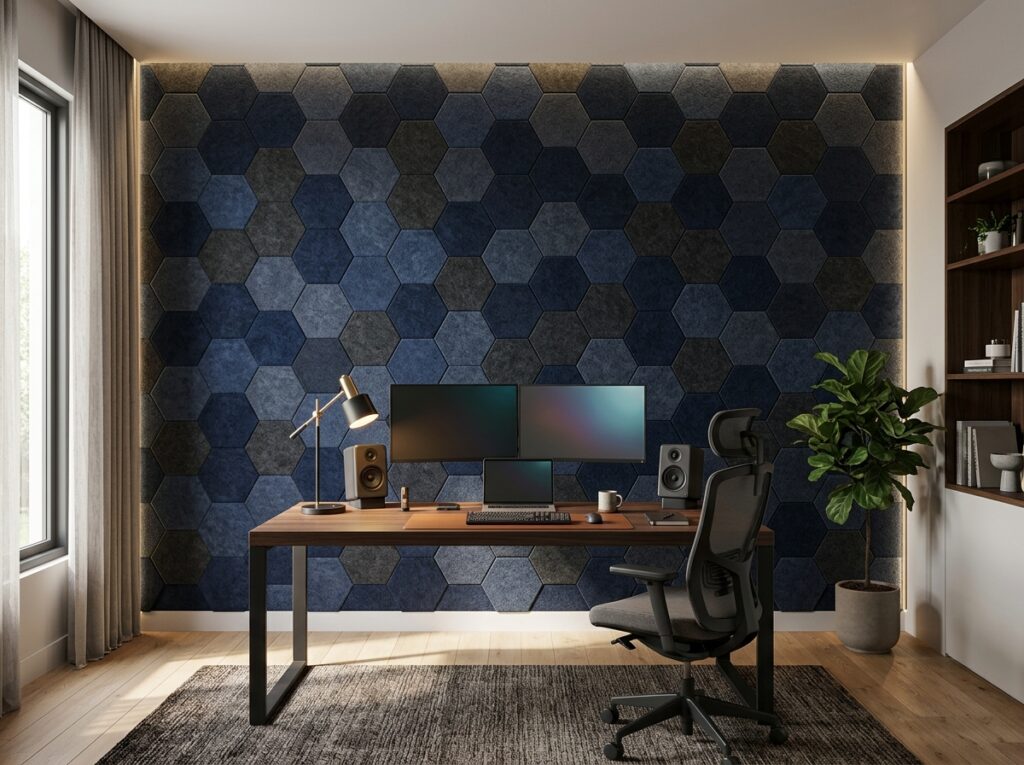
Workplaces are among the most common applications for acoustic treatment. Open-plan layouts, hard floors, glass partitions, and large meeting rooms can all contribute to unwanted sound reflections.
PET acoustic panels can be incorporated into office designs to improve the acoustic environment without relying exclusively on conventional fabric-covered absorbers.
Open-Plan Offices
Open-plan workplaces often contain multiple simultaneous conversations, telephone calls, and collaborative activities.
Wall-mounted panels can reduce reflections from selected surfaces, while ceiling-mounted absorbers may provide additional treatment where suitable.
PET panels should be combined with thoughtful workplace planning, suitable furniture layouts, and other noise-management measures where required.
Conference and Meeting Rooms
Meeting rooms need an environment that supports presentations and clear communication.
When speech reflects strongly from walls and ceilings, participants may struggle to follow discussions. Installing an appropriate quantity of sound-absorbing panels can help control reverberation and improve speech comfort.
Panel coverage should be selected according to the room’s dimensions, surface materials, occupancy, and intended use.
Reception Areas
Reception spaces influence visitors’ first impressions of a business. Decorative PET panels can introduce colour, texture, or geometric patterns while helping reduce reflections from hard interior finishes.
Custom shapes and corporate-colour schemes may also be considered where the manufacturer supports such designs.
Training Rooms and Shared Workspaces
Training rooms and collaboration areas often accommodate several people speaking and listening at the same time. Acoustic treatment can help create a more comfortable setting for discussion and presentations.
Improving Classroom Acoustics in Nouakchott
Educational environments require particular attention to speech clarity. Students need to hear teachers, follow instructions, and participate in classroom discussions.
Excessive reverberation can make these activities more difficult, especially in rooms with hard floors, bare walls, and high ceilings.
PET acoustic panels can form part of an acoustic treatment plan for classrooms, training centres, libraries, and lecture spaces.
Classrooms
Wall-mounted panels can absorb sound reflections and introduce a more controlled acoustic environment.
The appropriate panel coverage should be based on the classroom’s size, existing surfaces, occupancy, and acoustic objectives rather than on appearance alone.
Libraries and Study Areas
Libraries and study rooms benefit from environments that support concentration. PET panels can help manage reflections in suitable locations, while furniture, layout, and behavioural noise controls address other sources of disturbance.
Training Centres
Professional training facilities often combine presentations, group work, and digital learning. Appropriate acoustic treatment can help make speech and discussion more comfortable.
For educational projects, material selection should also consider cleaning requirements, durability, relevant fire-safety documentation, and the practical demands of daily use.
PET Acoustic Panels for Hotels, Restaurants, and Hospitality Interiors
Hospitality environments must balance attractive design with a pleasant visitor experience. Excessive noise can undermine that experience even when the furniture and finishes are carefully selected.
PET acoustic panels offer an adaptable option for managing reflections in selected hospitality spaces.
Hotel Lobbies
Lobbies frequently combine open layouts, hard flooring, glass, and large ceiling areas. These features can contribute to reverberation.
Decorative panels on appropriate walls or ceilings can introduce visual interest while absorbing some reflected sound.
Restaurants and Cafés
When multiple conversations overlap in a reflective dining area, background noise can build up. Suitable acoustic treatment may help reduce reverberation and make conversations more comfortable.
PET panels are one possible element of a broader strategy that can also include upholstered furniture, curtains, strategic seating arrangements, and other sound-absorbing surfaces.
Conference and Event Facilities
Meeting and event rooms require careful acoustic planning because they may accommodate presentations, group discussions, or amplified sound.
PET panels can be used where appropriate, but the complete room design must account for the intended activities and the relevant acoustic performance targets.
Residential Applications of PET Acoustic Panels
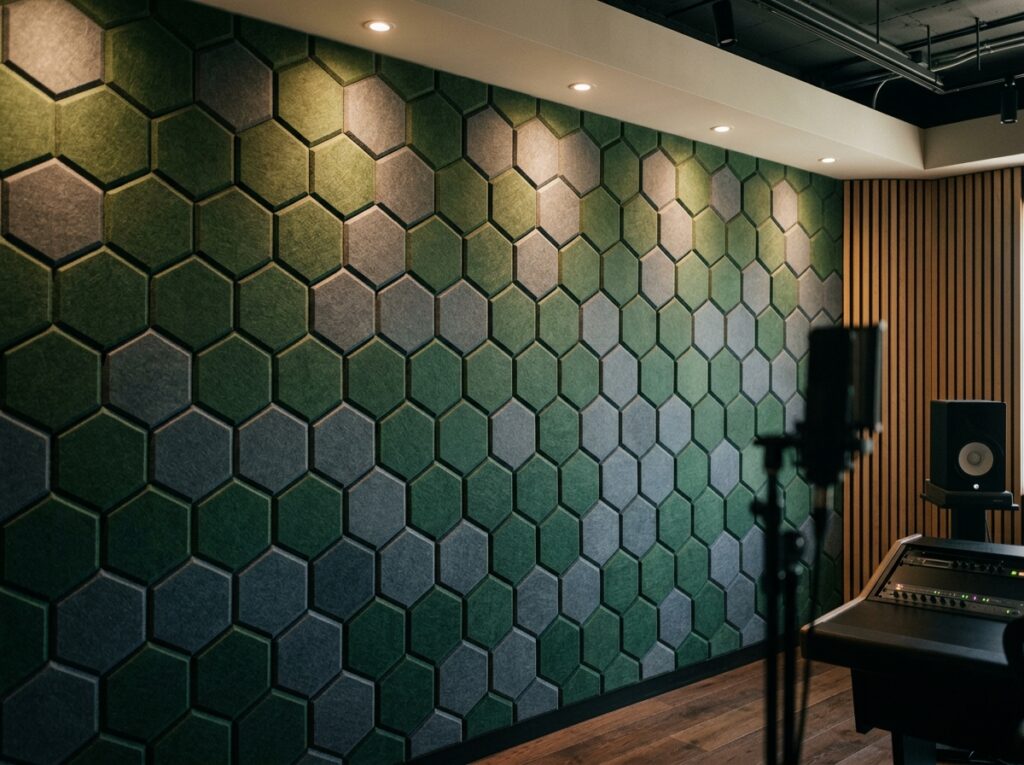
PET acoustic panels can also be useful in homes where echo, media-room reflections, or uncomfortable speech conditions affect everyday activities.
Living Rooms
Large living rooms with tiled floors, bare walls, and minimal soft furnishings can experience noticeable reflections. Decorative PET panels can provide a practical treatment option while contributing to the interior design.
Home Offices
Remote work and online meetings require clear communication. A properly positioned acoustic panel behind or near the working area can help manage some room reflections.
The best location depends on the room layout and the surfaces responsible for the reflections.
Media Rooms
Television rooms and home cinemas can benefit from acoustic treatment that helps control sound reflections. PET panels may be combined with other absorbers and bass-control measures where necessary.
However, they should not be treated as a complete soundproofing solution.
Bedrooms and Private Spaces
In suitable applications, PET panels can provide decorative wall treatments while helping control reflections. Product selection should account for the intended placement, installation method, and the manufacturer’s maintenance recommendations.
Choosing the Right PET Acoustic Panels
Not all polyester acoustic panels have the same construction or acoustic performance. A successful project begins with the requirements of the space rather than the colour or price of the material alone.
1. Select the Appropriate Thickness
PET panels are available in different thicknesses. Thicker products may provide greater absorption under certain conditions, but performance also depends on density, mounting, frequency, and the overall system.
Ask for test data for the exact panel being considered.
2. Review Acoustic Test Results
The Noise Reduction Coefficient (NRC) is one commonly used indicator of sound absorption. It provides a simplified summary of performance across selected frequencies.
However, NRC does not describe every aspect of a panel’s behaviour, particularly at lower frequencies. Where detailed performance matters, review the available frequency-by-frequency test results and the relevant test standard.
3. Consider Panel Density and Composition
Density, fibre structure, and manufacturing methods can influence panel performance and durability.
Confirm whether the material contains recycled PET, the percentage of recycled content, and whether this claim is supported by manufacturer documentation.
4. Choose Colours and Finishes Carefully
PET panels may be available in neutral tones, bold colours, grooved finishes, geometric shapes, and custom-cut patterns.
A coordinated design can complement a building’s interior without compromising the intended acoustic treatment area.
5. Verify Fire-Safety Requirements
Fire classifications vary by product and test standard. Confirm the documentation for the exact panel, thickness, finish, and installation assembly required for the project.
Do not assume that a rating advertised for one product applies to another panel from the same general material category.
6. Check Cleaning and Maintenance Requirements
Different panels have different cleaning limitations. Consider the expected level of use, dust exposure, access for maintenance, and the manufacturer’s recommended cleaning procedure.
7. Plan the Mounting System
Panels may be fixed directly to suitable walls or incorporated into ceiling systems, suspended absorbers, or other assemblies.
Mounting arrangements influence acoustic performance and must be compatible with the substrate, panel weight, and installation conditions.
PET Acoustic Panels vs. Traditional Acoustic Materials
PET panels are one option within a wider range of acoustic materials. The best choice depends on the performance requirements, available space, appearance, maintenance, and budget.
| Feature | PET acoustic panels | Fabric-wrapped acoustic panels | Acoustic foam |
|---|---|---|---|
| Typical purpose | Sound absorption and decorative treatment | Sound absorption and decorative treatment | Sound absorption in suitable applications |
| Design flexibility | Colours, shapes, and profiles vary by product | Fabric and frame finishes vary | Shapes and profiles vary |
| Recycled content | Available in some products | Depends on the core and fabric | Depends on the material |
| Installation | Wall, ceiling, or suspended options depending on system | Commonly wall or ceiling mounted | Commonly wall or ceiling mounted |
| Performance | Depends on thickness, density, and mounting | Depends on core, fabric, and assembly | Depends on foam type, thickness, and placement |
| Sound isolation | Not generally a standalone solution | Not generally a standalone solution | Not generally a standalone solution |
These categories overlap, and performance should be compared using product-specific test data rather than material names alone.
PET Acoustic Panels Are Not the Same as Soundproofing
An important part of planning an acoustic project is identifying the actual problem.
PET acoustic panels primarily absorb sound reflections within a room. They can help reduce echo and improve speech comfort when correctly selected and installed.
Soundproofing aims to reduce sound travelling between rooms or from outside a building. That typically requires suitable wall, floor, ceiling, door, or glazing assemblies, together with effective sealing and control of sound transmission paths.
For example, a meeting room with excessive echo may benefit from PET panels. If conversations from the neighbouring room remain audible through a partition, the underlying issue may require a sound-isolation solution instead.
In some projects, both acoustic treatment and soundproofing are needed. Each should be designed for its specific purpose.
Installation Considerations for Projects in Nouakchott
Correct installation is essential for achieving the intended result and maintaining a consistent finish.
A typical project process includes the following stages.
Step 1: Assess the space. Review the room dimensions, existing finishes, sources of noise, and how the room will be used.
Step 2: Define the acoustic objective. Establish whether the priority is echo reduction, speech clarity, or another acoustic requirement.
Step 3: Select the panel system. Choose the appropriate thickness, density, colour, shape, and backing arrangement using relevant technical data.
Step 4: Plan the treatment layout. Identify suitable wall and ceiling areas and coordinate the layout with lights, electrical fittings, access panels, and other building services.
Step 5: Prepare the surfaces. Confirm that the substrate and fixing method are suitable for the selected system.
Step 6: Install according to the manufacturer’s instructions. Use approved fixing methods and follow the required installation details.
Step 7: Inspect the completed work. Check panel alignment, joints, edges, surface condition, and overall coverage.
For projects in Nouakchott, storage, transportation, indoor conditions, and maintenance requirements should be considered when selecting materials and planning installation.
Common Mistakes to Avoid When Selecting PET Acoustic Panels
Several avoidable mistakes can reduce the value of an acoustic installation.
Choosing panels based only on appearance: A decorative panel may not provide the absorption needed for a particular room.
Assuming every PET panel has the same NRC: Acoustic ratings vary by thickness, density, product construction, and test conditions.
Installing too little treatment: A small decorative feature may not provide enough absorption for a large or highly reflective room.
Ignoring panel placement: The location and amount of treatment matter alongside the product specification.
Expecting complete soundproofing: Sound-absorbing panels do not automatically prevent sound transmission through walls, doors, or floors.
Overlooking fire and maintenance requirements: Verify product-specific documentation before using panels in commercial or public buildings.
Ignoring the mounting arrangement: An installation that differs from the tested configuration may perform differently from the advertised result.
Avoiding these mistakes helps ensure that PET panels support the actual design and acoustic objectives of the project.
Conclusion: PET Acoustic Panels for Better Interior Acoustics in Nouakchott
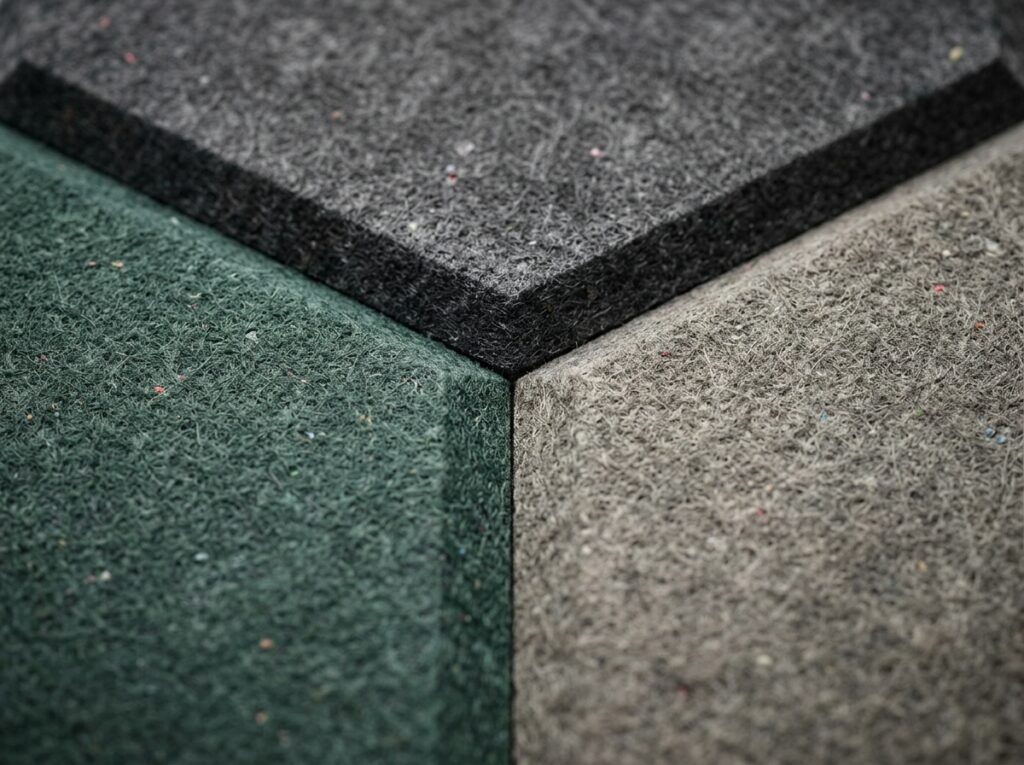
PET acoustic panels provide a flexible option for architects, designers, contractors, and property developers seeking to improve indoor acoustic comfort while maintaining a contemporary appearance.
Their potential applications include offices, classrooms, meeting rooms, hotels, restaurants, libraries, residential interiors, and other spaces where unwanted reflections affect communication or comfort.
The most effective solution depends on selecting an appropriate panel, verifying its acoustic performance, determining suitable treatment coverage, and following the manufacturer’s installation requirements.
For projects in Nouakchott, Mauritania, a considered approach can help integrate sound absorption into the interior design from the beginning, rather than treating it as an afterthought.
When selected for the right purpose, PET acoustic panels can help create more comfortable interiors, clearer communication, and visually coordinated spaces.
Frequently Asked Questions
1. What are PET acoustic panels made from?
They are made from polyester fibres. Some products use recycled polyethylene terephthalate (PET), including material recovered from plastic bottles. The exact recycled content and manufacturing process vary by product.
2. Do PET acoustic panels reduce echo?
Yes. Properly specified PET panels can absorb some sound reflections and reduce reverberation. Their effectiveness depends on panel thickness, density, mounting, coverage, and room conditions.
3. Are PET acoustic panels suitable for offices in Nouakchott?
They can be suitable for offices, boardrooms, reception areas, and collaborative spaces where reducing reflections and improving speech comfort are important.
4. Can PET acoustic panels be installed on ceilings?
Many products support ceiling applications, including suspended systems. The installation must follow the manufacturer’s requirements and use suitable structural support and fixings.
5. Are PET acoustic panels environmentally friendly?
Some PET acoustic panels incorporate recycled polyester, which can reduce reliance on virgin material. Environmental benefits depend on the product’s actual recycled content, manufacturing process, durability, and end-of-life options.
6. Do PET acoustic panels block outside noise?
They are primarily designed to absorb sound within a room rather than provide complete sound isolation. Reducing outside noise generally requires a properly designed building envelope or sound-isolation assembly.
7. How do I choose the right PET panel thickness?
Consider the room’s acoustic needs, the required treatment area, the intended mounting arrangement, and the manufacturer’s test data. Thicker panels may improve absorption in some configurations, but thickness alone does not determine performance.
8. Can PET acoustic panels be customized?
Depending on the manufacturer, they may be available in different colours, patterns, shapes, grooves, and sizes. Confirm the available options and their acoustic specifications before finalizing the design.