
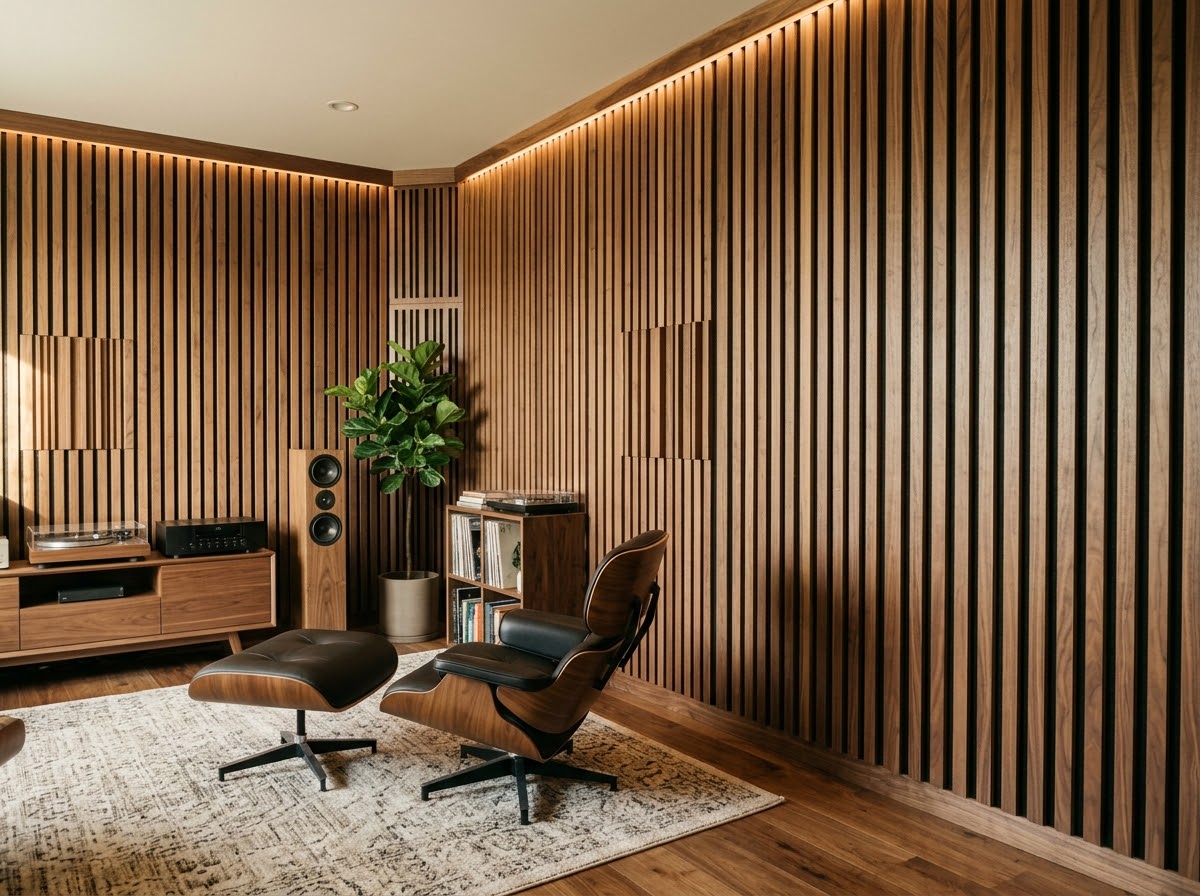
Wood has long been valued in interior design for its natural appearance, warmth, and versatility. From contemporary offices and hotel reception areas to residential living rooms and commercial meeting spaces, wood finishes can create an inviting environment. However, attractive interiors with hard walls, glass surfaces, tiled floors, and exposed ceilings can also experience unwanted echo and excessive sound reflections.
Acoustic wood panels in Sohar, Oman, offer a way to combine decorative wood finishes with practical acoustic treatment. Designed with specialised grooves, perforations, slats, or sound-absorbing backing materials, these panels can help manage reverberation while maintaining a refined architectural appearance.
For architects, interior designers, contractors, developers, and property owners, acoustic wood panels provide flexible options for wall coverings, ceiling treatments, feature walls, and selected commercial interiors.
This guide explains the different types of acoustic wood panels, their benefits, material options, applications, installation methods, and the factors to consider when choosing a suitable system for your project in Sohar.
What Are Acoustic Wood Panels?
Acoustic wood panels are interior panels designed to combine a wood-based decorative surface with a construction that helps absorb or manage sound.
Unlike conventional decorative wood boards, acoustic panels often include specially designed openings or channels that allow sound to reach an absorptive layer behind the visible surface.
Depending on the product, the construction may include:
- Natural wood veneer over an engineered wood substrate.
- MDF or plywood with precision-cut grooves or perforations.
- Wooden slats mounted over acoustic felt.
- Perforated wood panels with an acoustic fabric backing.
- Wood-faced panels combined with a cavity and suitable absorptive material.
The visible wood finish provides the aesthetic character, while the complete panel assembly determines much of its acoustic behaviour.
Acoustic wood panels are commonly used in offices, conference rooms, hotels, restaurants, educational facilities, auditoriums, and residential interiors.
It is important to distinguish acoustic treatment from soundproofing. These panels can help reduce sound reflections inside a room, but they do not automatically prevent sound from passing through walls, doors, floors, or windows.
Why Choose Acoustic Wood Panels in Sohar, Oman?
Sohar has residential developments, commercial premises, hospitality spaces, offices, and industrial facilities with different interior design and acoustic requirements. In rooms with extensive hard surfaces, sound may repeatedly reflect between walls and ceilings, making conversations less clear and increasing the perceived noise level.
Acoustic wood panels can help address this challenge while maintaining a professional, natural-looking interior.
1. Combine Natural Appearance with Acoustic Function
One of the main attractions of acoustic wood panels is their ability to integrate sound absorption into a decorative finish.
Wood veneer, textured surfaces, linear slats, and patterned perforations can complement contemporary or traditional interiors. This allows designers to incorporate acoustic treatment into the architectural concept instead of adding visibly unrelated materials later.
2. Reduce Echo and Reverberation
When sound reaches a hard surface, much of its energy is reflected into the room. Multiple reflections can cause speech and other sounds to overlap.
Acoustic wood panels with suitable perforations, grooves, slat gaps, and absorptive backing can reduce some of these reflections.
This can help improve speech clarity in meeting rooms, offices, restaurants, and other spaces where communication matters.
The result depends on the panel construction, tested acoustic performance, mounting arrangement, surface coverage, and room characteristics.
3. Create Professional Commercial Interiors
Wood finishes are often used in reception areas, boardrooms, executive offices, hotel lobbies, and client-facing environments.
Acoustic wood panels can provide a coordinated design across walls and ceilings while helping control sound reflections.
Designers can select a consistent wood finish or combine different panel patterns to create a feature area that complements lighting, furniture, flooring, and architectural details.
4. Support Better Listening Environments
Conference rooms, training spaces, and presentation areas require speech to remain clear and understandable.
Appropriately selected acoustic panels can help manage reverberation, making it easier for people to follow conversations and presentations.
For spaces with demanding acoustic requirements, panel selection should be based on room dimensions and acoustic assessment rather than appearance alone.
5. Offer Design Flexibility
Acoustic wood panels are available in different patterns, dimensions, and finishes. Depending on the manufacturer, options may include natural oak, walnut-style finishes, other wood veneers, laminates, and custom colours.
Panels may also be cut into linear grooves, perforated patterns, or coordinated modular formats.
This flexibility allows the same overall design language to be carried through multiple spaces while adjusting the acoustic specification for each room.
Types of Acoustic Wood Panels Available
Choosing the correct panel type starts with understanding how each construction works.
1. Wooden Slat Acoustic Panels
<AsyncImage query=”wooden slat acoustic wall panels natural oak veneer black acoustic felt backing modern interior” aspectRatio=”16:9″ width=”100%” />
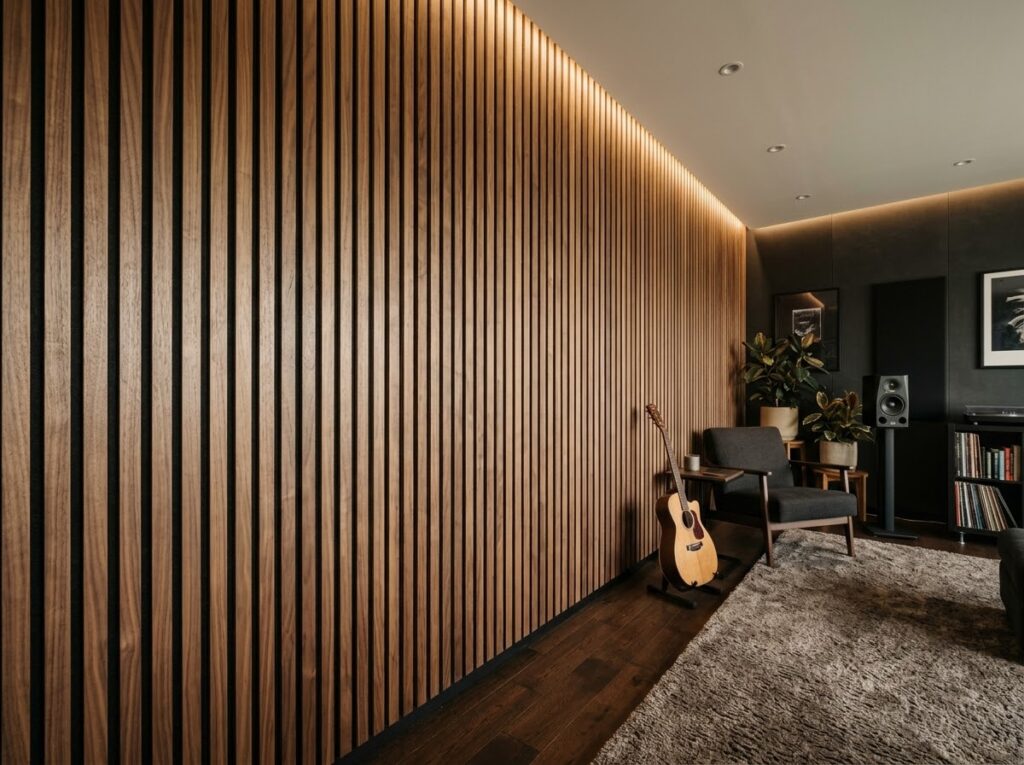
Wooden slat acoustic panels feature narrow wood or wood-faced slats arranged over an acoustic backing, commonly felt or another suitable sound-absorbing material.
The gaps between the slats allow sound to reach the backing layer, where some sound energy can be absorbed.
These panels are popular in:
- Office feature walls.
- Hotel reception areas.
- Living rooms and home offices.
- Meeting rooms and boardrooms.
- Restaurant interiors.
- Decorative ceiling installations.
Slat width, gap size, backing material, panel thickness, and installation arrangement all influence the finished product’s performance.
Wooden slats installed without an appropriate absorptive backing should not automatically be considered an effective acoustic treatment.
2. Perforated Acoustic Wood Panels
<AsyncImage query=”perforated wood veneer acoustic wall panels close up modern auditorium natural timber finish” aspectRatio=”16:9″ width=”100%” />
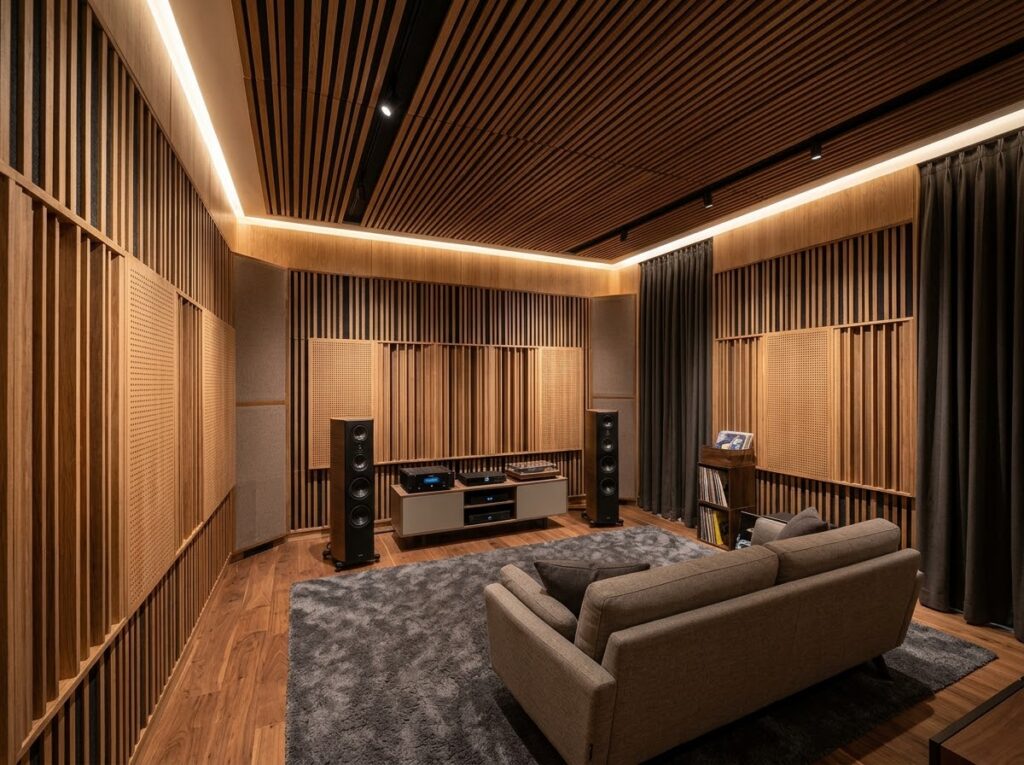
Perforated acoustic wood panels contain carefully positioned holes in the visible surface. Behind the perforated layer, manufacturers may incorporate acoustic fabric, fleece, mineral wool, or another specified absorptive material.
Sound enters through the openings and interacts with the backing and cavity construction.
These panels can be suitable for conference rooms, educational facilities, auditoriums, offices, and commercial interiors where a relatively uniform wood finish is preferred.
Perforation diameter, spacing, open area, backing materials, and cavity depth influence acoustic performance. The actual specification should be confirmed through product documentation.
3. Grooved Acoustic Wood Panels
Grooved panels feature channels or slots cut into a wood-based surface. Depending on the system, these grooves may expose or connect to a perforated backing layer or acoustic material behind the panel.
They offer a linear appearance that can work well in contemporary offices, corridors, meeting rooms, and hospitality interiors.
Not every grooved wood panel provides the same acoustic performance. Some grooves are mainly decorative, while others form part of a tested sound-absorbing construction.
Before purchasing, verify the panel’s internal structure and ask for test data relating to the complete system.
4. Veneered Acoustic Panels
Veneered panels use a thin layer of natural wood or engineered decorative veneer over a substrate such as MDF or plywood.
For acoustic applications, the substrate may contain perforations or slots, with an absorptive layer incorporated behind the visible surface.
Veneer offers the appearance of natural wood while allowing a consistent finish across multiple panels.
These products can be useful for boardrooms, offices, hotel interiors, and other spaces where the design calls for a refined timber appearance.
The selected veneer, substrate, adhesive system, and finish should be appropriate for the intended indoor environment.
5. Custom CNC-Cut Acoustic Wood Panels
Computer numerical control (CNC) machining allows grooves, perforations, and decorative patterns to be produced according to digital design files.
Custom CNC-cut panels can support geometric layouts, repeated patterns, branded interior features, and coordinated wall or ceiling designs.
Before production, the manufacturer should confirm the panel dimensions, minimum feature sizes, substrate thickness, edge treatment, and manufacturing tolerances.
For complex designs, an approved drawing or sample can help verify the appearance before a larger order is manufactured.
How Do Acoustic Wood Panels Absorb Sound?
Acoustic wood panels manage sound through their complete construction rather than through the wood finish alone.
When sound waves strike a conventional hard wood surface, much of the energy may be reflected into the room. In an acoustic panel, openings or gaps can allow some sound to pass through the face layer and reach an absorptive backing or cavity.
Porous materials dissipate some sound energy as air moves through their structure. The panel assembly can therefore reduce the amount of sound reflected back into the room.
Several factors influence the outcome.
Perforation and groove design: The size, spacing, and arrangement of openings affect how sound reaches the backing material.
Backing material: Acoustic felt, fabric, mineral wool, and other specified absorbers have different performance characteristics.
Air cavity depth: The space behind the panel can influence the frequencies absorbed.
Panel coverage: The amount and distribution of treatment affect the room’s overall reverberation.
Room characteristics: Ceiling height, dimensions, furniture, windows, flooring, and existing wall finishes all influence the acoustic result.
A manufacturer’s acoustic test report should identify the tested configuration and relevant measurement method. Ratings from one assembly should not be assumed to apply to a different panel, cavity, or backing arrangement.
Where Can Acoustic Wood Panels Be Used in Sohar?
Offices and Boardrooms
Offices can use acoustic wood panels to create feature walls, improve interior appearance, and help control reflected sound.
In boardrooms, properly selected panels can contribute to a more comfortable environment for discussions, presentations, and meetings.
Where confidential conversations are important, acoustic absorption should be combined with appropriate wall construction, doors, seals, and other sound-isolation measures.
Hotels and Hospitality Spaces
Hotel reception areas, lounges, restaurants, and conference rooms often require a balance between design quality and acoustic comfort.
Wood panels can provide a warm architectural finish while helping reduce sound reflections in suitable locations.
The product should be selected according to the intended use, cleaning requirements, fire performance, and maintenance conditions.
Restaurants and Cafés
Restaurants frequently contain hard flooring, glass, tables, and other reflective surfaces. When the space is busy, multiple reflections can contribute to a loud and uncomfortable environment.
Acoustic wood panels installed on suitable walls or ceilings can help manage reverberation.
Their effectiveness depends on the total absorptive area, panel construction, room layout, and other sound-absorbing materials in the space.
Educational Facilities
Classrooms, training rooms, libraries, and lecture spaces need acoustic conditions that support clear speech.
Perforated or slatted acoustic wood systems may be considered where a durable, coordinated architectural finish is desired.
For larger or more demanding learning spaces, the panel design should be based on the room’s acoustic requirements and applicable building specifications.
Residential Interiors
Wood acoustic panels can be used in living rooms, home offices, entertainment areas, and other residential spaces.
They can create a decorative focal point while helping reduce reflections from hard surfaces.
However, if the primary problem is noise entering from outside or passing between rooms, a different or additional solution may be required, such as improved glazing, door seals, wall construction, or other sound-isolation measures.
Auditoriums and Presentation Rooms
Auditoriums and presentation spaces may require a carefully balanced acoustic environment.
Perforated wood panels and other tested acoustic systems can be incorporated into walls or ceilings to manage reflections. Their position and coverage should be determined according to the intended use, room dimensions, sound system, and acoustic design.
How to Choose the Right Acoustic Wood Panels
Before selecting a panel for your project in Sohar, consider the following points.
Define the Acoustic Objective
Determine whether the main goal is to reduce echo, improve speech clarity, manage reflections, or achieve a combination of outcomes.
For reducing reverberation, sound-absorbing panels may be suitable. For preventing sound from travelling between rooms, the project may need additional sound-isolation measures.
Check Acoustic Test Results
Manufacturers may provide ratings such as the Noise Reduction Coefficient (NRC), weighted sound absorption coefficient, or sound absorption class.
These measures are not all interchangeable. Review the relevant test standard, panel thickness, backing construction, air cavity, and installation arrangement.
A published rating should refer to the actual product or tested assembly being considered.
Select the Right Wood Finish
Wood finish affects the visual result and may also influence maintenance requirements.
Natural veneer offers variation in grain and tone, while engineered finishes can provide more consistent appearance across larger projects.
Request samples to compare the finish with flooring, furniture, wall colours, and lighting.
Verify Substrate and Material Quality
Acoustic wood panels may use MDF, plywood, engineered wood, or other substrates.
The correct option depends on the product design, intended application, fixing method, environmental conditions, and applicable project requirements.
Ask for technical information about the substrate, surface finish, dimensions, and any relevant emissions or environmental declarations.
Confirm Fire and Safety Requirements
For commercial interiors, public spaces, hospitality facilities, and other regulated buildings, confirm the required fire performance.
Ask the supplier for documentation relating to the exact panel, substrate, finish, and assembly. Do not assume that every product with a wood veneer or similar appearance has the same fire classification.
Evaluate Installation and Maintenance
Check whether the panels require direct fixing, battens, concealed mounting hardware, or a suspended ceiling system.
Consider access to services, panel replacement, cleaning, and the condition of the supporting surface.
A suitable panel should meet the acoustic and visual requirements while remaining practical to install and maintain.
Installation of Acoustic Wood Panels
Correct installation helps preserve the intended appearance and acoustic performance of the complete system.
Step 1: Inspect the Surface
Check the wall or ceiling for stability, alignment, moisture issues, and suitability for the selected fixing method.
Any necessary substrate preparation should be completed before panels are installed.
Step 2: Plan the Layout
Confirm the panel dimensions, orientation, joint locations, edges, and alignment of grooves or perforations.
For feature walls, establish the starting point and check how the design will finish around corners, openings, and adjacent surfaces.
Step 3: Install the Support System
Depending on the product, installation may use direct fixings, battens, a concealed mounting system, or ceiling suspension hardware.
Follow the manufacturer’s instructions for the selected panel. Ceiling installations require appropriate support and secure fixings suitable for the building structure.
Step 4: Fit and Align the Panels
Panels should be installed with consistent spacing and accurate alignment.
Avoid unapproved modifications that could damage the panel, expose unsuitable substrate materials, or change the intended acoustic construction.
Step 5: Inspect the Finished Installation
Check joints, edges, fixings, surface finish, and alignment. Confirm that the panels are securely mounted and that the completed installation matches the approved layout.
Where the project has specific performance requirements, confirm that the installed system is consistent with the tested or specified assembly.
What Affects the Cost of Acoustic Wood Panels?
The price of acoustic wood panels in Sohar depends on the material specification, panel design, project size, and installation requirements.
Key factors include:
- Wood finish: Natural veneer, engineered finishes, and decorative laminates may have different costs.
- Panel construction: Slatted, grooved, perforated, and veneered systems use different materials and manufacturing processes.
- Acoustic backing: Felt, fabric, mineral wool, and other specified absorbers influence the overall assembly and price.
- Custom machining: CNC patterns, unusual perforations, and bespoke dimensions can increase production requirements.
- Panel dimensions: Sheet size, thickness, and the complexity of the installation affect material usage.
- Order quantity: Production volume can influence manufacturing efficiency and delivery arrangements.
- Installation method: Battens, fixings, support systems, ceiling hardware, and labour contribute to the total project cost.
- Shipping and delivery: Imported panels may involve packaging, freight, lead times, and applicable import charges.
- Finishing and documentation: Special finishes, samples, technical reports, or project-specific documentation may affect the quotation.
For a meaningful comparison, request itemised quotations using the same panel specification, acoustic requirements, quantities, and installation scope.
Common Mistakes to Avoid
Assuming All Wood Panels Absorb Sound
A decorative wood panel does not automatically provide acoustic absorption. The surface design, openings, backing, cavity, and material construction all influence performance.
Choose a product specifically designed for the required acoustic purpose.
Treating Acoustic Panels as Complete Soundproofing
Acoustic wood panels primarily help manage sound within a room. They do not automatically stop sound from passing through a wall or between adjoining spaces.
Identify the actual noise problem before choosing the system.
Ignoring the Backing Material
The backing and cavity often play an important role in sound absorption. A panel installed without the specified backing may perform differently from the tested assembly.
Check the manufacturer’s installation requirements before purchasing.
Choosing Only by Appearance
A panel may match the interior design but fail to meet the project’s acoustic, fire, durability, or maintenance requirements.
Evaluate technical documentation alongside the finish and price.
Overlooking Installation Costs
The quoted panel price may not include supports, fixings, cutting, finishing, delivery, or installation labour.
Clarify the complete supply-and-installation scope before approving the budget.
Frequently Asked Questions
Are acoustic wood panels suitable for offices in Sohar?
Yes. They can be used in offices, boardrooms, reception areas, and meeting rooms to combine a wood finish with sound absorption. The correct system depends on the room’s acoustic requirements and design.
What is the difference between acoustic wood panels and decorative wood panels?
Decorative wood panels are primarily selected for appearance. Acoustic wood panels incorporate a construction intended to manage sound, often through perforations, grooves, slat gaps, or an absorptive backing.
Do acoustic wood panels completely soundproof a room?
No. Their main purpose is to reduce sound reflections and reverberation. Sound travelling through walls, windows, doors, and floors may require additional sound-isolation measures.
Which type is best: slatted, grooved, or perforated panels?
There is no single best type for every project. The right choice depends on the desired appearance, tested acoustic performance, backing material, cavity depth, installation method, and room requirements.
Can acoustic wood panels be installed on ceilings?
Yes, where the selected product and mounting system are designed for ceiling use. The installation must provide suitable structural support and follow the manufacturer’s requirements.
Can acoustic wood panels be customised?
Many manufacturers offer different veneer finishes, groove patterns, perforations, dimensions, and CNC-cut designs. Confirm available options, production tolerances, and minimum order quantities with the supplier.
How do I maintain acoustic wood panels?
Maintenance depends on the veneer, surface finish, and backing construction. Follow the manufacturer’s instructions for dust removal, cleaning, moisture exposure, and replacement of damaged components.
How can I obtain a quotation for acoustic wood panels in Sohar?
Prepare the room dimensions, estimated panel area, preferred finish, installation location, and any acoustic or fire-performance requirements. Share drawings or photographs where available so a supplier can assess the specification and prepare a relevant quotation.
Conclusion: Choose Acoustic Wood Panels for Stylish Sound Control in Sohar
Acoustic wood panels offer a practical way to combine architectural wood finishes with improved indoor acoustic comfort. For offices, hospitality spaces, restaurants, educational facilities, and residential interiors in Sohar, they can help reduce unwanted reflections while maintaining a natural and contemporary appearance.
The most suitable panel depends on the room’s acoustic objective, the construction of the panel, the backing materials, the required finish, and the installation method. Reviewing test data and technical documentation helps ensure that the selected product meets the project’s needs.
It is equally important to understand the difference between acoustic treatment and soundproofing. Wood acoustic panels can help control reverberation inside a space, but noise transmission through the building structure may require additional solutions.
Planning an interior project in Sohar, Oman? Explore slatted, grooved, perforated, and veneered acoustic wood panel options. Request product samples, technical specifications, and an itemised quotation to find a system that balances appearance, acoustic performance, and budget.