
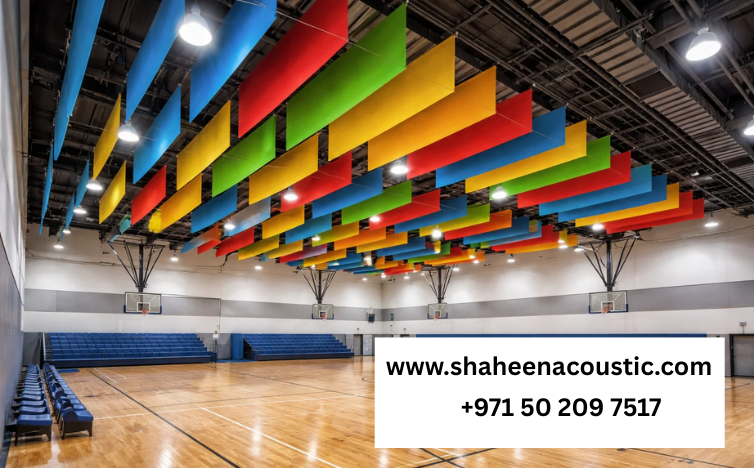
The first time I walked into a multi-purpose sports hall in Dubai Sports City without any acoustic treatment, I genuinely thought something was broken. The referee’s whistle didn’t just echo — it multiplied. Players were shouting at each other from three meters away. And the crowd? Forget it. The noise was a physical thing, bouncing off every hard surface until you couldn’t tell where sound ended and chaos began.
That’s the Dubai problem nobody puts in the brochure.
You build these stunning, warehouse-scale facilities with polished concrete floors, glass facades, and steel-frame ceilings — all materials that love to throw sound around. Then you add 200 basketball players, spectators, and a PA system, and suddenly you’ve got a reverberation time pushing 4 to 6 seconds. For context, a normal conversation works best in rooms with reverberation times under 0.8 seconds. So yes — these spaces are acoustic disasters by default.
Acoustic ceiling baffles are the fix. But choosing the wrong ones for Dubai’s specific conditions? That’s where most projects go sideways.
Why Dubai Sports Halls Are Acoustically Brutal (And It’s Not Just the Architecture)
Here’s the thing most acoustic consultants gloss over when they’re working in this region: Dubai’s climate creates a unique set of challenges that go beyond standard acoustic engineering.
I’ve noticed that humidity fluctuations inside large sports facilities here are extreme. You’re running aggressive air conditioning in summer to fight the 45°C heat outside, which means the indoor air is often very dry. Then maintenance opens the loading bay doors for equipment, and suddenly humid Gulf air rushes in. Materials that perform brilliantly in European or North American installations can warp, lose structural integrity, or even grow mold under these swing conditions.
Fiberglass baffles, for instance, are acoustically excellent — but some products aren’t sealed properly for high-humidity environments. I’ve seen installations in Al Ain and Sharjah where unprotected fiberglass panels had visible sagging within 18 months. Not ideal when the baffle is hanging 10 meters above a court.
The other issue? Dust. Dubai’s ambient dust levels are among the highest in the world. Open-face acoustic materials trap particulate over time, degrading both performance and hygiene. In a sports facility, where you need to meet health and safety standards, this matters enormously.
What Ceiling Baffles Actually Do (And What They Can’t)
Let’s be precise here because there’s a lot of confusion between acoustic products.
Ceiling baffles hang vertically from the structure, typically in rows. Unlike flat ceiling panels, they work on both faces simultaneously — which is why they’re so effective in tall-volume spaces like sports halls, swimming pools, and indoor arenas. A 2019 study published in the Journal of the Acoustical Society of America found that vertical baffle systems in high-volume spaces can reduce reverberation time by 40–60% compared to horizontal ceiling-only treatment, simply because of the increased exposed surface area.
What they can’t do is eliminate impact noise, control bass frequencies below 250Hz effectively, or compensate for a poorly designed room. Baffles are a mid-to-high frequency solution. If your facility has major low-frequency booming issues from a powerful sound system, you’ll need bass traps and wall treatment working alongside the ceiling baffles.
From what I’ve seen in Dubai’s newer facilities — particularly the ones built post-2018 with international architects on board — the trend is toward hybrid systems: perforated metal panels on the ceiling combined with hanging baffles in the spaces between structural beams. It’s more expensive upfront, but the acoustic result is dramatically better and the metal panels handle the Gulf environment without any of the material degradation issues.
The Material Conversation: What Actually Holds Up in the Gulf
This surprised me when I first learned it during a project consultation: polyester fiber baffles, not fiberglass, are increasingly the preferred choice for Dubai sports facilities.

Here’s why. Polyester fiber (PET) acoustic baffles are made from recycled material, fully washable, non-allergenic, and don’t support mold or bacterial growth the way some natural fibers do. They’re also Class A fire rated, which UAE Civil Defense requires for any large public assembly space. ASTM testing has confirmed that quality PET baffles maintain their NRC (Noise Reduction Coefficient) rating above 0.90 even after repeated humidity cycling — which is exactly the kind of punishment they’ll face in a Dubai sports hall.
The leading specifications I’ve consistently seen on Dubai sports projects call for baffles with:
- Minimum thickness of 50mm for adequate low-mid frequency absorption
- NRC rating of 0.85 or higher
- Class 1 fire resistance per BS 476 or equivalent UAE standard
- UV-stable facing material for facilities with natural light
For swimming pools specifically — and Dubai has some spectacular ones — you want marine-grade acoustic baffles with fully sealed edges. Standard baffles in an aquatic environment will delaminate within a year. The cost difference is maybe 20–25% more per unit, and it’s completely worth it.
The Numbers That Make the Case for Facility Owners
Look — sports facility managers in Dubai are often dealing with tight capex budgets and long ROI conversations. So let me put some real numbers on this.
A standard 2,000 sqm multi-purpose sports hall in Dubai typically requires between 600–900 sqm of acoustic baffle coverage, depending on ceiling height and target reverberation time. At current regional pricing, that translates to approximately AED 180,000–350,000 for a quality installation with proper Gulf-specification materials. That’s a meaningful number.
But here’s the counter-argument: According to research by the World Health Organization, prolonged exposure to noise above 85 dB causes measurable hearing fatigue and cognitive performance degradation. In a commercial sports context — where you’re running professional coaching sessions, competitive matches, and fitness classes — poor acoustics directly impact the quality and perception of your offering. Facilities with poor acoustics get worse reviews. Coaches report exhaustion from having to shout constantly. And this is actually measurable: a 2022 survey by the International Sports Facility Management Association found that acoustic quality ranked in the top 5 factors affecting member satisfaction and retention at premium sports clubs.
There’s also the event revenue angle. A facility that can host broadcast-quality events — with acoustic specs that meet sports TV production standards — commands dramatically higher rental rates. I’ve spoken to facility directors at venues in Business Bay who estimated acoustic upgrades directly enabled them to attract international event organizers, adding AED 500,000+ in annual event revenue.
The math isn’t difficult.
Practical Installation Notes for High Ceilings
One thing nobody tells you until you’re already mid-project: installation in a Dubai sports hall is a major logistical operation, not a simple contractor job.
Ceilings in these facilities are typically 8–15 meters high. That means scaffolding or elevated work platforms, coordination with structural engineers to confirm load ratings (hanging baffles add weight, and the cable or rigid suspension systems need to be properly anchored), and sequencing with other trades if you’re doing a new build.
For retrofits — which is actually most of what happens in Dubai, given how many facilities were built before acoustic design became a standard consideration — expect 5–8 working days for a typical hall installation, with the facility out of use for at least part of that period. Plan it during Ramadan or summer low-season if you can.
One more thing: baffle spacing matters as much as baffle quantity. A common mistake is overcrowding baffles, which reduces their effectiveness because the sound doesn’t have enough space to interact with all surfaces. Industry guidance suggests spacing baffles at 1.2 to 1.5 times their width for optimal performance — your acoustic consultant should model this before installation, not after.
Call us: Contact Shaheen Acoustic Soundproofing Expert in Dubai For Soundproofing: +971 50 209 7517
My Honest Take After Seeing Dozens of These Projects
Dubai is getting better at this. The facilities being designed now — whether it’s the newer padel complexes, the upgraded cricket academies, or the high-spec gymnastics centers going up for competitive use — are incorporating acoustic design from the concept stage. That’s a shift from five years ago when acoustics was almost an afterthought.
But there’s still a significant stock of older facilities operating with reverberation problems that make them genuinely unpleasant to use. If you’re managing one of those, acoustic ceiling baffles are one of the highest-impact, most cost-effective upgrades available to you. Not a full renovation. Not structural changes. Just thoughtful material selection, proper specification for the Gulf environment, and professional installation.
Start with an acoustic measurement from a qualified consultant — not just a product supplier’s estimate. Get your baseline reverberation time documented, set a target (typically 1.2–1.8 seconds for multi-sport halls), and work backward to the baffle specification you actually need.
The difference between a sports hall that people want to spend time in and one they want to leave as quickly as possible is often just what’s hanging from the ceiling.
If you’re currently designing or upgrading a sports facility in the UAE and haven’t had an acoustic consultant on the project yet, that’s the first call to make. Everything else follows from there.