
Introduction
Unwanted noise can affect comfort, privacy, concentration, and productivity in residential and commercial environments. In growing urban areas such as N’Djamena, Chad, buildings may need effective noise-control solutions for busy offices, apartments, hotels, healthcare facilities, recording rooms, and commercial premises.
Acoustic mass loaded vinyl (MLV) is a flexible, dense sound-barrier material designed to help reduce the transmission of airborne noise through building elements. Its relatively thin profile makes it useful in projects where adding substantial wall thickness is undesirable.
Whether the goal is improving privacy between adjoining rooms, reducing noise transfer around mechanical equipment, or upgrading a wall or ceiling assembly, MLV can form part of a carefully designed sound-insulation system.
This guide explains how acoustic mass loaded vinyl works, its practical applications in N’Djamena, how to select the appropriate specification, and why correct installation is essential for reliable results.
What Is Acoustic Mass Loaded Vinyl?
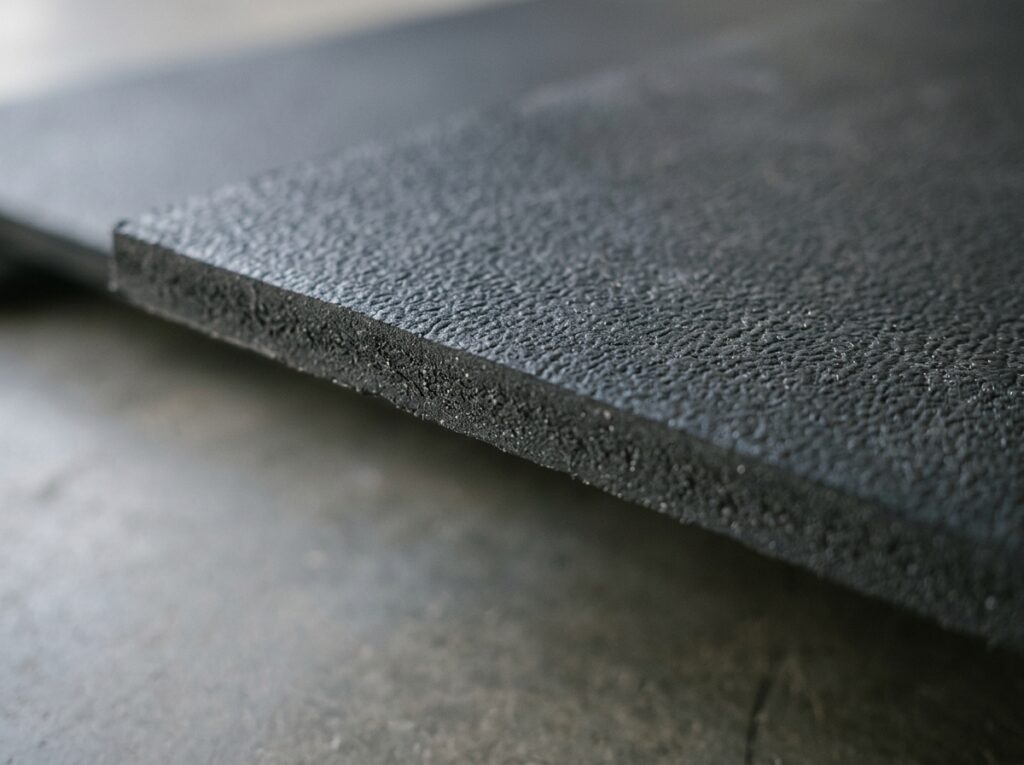
Mass loaded vinyl is a dense, flexible material formulated to provide a sound-transmission barrier. Unlike conventional sound-absorbing foam, which primarily reduces sound reflections inside a room, MLV is intended to limit the amount of sound passing through a partition or other assembly.
Its effectiveness comes partly from its surface mass. When correctly integrated into a suitable construction system, the material can make it more difficult for airborne sound energy to pass through the assembly.
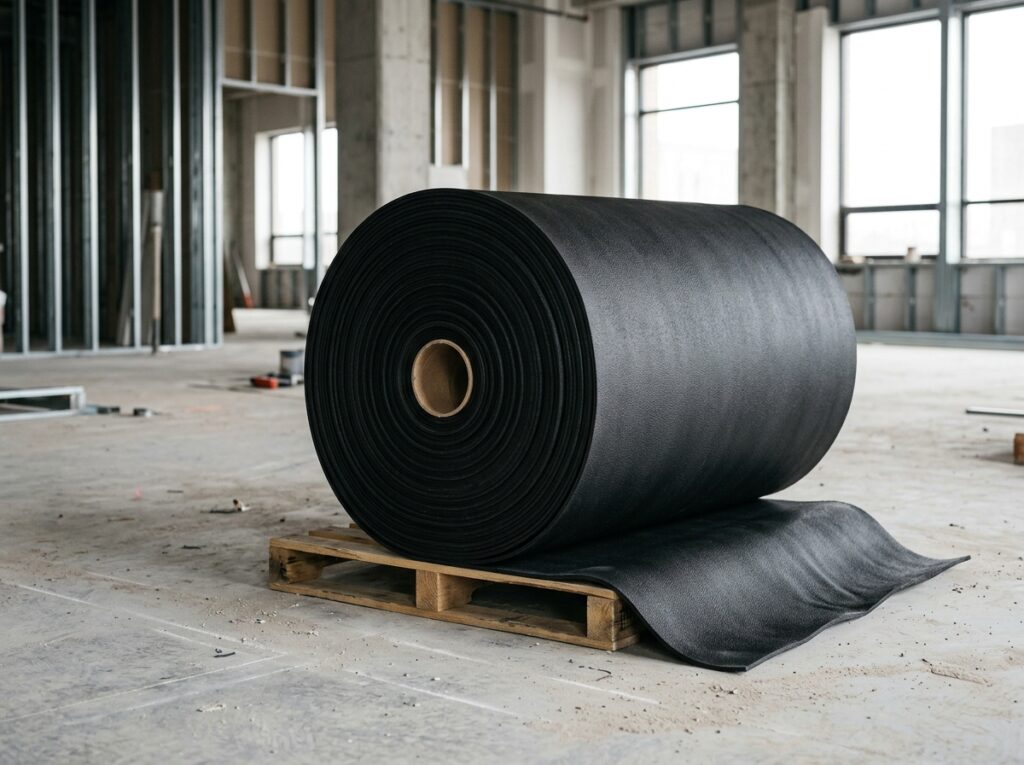
MLV is commonly supplied in rolls or sheets, with different thicknesses, weights, and reinforced or unreinforced options available depending on the manufacturer.
Typical applications include:
- Internal wall and partition systems
- Ceiling assemblies
- Selected floor constructions
- Machinery and equipment enclosures
- Ductwork and pipe-noise control systems
- Acoustic barriers around noisy service areas
- Sound-isolation upgrades in offices and residential buildings
The right product depends on the intended application, the surrounding construction, and the level of sound reduction required.
Why Consider Mass Loaded Vinyl for Projects in N’Djamena?
N’Djamena has a variety of residential, commercial, institutional, and industrial building requirements. Each type of space can face different acoustic challenges, from conversations passing through internal walls to equipment noise affecting nearby work areas.
Rather than relying on one material to solve every noise problem, a properly designed sound-insulation assembly considers the source of the noise, the transmission path, and the receiving space.
1. Improving Privacy Between Rooms
In apartments, offices, hotels, and other multi-room buildings, sound can travel through lightweight partitions or poorly sealed construction joints.
MLV can be incorporated into a suitable wall assembly to help reduce airborne sound transmission. It may be installed behind gypsum board or another approved finishing layer, depending on the system design.
This can be particularly useful for:
- Private offices and meeting rooms
- Hotel guest-room partitions
- Residential bedrooms
- Consultation rooms
- Staff rooms and administrative areas
However, the final result depends on the entire wall assembly, including the framing, insulation, board layers, seals, and any paths that allow sound to bypass the barrier.
2. Controlling Noise in Commercial Buildings
Commercial premises often need a balance between functional layouts and acceptable noise levels. Conversations, office equipment, and activities in adjacent rooms can interfere with meetings and focused work.
When included in an appropriate partition or enclosure, MLV can help reduce sound transmission between spaces.
Potential applications include:
- Open-plan offices with enclosed meeting rooms
- Reception areas and administrative offices
- Training rooms and conference facilities
- Retail premises with back-office areas
- Shared commercial buildings
For spaces that also suffer from echo, MLV alone is not enough. Sound-absorbing ceiling panels, acoustic wall treatments, carpets, or other appropriate absorbers may be required to improve the sound inside the room.
3. Reducing Mechanical Equipment Noise
Mechanical equipment can generate noise that travels through walls, ceilings, ducts, pipes, and surrounding structures.
MLV may be used as part of an engineered barrier or enclosure around certain equipment, subject to temperature, fire-safety, ventilation, and maintenance requirements.
Possible applications include:
- HVAC and ventilation equipment
- Pumps and utility equipment
- Generator enclosures
- Mechanical service rooms
- Ductwork and selected pipe systems
For these applications, the barrier must be designed for the actual operating environment. Equipment still needs sufficient ventilation and access for inspection and servicing. MLV should not be applied directly to hot surfaces or installed where it would compromise required cooling or safety clearances.
4. Supporting Home Theatre and Media Rooms
Home theatres, gaming rooms, and media spaces can generate sound that disturbs other occupants. MLV can contribute to a wall, ceiling, or floor sound-isolation system when incorporated into the correct assembly.
For effective results, designers may combine MLV with:
- Multiple layers of gypsum board
- Cavity insulation
- Resilient channels or isolation clips
- Properly sealed perimeters
- Suitable doors and acoustic seals
The design should account for low-frequency sound from subwoofers, which can be difficult to control and may require additional structural isolation.
How Does Mass Loaded Vinyl Reduce Sound Transmission?
MLV works primarily as a mass-based sound barrier. Its dense, flexible structure helps resist airborne sound transmission when it forms part of a continuous, properly installed assembly.
For example, if a partition allows speech to pass between two rooms, an acoustic specialist may assess whether adding a barrier layer, improving cavity insulation, sealing openings, or decoupling the wall surfaces would help address the problem.
MLV performance is influenced by several factors:
Surface weight: Heavier products can provide different transmission-loss characteristics from lighter versions.
Construction assembly: The framing, board layers, cavity depth, and insulation affect the overall performance.
Continuity: Gaps around joints, outlets, service penetrations, and edges can undermine the barrier.
Flanking transmission: Sound may travel through adjoining floors, ceilings, ducts, doors, and structural elements instead of directly through the treated wall.
Installation quality: Poorly supported material or unsealed joints can reduce the practical benefit of the system.
For these reasons, a product’s standalone Sound Transmission Class (STC) rating should not be treated as the rating of the completed wall or ceiling. The overall assembly must be evaluated separately. Manufacturer data provides examples of how MLV specifications and tested performance vary by product. (See Acoustical Surfaces’ MLV specifications.)
Common Applications of Acoustic MLV
The following table outlines where mass loaded vinyl may be considered as part of a broader sound-insulation strategy.
| Application | Potential purpose | Important consideration |
|---|---|---|
| Residential walls | Reduce airborne noise between rooms | Seal edges and service openings |
| Office partitions | Improve speech privacy | Assess doors and ceiling voids |
| Hotel rooms | Help limit noise transfer between spaces | Consider the complete partition and door system |
| Ceilings | Reduce transmission from spaces above | Check structural support and flanking paths |
| Machinery enclosures | Help contain airborne equipment noise | Account for heat, ventilation, and access |
| Ductwork | Reduce certain forms of transmitted equipment noise | Use a suitable product and installation method |
| Media rooms | Contribute to a sound-isolation assembly | Low-frequency noise may require additional measures |
These are potential applications rather than guarantees of a particular noise-reduction result. A suitable specification should be selected for each project.
Choosing the Right MLV Specification
Not all mass loaded vinyl products have the same weight, thickness, construction, or tested acoustic performance. Choosing a product based only on appearance or thickness can lead to an unsuitable installation.
Surface Weight and Thickness
Manufacturers commonly offer different surface weights. For example, some product ranges include approximately 0.5, 1, and 2 pounds per square foot, with thickness varying by formulation.
The following figures are illustrative examples from a published manufacturer specification, not universal performance guarantees.
| Example surface weight | Approximate thickness in one product range | Selection consideration |
|---|---|---|
| 0.5 lb/ft² | 1/16 inch | Lighter barrier option |
| 1 lb/ft² | 1/8 inch | Common intermediate option |
| 2 lb/ft² | 1/4 inch | Heavier barrier option |
Source: Acoustical Surfaces’ mass loaded vinyl product data.
A heavier material is not automatically the best choice for every project. The design should consider the target noise, available space, supporting structure, fire requirements, and the performance of the complete assembly.
Fire and Building Requirements
Before selecting MLV for a building in Chad, verify the relevant project specifications and applicable fire-safety requirements.
Check the manufacturer’s documentation for the exact product, including any applicable fire-test classification, installation limitations, and restrictions for concealed cavities or mechanical spaces. Do not assume that one product’s certification applies to every MLV product.
Durability and Installation Conditions
The material should be appropriate for the expected temperature, moisture exposure, and physical conditions. The installation must also provide adequate support for the weight of the sheet or roll.
For demanding environments, confirm that the selected material is compatible with the other construction components and that maintenance requirements can be met.
Installation Guidelines for Mass Loaded Vinyl
Correct installation is essential because sound can pass through gaps even when the main surface has an effective barrier layer.
A typical installation process includes the following stages.
Step 1: Assess the Existing Structure
Identify the main noise source and determine how sound is travelling. Inspect walls, ceilings, doors, windows, service penetrations, and adjoining construction.
This assessment helps establish whether MLV is appropriate or whether the project also requires structural decoupling, better doors, cavity insulation, or other measures.
Step 2: Prepare the Supporting Surface
Ensure the supporting structure is suitable for the material’s weight and the intended fixing method. Remove obstructions and plan how the barrier will be fitted around outlets, pipes, and other penetrations.
Step 3: Install the Barrier Correctly
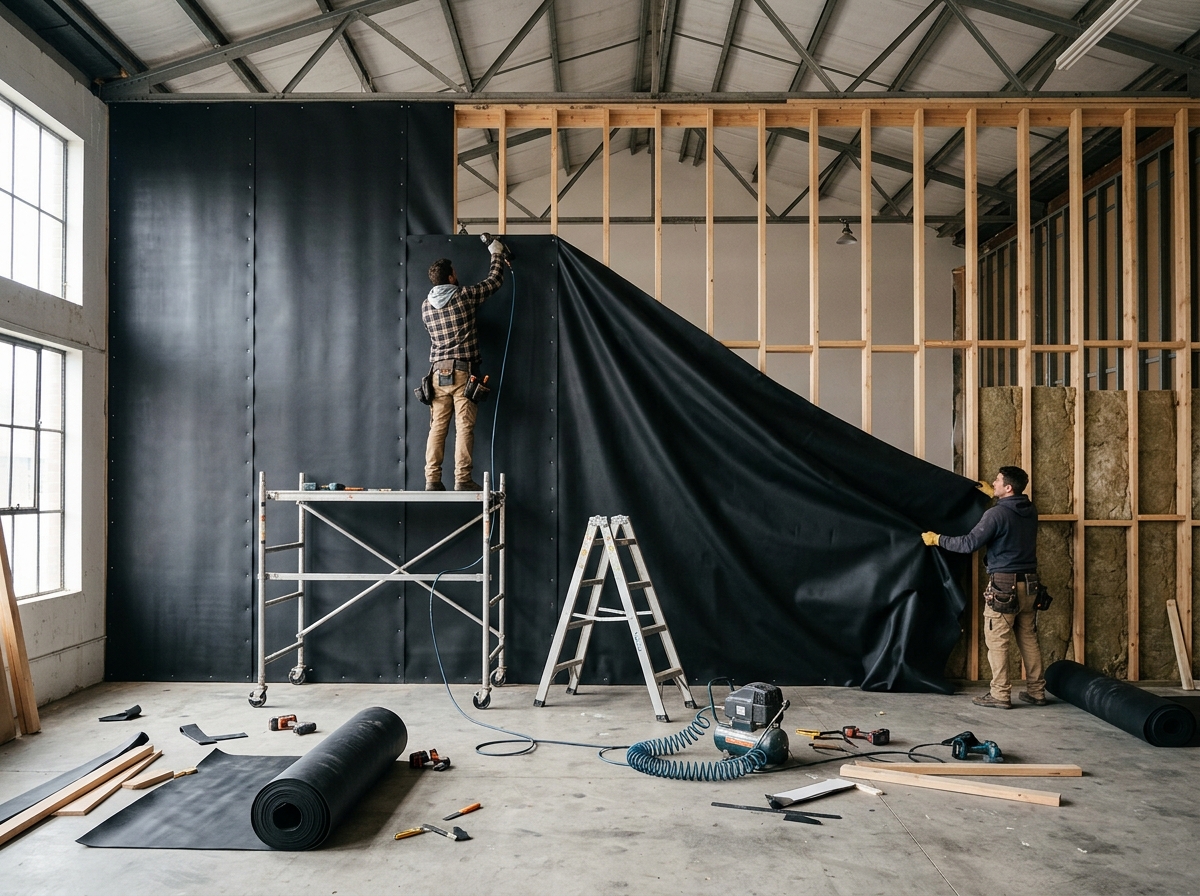
Follow the installation instructions for the selected product and assembly. Depending on the system, MLV may be fixed to framing, installed within a wall build-up, or used as part of a specially designed enclosure.
Use suitable fasteners and adequate support. Do not assume that a small number of fixings or unsupported sections will safely carry the material.
Step 4: Seal Seams and Perimeters
Treat seams, edges, and service penetrations according to the manufacturer’s instructions. Compatible acoustic sealant and seam tape may be required to maintain continuity.
A small opening can allow sound to bypass the barrier, so sealing should be treated as a core part of the installation rather than an optional finishing step.
Step 5: Complete the Finishing Layers
Where the system requires a covering layer, install the specified board or finish without damaging the MLV or leaving unintended gaps.
Check that the finished assembly meets structural, fire-safety, access, and maintenance requirements.
Step 6: Inspect the Completed Assembly
Before closing concealed cavities, inspect the barrier, fixings, seams, and penetrations. Where the project has defined acoustic targets, consider suitable testing or verification after completion.
For additional installation guidance, consult the Mass Loaded Vinyl Acoustic Barrier Installation Guide.
MLV Compared with Other Acoustic Materials
Different acoustic materials solve different problems. Understanding the distinction helps avoid spending money on a material that does not address the main source of noise.
| Material | Primary function | Typical role |
|---|---|---|
| Mass loaded vinyl | Sound transmission barrier | Helps reduce airborne noise through an assembly |
| Acoustic foam | Sound absorption | Reduces reflections within a room |
| PET acoustic panels | Sound absorption | Helps control echo and improve speech clarity |
| Mineral wool | Cavity absorption and insulation | Supports suitable wall, ceiling, and enclosure systems |
| Resilient channels or isolation clips | Vibration decoupling | Reduce direct mechanical connections between surfaces |
| Acoustic sealant | Air-gap sealing | Closes gaps around joints and penetrations |
These materials can work together, but they are not interchangeable. For example, adding foam to a wall may reduce room reflections without providing the same sound-isolation benefit as a properly designed barrier assembly.
Common Mistakes to Avoid
Expecting Complete Silence from MLV Alone
MLV can help reduce sound transmission, but it does not guarantee complete soundproofing. The result depends on the building structure and the routes through which sound travels.
Ignoring Doors and Windows
A treated wall may still perform poorly if sound passes through a lightweight door, an unsealed frame, or a window assembly. The weakest part of the room envelope can limit the overall result.
Leaving Gaps Around Services
Electrical boxes, pipes, ducts, and other openings need appropriate detailing. Unsealed penetrations can create paths around the barrier.
Using the Wrong Material for Echo Problems
If the main complaint is a room that sounds hollow or reverberant, sound-absorbing treatment may be more appropriate than MLV alone.
Overlooking Structural Noise
Footsteps, machinery vibration, and other structure-borne sounds may require resilient isolation or changes to the construction assembly. A mass barrier alone may not resolve these problems.
Selecting an Acoustic MLV Solution for Your Project in N’Djamena
The best starting point is a clear understanding of the noise problem. Consider the following questions before choosing a product or system:
- Is the noise coming from an adjoining room, outdoor activity, or mechanical equipment?
- Does it travel mainly through a wall, ceiling, floor, duct, or structural element?
- Is the priority speech privacy, equipment-noise control, or a quieter media room?
- How much space is available for additional construction layers?
- What fire, durability, and maintenance requirements apply?
- Is there a tested wall or ceiling assembly that meets the project’s performance target?
A specification based on these factors is more useful than selecting MLV by thickness alone. For larger commercial or industrial projects, acoustic assessment and coordination with the architect or building-services team can help identify the most effective solution.
Frequently Asked Questions
1. What is acoustic mass loaded vinyl used for?
Mass loaded vinyl is used as a flexible, dense barrier to help reduce airborne sound transmission. It may be incorporated into walls, ceilings, selected floor systems, equipment enclosures, ducts, and other sound-control assemblies.
2. Does mass loaded vinyl completely block noise?
No. Its performance depends on the product, the complete construction assembly, installation quality, and sound paths around the treated area. It should not be presented as a guarantee of complete silence.
3. Can MLV be installed inside an existing wall?
It may be possible during a renovation, but the appropriate method depends on the existing construction. A specialist should assess whether the wall needs to be opened, whether additional layers are required, and whether other sound paths need treatment.
4. Is MLV suitable for offices and hotels?
It can be considered for suitable partition and enclosure systems in offices, hotels, and other commercial buildings. The design should also account for doors, ceilings, ventilation systems, and other paths that may compromise privacy.
5. Is thicker MLV always better?
Not necessarily. Surface weight is an important factor, but overall performance depends on the complete assembly and its intended use. The appropriate specification should be selected using relevant manufacturer data and project requirements.
6. Can MLV reduce machinery noise?
It can help contain airborne noise when used in a suitable barrier or enclosure. Vibration, low-frequency noise, ventilation, and equipment temperature may require additional design measures.
7. Does MLV reduce echo inside a room?
MLV is primarily a sound-transmission barrier rather than a room sound absorber. Acoustic panels, ceiling absorbers, and other suitable treatments are generally more appropriate for reducing reverberation.
8. What is the most important part of MLV installation?
There is no single factor that determines success, but continuity and correct detailing are essential. Proper support, sealed seams, treated penetrations, and attention to flanking paths all contribute to the performance of the finished system.
Conclusion
Acoustic mass loaded vinyl can be a useful component of sound-insulation systems for residential, commercial, and industrial projects in N’Djamena, Chad. Its flexible, dense construction allows it to be integrated into suitable walls, ceilings, equipment enclosures, and other assemblies where reducing airborne sound transmission is a priority.
However, effective noise control requires more than choosing a heavy barrier. The correct surface weight, supporting structure, sealing details, and complementary acoustic measures must all be considered.
For a successful project, begin by identifying the main source and transmission path of the noise, then select an MLV specification and complete assembly suited to the building’s requirements. This approach supports more practical, reliable acoustic improvements while avoiding unrealistic expectations about what one material can achieve.