

The sound quality of an indoor space can influence communication, concentration, and the overall experience of people using the building. Offices with competing conversations, classrooms with excessive echo, restaurants with reflective surfaces, and meeting rooms with unclear speech can all benefit from appropriate acoustic treatment.
Acoustic PET panels in Khartoum, Sudan, provide a versatile option for managing sound reflections while maintaining a clean, contemporary interior design. Manufactured from polyester-based fibres, these panels are available in various thicknesses, colours, shapes, and formats to suit different architectural and commercial applications.
They can be used on selected walls and ceilings, incorporated into decorative features, or configured as acoustic screens and suspended elements, depending on the product.
For property owners, architects, contractors, and interior designers, understanding the material, acoustic performance, installation requirements, and available design options is essential when selecting PET acoustic panels for a project in Khartoum.
What Are Acoustic PET Panels?
PET acoustic panels are sound-absorbing products made from polyethylene terephthalate, a type of polyester. The material is processed into a fibrous structure that allows sound energy to interact with the fibres rather than simply reflecting from a hard surface.
Some manufacturers use recycled polyester, including fibres made from recycled plastic bottles. However, the proportion of recycled content varies by product and should be verified through the relevant technical documentation.
PET panels can be manufactured as flat wall panels, ceiling elements, decorative shapes, acoustic dividers, desk screens, and other interior components. Their lightweight construction and design flexibility make them useful for projects where acoustic performance and appearance both matter.
Unlike an ordinary decorative board, a purpose-designed PET acoustic panel is intended to absorb some of the sound energy reaching its surface. Its effectiveness depends on the material construction, thickness, mounting arrangement, and amount of coverage.
PET panels are generally used for reducing reverberation inside a room, not as a standalone method of blocking sound from neighbouring rooms or outdoor environments.
Why Consider Acoustic PET Panels in Khartoum?
Buildings can have very different acoustic requirements depending on their layout, occupancy, finishes, and intended use. A private office may need better speech clarity, while a large training room may require a more comprehensive approach to reverberation control.
Where hard walls, tiled floors, glass partitions, and reflective ceilings dominate, sound can bounce around a room and make conversations less comfortable.
PET acoustic panels can help address these reflections when selected and positioned appropriately.
1. Better speech intelligibility
In meeting rooms, classrooms, and workplaces, excessive reverberation can make spoken words harder to understand. Sound-absorbing panels reduce some reflected sound, helping improve the listening environment.
The result depends on the room’s dimensions, existing surfaces, occupancy, and treatment design.
2. Flexible interior design
PET panels are available in different colours and can often be cut into custom shapes. Designers can combine contrasting colours, create geometric patterns, or integrate panels into branded interiors.
Depending on the product, the panels can become functional design elements rather than being concealed behind other finishes.
3. Lightweight panel construction
Many PET acoustic panels are relatively lightweight, which can simplify handling and installation in suitable applications. However, all wall fixings, ceiling supports, and suspension systems must be appropriate for the selected product and installation conditions.
4. Options with recycled material
Some PET panels contain recycled polyester and may offer environmental documentation to support project requirements. Buyers should check the declared recycled-content percentage and whether the product has relevant environmental certifications or assessments.
Recycled content alone does not establish the complete environmental impact of a product.
5. Suitability for varied indoor environments
Depending on the manufacturer’s specifications, PET panels may be suitable for offices, educational facilities, hospitality interiors, meeting rooms, and selected residential spaces.
The correct product should be selected according to the intended use, cleaning requirements, fire-safety conditions, and mounting method.
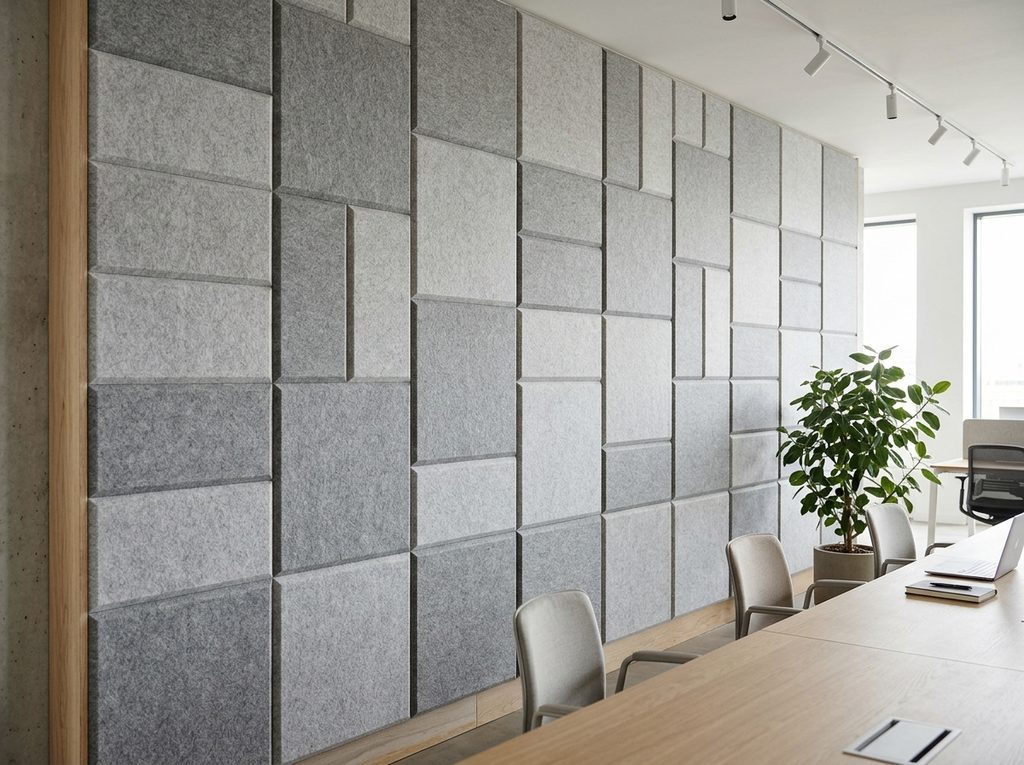
How Do PET Acoustic Panels Reduce Echo?
Sound travels through a room and reflects from surfaces such as plasterboard, concrete, glass, and tile. When several reflections overlap with direct sound, the room can become reverberant.
PET acoustic panels work by allowing some sound energy to interact with their fibrous structure. Movement within the material converts a portion of that acoustic energy into small amounts of heat, reducing the amount reflected back into the room.
The degree of absorption varies according to several factors:
- Panel thickness and material density.
- Fibre structure and manufacturing process.
- Sound frequency.
- Total area of acoustic treatment.
- Direct wall mounting versus installation with an air gap.
- Placement on walls, ceilings, or suspended systems.
For example, a thin decorative PET sheet mounted directly on a wall may perform differently from a thicker panel installed with a cavity behind it.
Manufacturer test data should therefore be reviewed alongside the proposed installation method. A published Noise Reduction Coefficient (NRC) is not a universal guarantee of performance in every room.
Applications of PET Acoustic Panels in Khartoum
Commercial offices
Offices often contain conversations, telephone calls, video meetings, and equipment noise. Reflective surfaces can make these sounds more distracting.
PET panels can be installed on selected walls, used as desk dividers, or incorporated into appropriate suspended systems. A complete acoustic plan may also consider ceiling absorption, workstation layout, partitions, and the location of noisy equipment.
Conference and meeting rooms
Clear communication is important in rooms used for negotiations, presentations, training, and online meetings.
PET panels may help control sound reflections, while microphone placement, loudspeaker position, room dimensions, and background noise also affect the final result.
Educational and training facilities
Classrooms and training centres benefit from environments where students can hear instructors clearly.
Acoustic PET panels can contribute to reverberation control. Product selection should also consider durability, cleaning, mounting security, and any fire-performance requirements applicable to the building.
Hotels, restaurants, and cafés
Hospitality spaces often combine decorative finishes with hard floors and large windows. During busy periods, overlapping conversations can make a room feel particularly noisy.
Strategically positioned PET panels may help reduce excessive reverberation while supporting the interior design. The amount of treatment needed depends on the room’s size, occupancy, furnishings, and existing surfaces.
Healthcare and professional facilities
Waiting areas, consultation rooms, administrative offices, and reception spaces may benefit from improved acoustic comfort.
For healthcare or hygiene-sensitive environments, confirm whether the selected panel is compatible with the cleaning products, maintenance procedures, and other requirements of the intended application. Not every decorative PET panel is suitable for every clinical setting.
Residential interiors
Home offices, study rooms, entertainment spaces, and living rooms may benefit from PET panels where hard surfaces contribute to echo.
For rooms affected by outdoor traffic, neighbouring properties, or sound travelling through shared walls, additional sound-isolation measures may be necessary.
Choosing the Right PET Panel Thickness
Thickness is an important factor in acoustic panel selection, but it should not be the only consideration.
A thicker panel can provide different absorption characteristics from a thinner panel, particularly when the mounting arrangement also changes. Density, fibre construction, air gaps, and the frequency of the sound all influence performance.
For a project in Khartoum, compare the available products using the following criteria.
Panel thickness and dimensions: Check the standard sheet sizes, thickness options, and dimensional tolerances. Confirm whether custom sizes are available.
Acoustic absorption data: Request tested absorption results and the relevant standard, such as ASTM C423 or ISO 354 where applicable. Verify the mounting configuration used during testing.
Material composition: Establish whether the panel contains recycled polyester, virgin polyester, or a combination of materials.
Fire-performance documentation: Obtain documentation for the exact product and confirm its suitability for the intended building application.
Finish and colour: Review physical samples where colour consistency and visual appearance are important.
Installation method: Confirm whether the product uses adhesive, mechanical fasteners, framing, or a suspension system.
Cleaning and maintenance: Check the manufacturer’s recommendations for removing dust, marks, and other surface contamination.
Comparing these details helps avoid choosing a panel solely because it looks attractive or has a low purchase price.
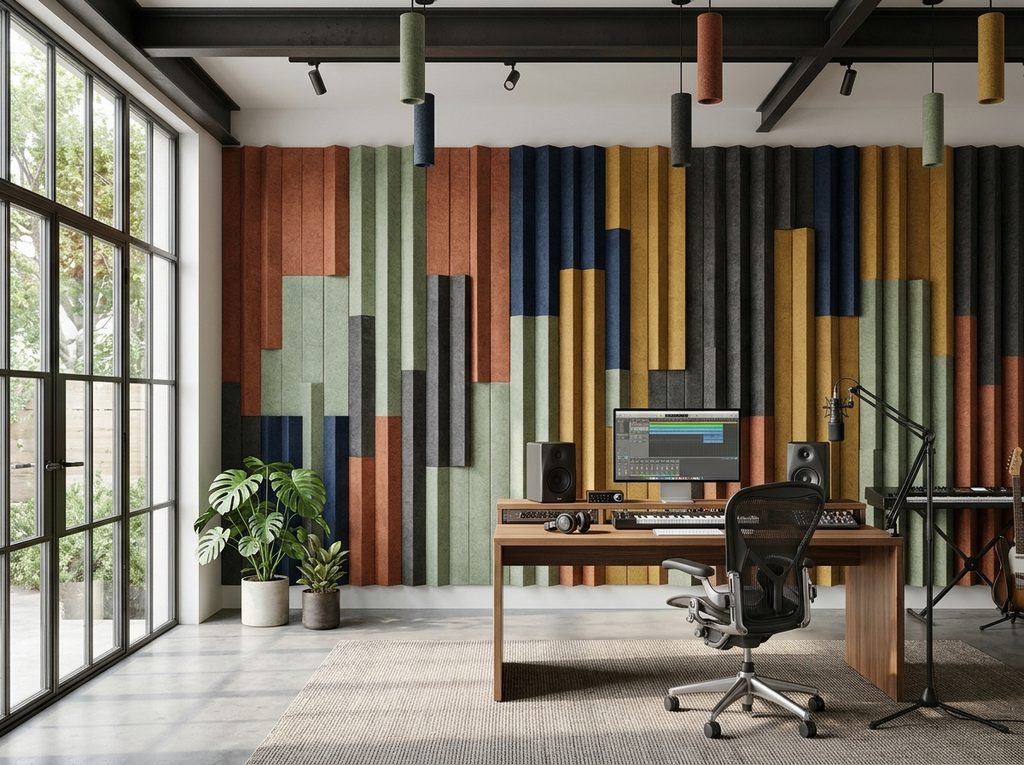
PET Acoustic Panels Versus Traditional Acoustic Foam
PET panels and acoustic foam can both be used to absorb sound, but their material construction, finish, physical properties, and available installation formats differ.
PET panels are often selected for decorative wall treatments, geometric designs, acoustic screens, and certain ceiling applications. Acoustic foam products may be appropriate for other applications depending on their design and documented performance.
The right choice should be based on acoustic test results, material suitability, durability, appearance, fire requirements, and the intended installation.
Neither material should be assumed to provide complete sound isolation simply because it absorbs sound.
PET Panels Versus Soundproofing Systems
Understanding the difference between sound absorption and soundproofing is essential when planning an acoustic project.
PET acoustic panels generally help manage sound reflections within the same room. They do not automatically stop noise from travelling through walls, doors, windows, ceilings, or floors.
If a room is affected by noise from outside the building or an adjacent space, the source and transmission path should be investigated.
Depending on the problem, improvements may involve sealing air gaps, upgrading doors or glazing, adding suitable wall construction, improving ceiling assemblies, or addressing flanking transmission.
For example, installing PET panels on an office wall may reduce echo inside the office, but it will not necessarily prevent conversations from being heard in the room next door.
In some projects, acoustic absorption and sound isolation are both required. They should be designed as separate but complementary parts of the overall solution.
Installation Planning for PET Panels in Khartoum
A successful installation begins with a clear understanding of the room and the desired acoustic result.
Assess the room
Measure the dimensions, ceiling height, and available wall or ceiling surfaces. Identify windows, doors, lighting, switches, ventilation openings, and other obstructions.
Consider the room’s main purpose and the sound problem that needs to be addressed. A conference room may need a different arrangement from a restaurant or residential study.
Prepare a panel layout
Plan the location, quantity, shape, and orientation of the panels before installation. A layout drawing helps reduce unnecessary cutting and ensures that the finished design works with the surrounding architecture.
For custom shapes or branded designs, check that the proposed cutting method is compatible with the selected PET material.
Check the substrate and fixings
Ensure that the wall or ceiling can support the intended installation. Use the manufacturer’s specified adhesive, mechanical fixings, framing, or suspension system.
Ceiling-mounted panels require particular attention to secure supports and suitable installation practices.
Inspect the finished installation
After installation, check panel alignment, attachment, edges, colour consistency, and any visible damage.
Follow the manufacturer’s instructions for cleaning and maintenance, especially where the panels are located in busy commercial environments.
How Much PET Panel Coverage Is Required?
There is no single coverage percentage that suits every project.
The required quantity depends on the room’s volume, intended use, existing finishes, occupancy, and desired acoustic performance. A small meeting room may need a different treatment plan from a large open office or hospitality space.
For straightforward applications, a supplier may help estimate the required quantity using product data and room dimensions. More demanding projects may benefit from an acoustic assessment that considers reverberation time, speech intelligibility, and the location of reflective surfaces.
A good design does not necessarily cover every wall. It provides sufficient absorption in appropriate locations to meet the project’s objectives.
What Influences the Cost of PET Acoustic Panels in Khartoum?
Pricing depends on the product specification and the complete supply-and-installation scope. It is best to compare quotations using matching requirements rather than relying on a generic price estimate.
Common cost factors include:
- Panel thickness, density, and material composition.
- Standard versus custom colours and shapes.
- Total panel quantity and surface coverage.
- Cutting, printing, and edge-finishing requirements.
- Wall mounting, framing, or suspended installation.
- Site preparation and installation labour.
- Delivery arrangements, import costs, and local availability.
- Special documentation or performance requirements.
Request an itemised quotation that clarifies whether material supply, fabrication, accessories, delivery, and installation are included.
For custom projects, provide drawings and dimensions so suppliers can estimate material usage and fabrication requirements more accurately.
How to Choose a PET Acoustic Panel Supplier
A reliable supplier should be able to explain the product’s construction, acoustic performance, installation requirements, and limitations.
Before placing an order, request:
- A technical data sheet for the exact product.
- Acoustic absorption test results.
- Fire-performance documentation where required.
- Material composition and recycled-content information.
- Available thicknesses, dimensions, and colours.
- Installation instructions and fixing recommendations.
- Sample pieces for finish and colour evaluation.
- Warranty terms, lead times, and delivery arrangements.
For projects in Khartoum, confirm the actual delivery location, availability of the selected specification, and whether replacement panels can be supplied in the future.
Do not rely on an NRC value, fire rating, or recycled-content claim taken from a different panel model. Product-specific evidence is more useful when comparing competing offers.
Frequently Asked Questions
What are acoustic PET panels made from?
PET panels are made from polyester-based fibres. Some products include recycled polyester, but the exact material composition and recycled-content percentage vary by manufacturer.
Do PET panels soundproof a room?
They are primarily designed to absorb sound and reduce reverberation within a room. They are not a substitute for a properly designed sound-isolation assembly.
Can PET acoustic panels be installed on ceilings?
Some products are designed for ceiling applications, including suspended systems and baffles. Always confirm the approved mounting method and support requirements for the selected panel.
Are PET panels suitable for offices and schools?
Many products are designed for commercial and educational interiors. Confirm acoustic test results, durability, fire documentation, and installation requirements before specifying them.
Can PET panels be cut into custom designs?
Many PET panels can be cut into geometric shapes and custom patterns, depending on the material and fabrication method. Confirm the manufacturer’s guidance for cutting and finishing.
Does a thicker PET panel always absorb more sound?
Not necessarily under every installation condition. Thickness, density, fibre structure, air gaps, and mounting method all influence the acoustic results.
How can I maintain PET acoustic panels?
Follow the manufacturer’s cleaning instructions. Test any cleaning method on a small, inconspicuous area where permitted, and avoid treatments that may damage the surface or affect the panel’s performance.
How do I choose PET acoustic panels in Khartoum?
Start by identifying the room’s acoustic requirements. Then compare panel specifications, absorption data, fire documentation, finishes, installation methods, supplier reliability, and delivery terms.
Conclusion
Acoustic PET panels offer a flexible way to manage sound reflections while supporting modern interior design. For offices, educational spaces, hospitality venues, meeting rooms, and selected residential interiors in Khartoum, Sudan, they can form a useful part of an acoustic improvement plan.
The best results depend on selecting a panel with appropriate tested performance, confirming its material and safety documentation, and installing it according to the manufacturer’s recommendations.
Where the main concern is noise travelling between rooms or entering from outside, additional sound-isolation measures may be required. By distinguishing absorption from soundproofing and comparing products carefully, buyers can make better-informed decisions for their acoustic projects.