
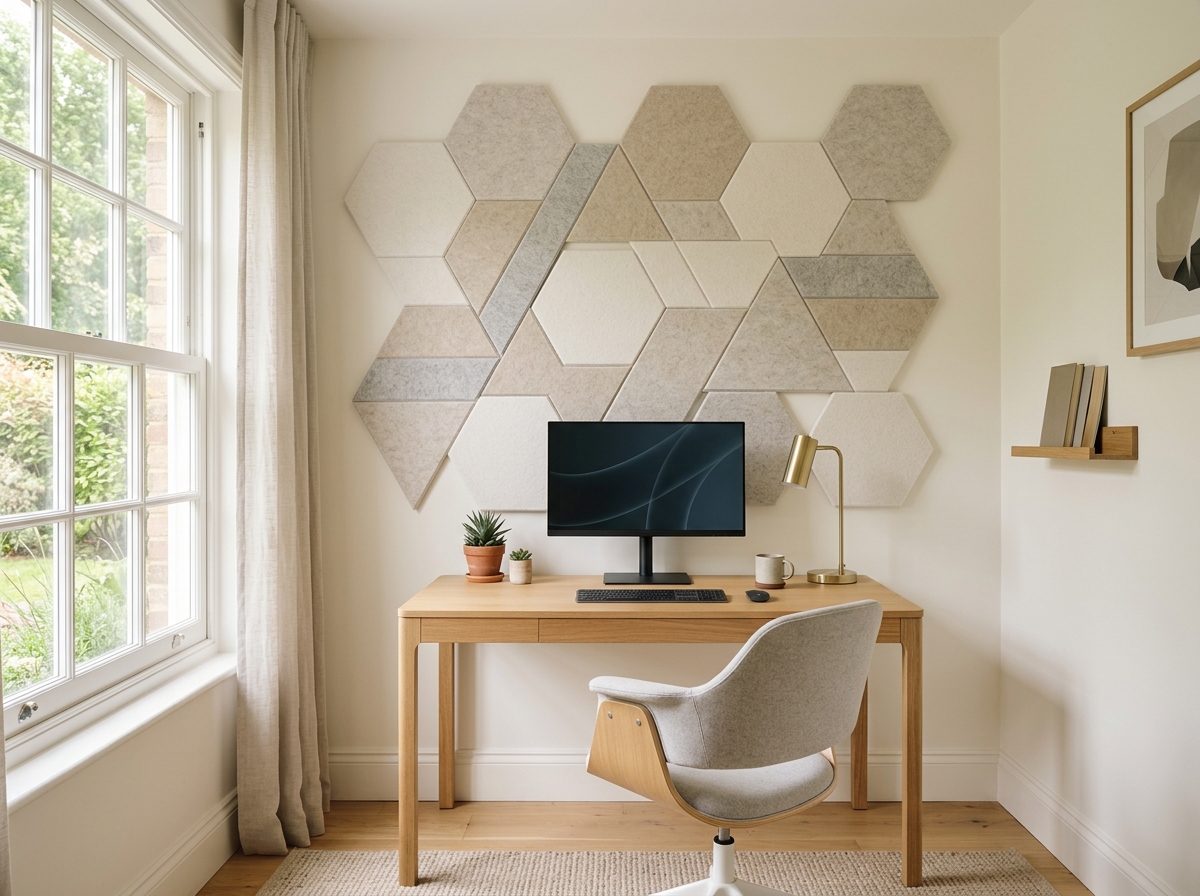
A modern interior can be visually impressive and still feel acoustically uncomfortable.
Large windows, polished floors, concrete surfaces, plastered walls, exposed ceilings, and contemporary furniture can give a space a clean architectural appearance. But when too many hard surfaces reflect sound at the same time, conversations can become difficult to follow and background noise can quickly build up.
For offices, restaurants, hotels, schools, studios, healthcare facilities, and residential interiors in Kigali, controlling these reflections is becoming an important part of creating comfortable spaces.
One solution is acoustic PET panels.
Made from polyester fibres, commonly incorporating recycled PET, these panels are designed primarily for sound absorption. Their fibrous structure helps dissipate sound energy instead of allowing all of it to return directly into the room. Depending on their construction, thickness, mounting method, and air gap, PET panels can provide substantial sound absorption.
But the most interesting thing about PET acoustic panels is not simply their ability to absorb sound.
It is their ability to become part of the architecture of the room.
Start With the Room, Not the Panel
One of the easiest mistakes in acoustic projects is choosing a panel before understanding the room.
A client may see a particular colour or shape and immediately decide that it should cover a wall.
But acoustic treatment works best when it responds to the way sound behaves in the actual space.
Before specifying PET panels, several questions should be considered:
- How large is the room?
- How high is the ceiling?
- How many people normally occupy it?
- Which surfaces are reflective?
- Where do conversations take place?
- Is the problem echo or sound transmission?
- Are there large areas of glass?
- Is the ceiling exposed?
- Does the room need wall treatment, ceiling treatment, or both?
The answer may lead to a completely different design from room to room.
A conference room might need concentrated wall treatment.
A large open office may benefit from ceiling baffles.
A restaurant could require distributed absorption throughout the dining area.
An auditorium may need extensive treatment across both walls and ceiling.
The material can remain the same while the acoustic strategy changes completely.
What Makes PET Different From Conventional Wall Finishes?
PET acoustic panels are manufactured from polyester fibres that are formed into relatively lightweight acoustic boards.
Their porous/fibrous structure allows sound energy to interact with the fibres, helping dissipate acoustic energy through friction rather than reflecting all of it back into the room.
This makes them fundamentally different from a conventional decorative wall finish.
A painted gypsum wall reflects much of the incident sound.
A stone surface reflects strongly.
Glass is highly reflective.
A PET acoustic panel is designed to do something different.
It provides an absorptive surface.
That difference is what allows PET panels to become useful in spaces where reverberation is affecting speech, concentration, or general comfort.
Kigali Offices: Creating Acoustic Zones Instead of Silent Offices
Open-plan offices are not supposed to be completely silent.
People need to communicate.
Teams need to collaborate.
Phones need to ring.
Meetings need to happen.
The problem occurs when every sound spreads across the entire workspace.
A conversation at one workstation may become background noise several metres away. A telephone call can become distracting. Multiple conversations can merge into a constant layer of noise.
PET panels can be used to create acoustic zones.
For example:
Individual Work Areas
Wall-mounted PET panels can provide absorption around concentrated work areas.
Collaboration Zones
Larger acoustic surfaces can help control sound where groups gather.
Meeting Areas
Suspended elements or wall panels can improve the acoustic environment around meeting tables.
Circulation Areas
Strategically placed treatment can prevent sound from travelling freely between zones.
The goal is not silence.
It is controlled sound distribution.
Turning an Acoustic Panel Into a Design Element
Acoustic products are sometimes treated as something that should be hidden.
PET panels offer another possibility.
They can become part of the visual identity of the interior.
Panels can be manufactured or cut into:
- Geometric patterns
- Curved forms
- Vertical strips
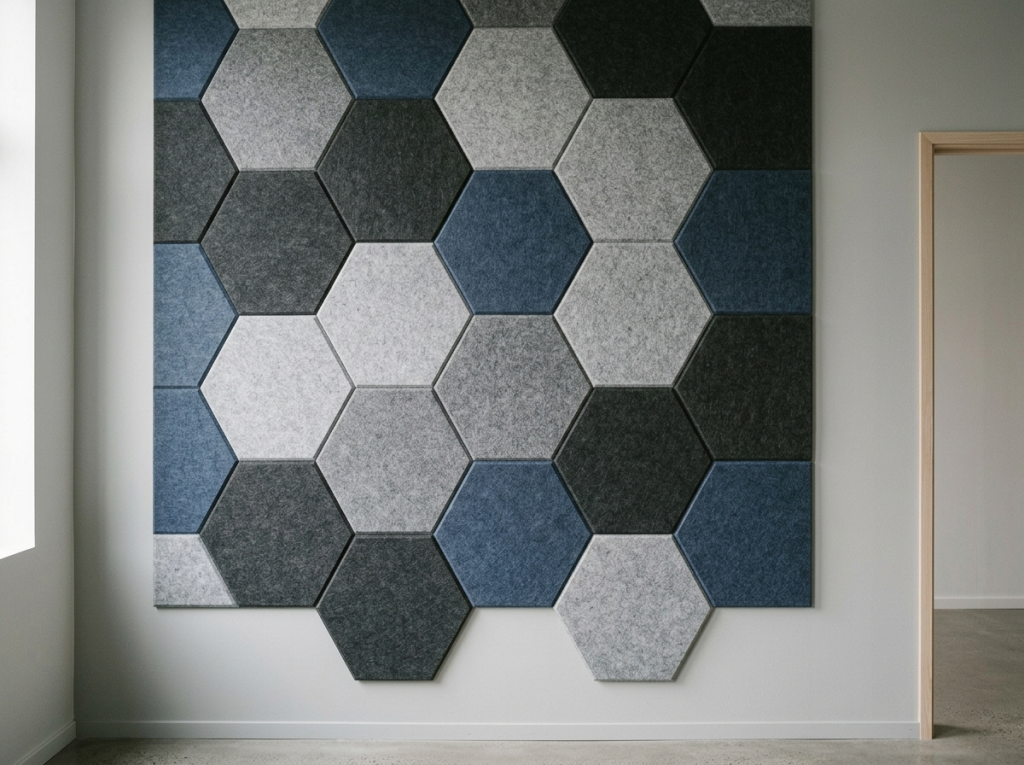
- Hexagonal arrangements
- Repeating shapes
- Large feature panels
- Custom CNC-cut designs
Some PET manufacturers specifically offer CNC cutting, grooving, embossing, printing, and custom fabrication, allowing acoustic surfaces to be integrated into architectural concepts.
This means an acoustic wall does not have to look like a collection of identical rectangles.
It can become artwork.
Reception Areas: The First Impression Should Not Be Noisy
A reception area has an unusual combination of requirements.
It needs to look impressive.
It needs to feel welcoming.
It needs to accommodate conversations.
And it often contains highly reflective architectural materials.
Glass reception desks, stone flooring, large windows, decorative ceilings, and open layouts can create an acoustically lively environment.
PET panels can be introduced as a feature wall behind the reception desk or as suspended elements overhead.
The acoustic treatment can also be shaped around the company’s branding.
For example, a geometric PET installation can incorporate the company’s colours while providing useful sound absorption.
This creates a feature that visitors notice for its design rather than simply recognizing it as an acoustic product.
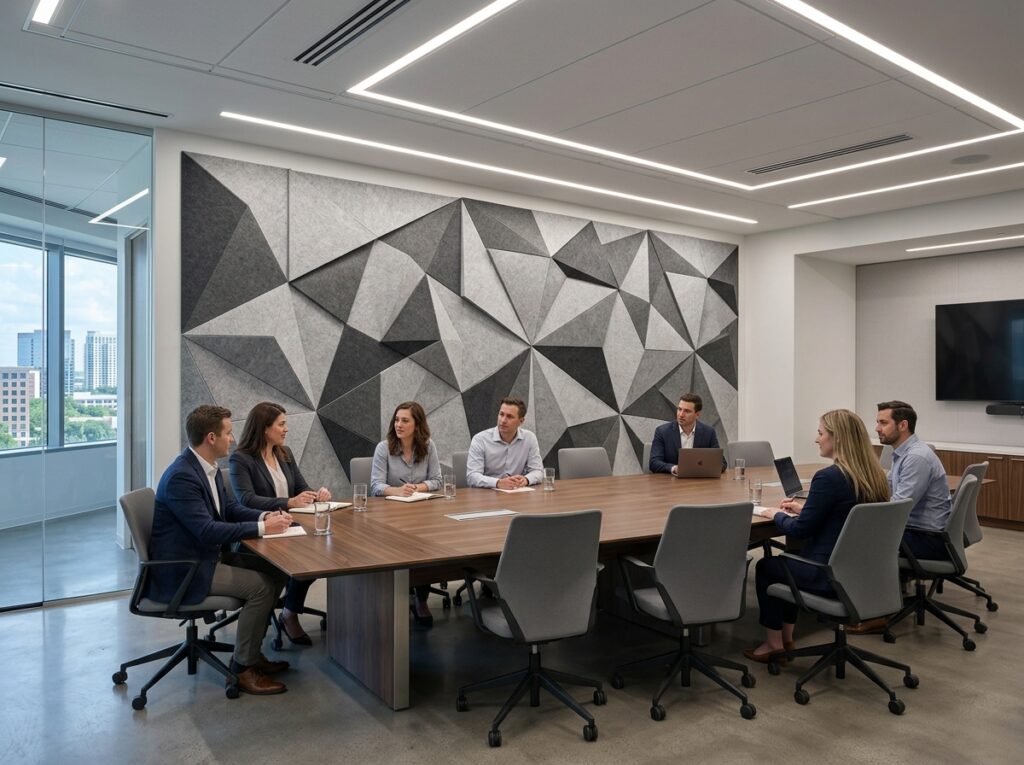
Boardrooms: When Every Word Matters
A boardroom is not a space where excessive reverberation is desirable.
Meetings depend on clear communication.
A typical contemporary boardroom may include:
- Glass partitions
- A large hard conference table
- Polished flooring
- Minimal furniture
- Large displays
- Hard ceiling surfaces
The result can be a highly reflective acoustic environment.
PET panels can be installed behind participants, on side walls, or overhead to introduce additional absorption.
The treatment can be distributed according to the room geometry rather than simply covering the largest available wall.
For video-conferencing rooms, controlling reflections can be particularly useful because microphones capture the acoustic environment as well as the speaker.
A visually sophisticated boardroom therefore needs to be acoustically sophisticated as well.
The Ceiling Can Do More Work Than You Think
Walls are not the only place for PET treatment.
In large spaces, the ceiling can provide an enormous opportunity for acoustic absorption.
Suspended PET baffles or clouds can hang within the room and interact with sound from multiple directions.
This can be particularly useful where:
- Walls are occupied by glazing
- Decorative walls cannot be covered
- The ceiling is very high
- The room is open-plan
- There is limited wall space
PET ceiling systems can also become architectural features rather than simply technical components. Manufacturers offer PET baffles in different forms, colours, and dimensions for offices, restaurants, halls, and other interior environments.
Restaurants: Reducing Noise Without Removing Energy
A restaurant should feel alive.
The sound of people talking is part of the atmosphere.
But there is a point where that atmosphere becomes uncomfortable.
As more customers arrive, the sound level can rise. Reflections from ceilings, floors, walls, and windows can cause conversations to become increasingly difficult.
Customers may respond by speaking louder.
Other customers do the same.
The overall noise level continues rising.
This is why acoustic absorption is important in restaurant design.
PET panels can be integrated into:
- Ceiling systems
- Decorative wall installations
- Booth dividers
- Dining-zone partitions
- Bar areas
- Private dining rooms
- Suspended acoustic features
The treatment does not need to make the restaurant quiet.
It needs to make conversation easier.
PET Panels as Space Dividers
One of the more interesting uses of PET is as an acoustic partition.
In an open office or hospitality environment, a divider can perform several functions simultaneously.
It can:
Separate spaces
while also
absorb sound
and
contribute to the interior design.
PET’s lightweight nature makes it suitable for a variety of architectural forms, including screens and suspended elements.
A divider between two workstations, for example, can provide a degree of visual separation while helping absorb sound around the occupants.
In a restaurant, decorative PET screens can visually divide tables without constructing permanent walls.
This makes acoustic treatment part of space planning.
Schools and Training Rooms
A classroom can be acoustically challenging even when it appears relatively simple.
Students need to understand speech.
Teachers need to communicate without constantly raising their voices.
And group activities generate additional background noise.
If the room has hard floors, painted walls, glass windows, and a reflective ceiling, sound can remain in the space for longer than desired.
PET wall panels and ceiling treatments can help introduce absorption.
The placement should be based on the room’s geometry and teaching arrangement.
For example, treatment around the rear and side walls may be useful where reflected speech is contributing to the acoustic problem.
The objective is not simply to make the room quieter.
It is to make speech easier to understand.
Hotels and Hospitality Interiors
Hotels require acoustic comfort in many different spaces.
The acoustic requirements of a lobby are different from those of a conference room.
A restaurant is different from a lounge.
An event hall is different from a corridor.
PET panels provide enough design flexibility to be adapted to these different environments.
Hotel Lobby
Use sculptural ceiling elements or feature walls to control reverberation while creating a strong visual impression.
Conference Facility
Use wall and ceiling absorption to support speech clarity.
Restaurant
Distribute absorption around dining areas to reduce accumulated background noise.
Lounge
Combine soft acoustic elements with furniture and decorative materials.
Event Space
Use larger ceiling systems where high room volume creates excessive reverberation.
The material can therefore remain consistent while the installation strategy changes according to the space.
When the Ceiling Is Too High
Large rooms often have a particular acoustic problem: volume.
The larger the room, the more opportunity there is for sound to travel and reflect before losing energy.
High ceilings can be particularly challenging in:
- Auditoriums
- Atriums
- Event spaces
- Worship spaces
- Large offices
- Restaurants
- Multipurpose halls
Suspended PET baffles can be useful in these situations because they introduce absorptive surfaces into the room rather than keeping all treatment around the perimeter.
They can also be arranged rhythmically to create a strong architectural ceiling.
For large-volume spaces, suspended PET acoustic systems are used specifically for reverberation control.
Custom Shapes for Modern Interiors
One of PET’s strongest design advantages is its ability to be cut and formed into different patterns.
A designer might create:
A Geometric Wall
Large triangular or polygonal sections arranged as an acoustic feature.
A Gradient Installation
Panels transitioning from one colour to another.
A Brand Pattern
The company’s logo or visual identity integrated into the acoustic wall.
A Sculptural Ceiling
Different panel shapes suspended at varying heights.
A Directional Pattern
Panels arranged to visually guide movement through a space.
The result is an acoustic installation that does not look generic.
Choosing Colours Strategically
Colour is not just a decorative decision.
It can help determine whether acoustic treatment becomes a subtle background element or a dominant feature.
Neutral PET Panels
Useful when the acoustic treatment should blend into the architecture.
Dark Colours
Can create strong contrast behind timber, metal, or light-coloured interiors.
Corporate Colours
Can reinforce a company’s branding.
Bright Colours
Can work well in educational, creative, and hospitality environments.
Gradient Combinations
Can turn a large acoustic wall into a visual focal point.
Because PET acoustic panels are available in broad colour ranges from various manufacturers, designers can use acoustic surfaces as part of the overall colour strategy rather than treating them as an afterthought.
PET Panels and Sustainability Considerations
Many PET acoustic products use recycled polyester derived from post-consumer PET.
However, sustainability should not be judged solely by the phrase “recycled PET.”
For a commercial project, it is sensible to examine the actual product documentation, recycled content, manufacturing process, fire classification, VOC information, and relevant environmental certifications.
Some manufacturers offer panels made from recycled PET and provide environmental or indoor-air-quality information as part of their product specifications.
This allows sustainability goals to be evaluated alongside acoustic and safety requirements.
PET Acoustic Panels Are Not Soundproofing Barriers
This distinction is extremely important.
PET panels primarily address sound absorption inside a room.
They can reduce:
- Reverberation
- Echo
- Reflected speech
- Acoustic buildup
But they do not automatically prevent sound from travelling through a wall into another room.
If the issue is:
“I can hear my neighbour through the wall.”
then PET panels on the room-side wall may not be the correct primary solution.
A sound-isolation system may instead require combinations of:
- Acoustic insulation
- Additional wall mass
- Decoupled construction
- Mass loaded vinyl
- Acoustic sealants
- Sound-rated doors
- Acoustic glazing
The first question should always be:
Is the problem inside the room or between rooms?
A Simple Way to Evaluate a PET Acoustic Project
Before installation, an acoustic assessment can divide the project into four questions.
1. What Is Creating the Noise?
People?
Equipment?
Music?
Traffic?
HVAC?
2. Where Is the Sound Being Reflected?
Walls?
Ceiling?
Glass?
Floor?
3. Where Can Absorption Be Added?
Wall panels?
Ceiling baffles?
Suspended clouds?
Partitions?
4. What Should the Finished Space Look Like?
Minimal?
Corporate?
Colourful?
Natural?
Sculptural?
The answers determine the final PET panel strategy.
Wall Panels vs Ceiling Baffles
| Solution | Particularly Useful For | Design Character |
|---|---|---|
| Flat wall panels | Offices, meeting rooms, classrooms | Clean and minimal |
| Decorative PET shapes | Reception areas, creative offices | Artistic |
| Suspended baffles | High ceilings, open spaces | Architectural |
| Acoustic clouds | Large offices, halls | Floating feature |
| PET partitions | Open offices, restaurants | Functional + decorative |
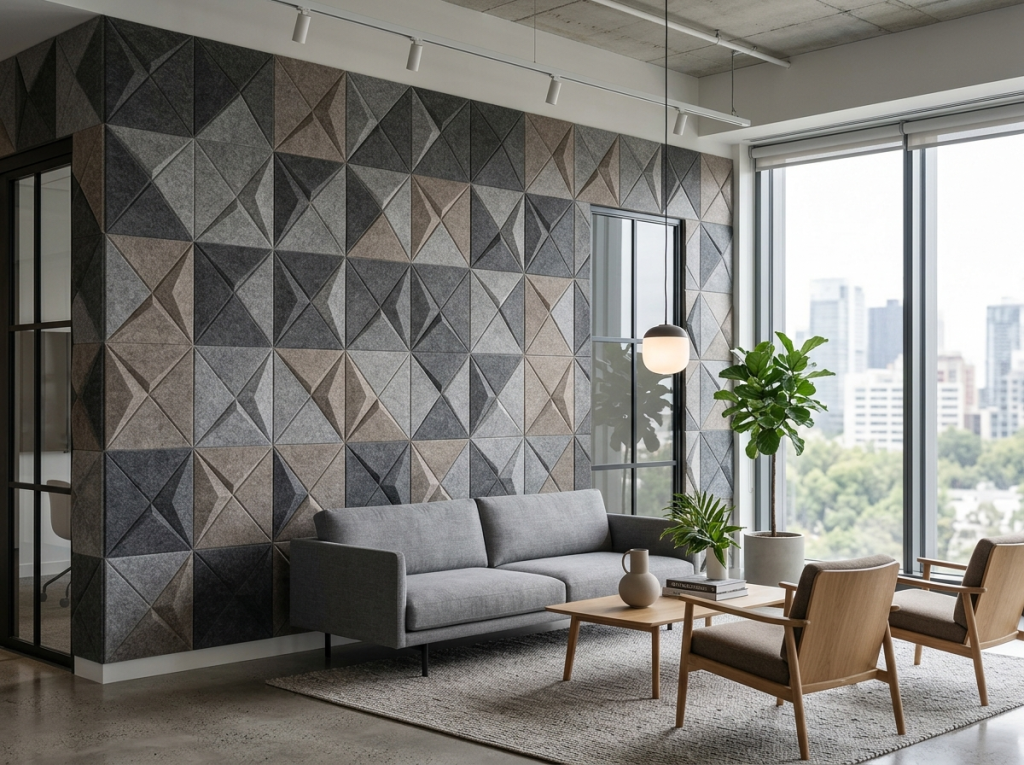
| 3D PET panels | Feature walls, hospitality | Sculptural |
| Custom CNC panels | Branded interiors | Highly customized |
The best option depends on the room rather than the popularity of a particular product style.
Installation Should Be Planned With the Interior
Acoustic panels should not be installed after every other contractor has finished without considering what is already in the room.
Before installation, the acoustic team should coordinate with:
- Interior designers
- Ceiling contractors
- Electrical teams
- HVAC contractors
- Joinery teams
- Lighting designers
This is particularly important for ceiling systems.
A suspended acoustic cloud needs to coexist with lights, sprinklers, ducts, diffusers, cameras, and other services.
Good acoustic installation therefore involves coordination as much as fixing panels to a surface.
Professional Acoustic PET Panel Services in Kigali
For projects in Kigali, PET panels can be incorporated into a complete acoustic treatment service rather than being treated as an isolated product purchase.
A professional acoustic service can include:
- Site assessment
- Acoustic consultation
- Room analysis
- Reverberation assessment
- Treatment planning
- Wall panel design
- Ceiling baffle design
- Custom PET shapes
- Colour selection
- Installation planning
- Final installation
The objective is to determine how much absorption the space actually requires and where it will provide the greatest benefit.
This prevents unnecessary coverage while ensuring that important reflective areas are not overlooked.
A Room Should Be Designed for the People Using It
The final test of an acoustic project is not how many panels were installed.
It is how the room feels when people use it.
Can employees concentrate?
Can colleagues communicate without shouting?
Can a restaurant customer comfortably talk across the table?
Can students clearly hear their teacher?
Can guests enjoy a hotel lobby without being overwhelmed by background noise?
Can a meeting happen without every voice bouncing around the room?
These are the outcomes that matter.
PET panels are simply one of the tools available to achieve them.
Frequently Asked Questions
What are acoustic PET panels?
They are sound-absorbing panels manufactured from polyester fibres, commonly including recycled PET content. Their fibrous structure helps dissipate sound energy and reduce reflections.
Do PET panels reduce echo?
Yes. They are designed primarily to absorb reflected sound and can help reduce reverberation and echo within a room.
Can PET panels be installed on ceilings?
Yes. PET products are available as suspended baffles, clouds, and other ceiling-mounted acoustic systems.
Are PET panels suitable for offices?
Yes. They can be used in open-plan offices, meeting rooms, boardrooms, reception areas, and collaboration spaces.
Can PET panels be used as room dividers?
Yes. Their lightweight construction and design flexibility make PET suitable for acoustic screens and partitions.
Do PET panels soundproof a room?
No. They primarily absorb sound within the room. They should not be confused with sound-isolation systems designed to prevent sound transmission through walls, floors, ceilings, doors, or windows.
Can PET panels be customized?
Many manufacturers offer CNC cutting, custom shapes, patterns, colours, and other fabrication options.
Are PET panels suitable for restaurants?
Yes. They can be incorporated into walls, ceilings, suspended features, and partitions to help control reverberation and improve conversational comfort.
From Acoustic Material to Architectural Strategy
The most effective acoustic interiors are rarely created by simply placing panels on empty walls.
They are planned around the people, the architecture, and the way sound behaves inside the space.
Acoustic PET panels provide considerable flexibility because they can be used as conventional wall treatments, sculptural features, suspended ceilings, acoustic dividers, or custom architectural elements.
For offices, hotels, restaurants, schools, studios, healthcare environments, and residential interiors in Kigali, Rwanda, they can provide a practical way to introduce sound absorption without sacrificing contemporary design.
The important thing is to specify the right system for the actual acoustic problem.
Because a quieter room isn’t necessarily the goal. A more comfortable room is.