
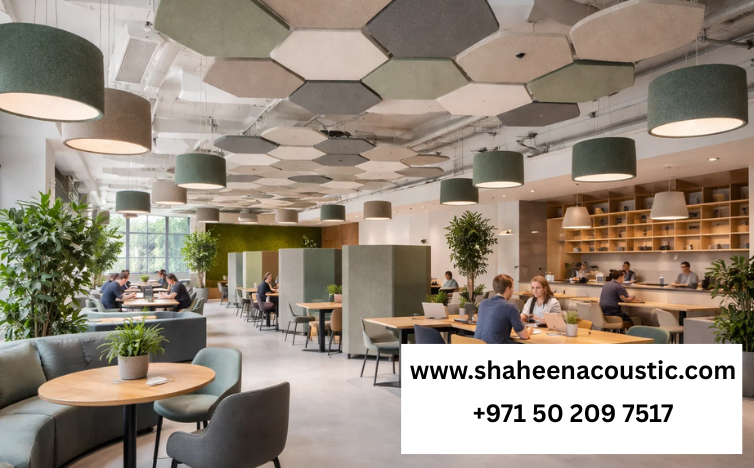
Co-working spaces sell a promise. Flexible, professional, productive. A place where freelancers, startups, and remote workers can show up, plug in, and do serious work. The marketing is always some variation of the same imagery — calm, focused people at clean desks, natural light, plants, good coffee.
The acoustic reality of most Dubai co-working spaces is considerably less serene. Twenty people in an open-plan room, half of them on phone calls simultaneously, the other half trying to concentrate through it. A phone booth that someone is using as a full video conference room with the door slightly open. A hot desk section where the ambient noise level peaks at 75 decibels during the 10 AM rush. The plants are real. The quiet is not.
This matters commercially as well as practically. Dubai’s co-working market has matured rapidly — there are now over 200 registered co-working facilities across the emirate, ranging from budget hot-desk operations in Business Bay to premium managed workspace environments in DIFC and Downtown. In a crowded market where members have genuine choice, the acoustic quality of a space has become a tangible differentiator. Members leave co-working spaces for one reason more consistently than any other: they can’t concentrate.
What Noise Actually Does to the People Paying for Your Space
This isn’t abstract. The research on noise and cognitive performance in shared work environments is consistent enough to have practical implications for any co-working operator thinking seriously about member retention.
A 2021 study published in the Journal of Applied Psychology found that open-plan noise reduces performance on complex cognitive tasks — writing, analysis, coding, strategic thinking — by 66% compared to quiet environments. Not 10%. Not 20%. Two thirds of cognitive capacity, measurably gone, purely from uncontrolled ambient noise. For members whose entire reason for choosing a co-working space over working from home is professional productivity, a space that delivers this acoustic environment is not delivering on its core promise.

The listening fatigue dimension compounds this. Sustained exposure to unpredictable noise keeps the auditory cortex in a low-level alert state even when the person has habituated to the sound. Members who work in acoustically poor co-working spaces consistently report feeling more exhausted at the end of the day than they do after equivalent work in quieter environments. They don’t always connect the fatigue to the noise. But the fatigue drives churn — people seek out quieter alternatives without necessarily articulating why.
The Dubai Co-Working Space Typology Problem
Dubai’s co-working spaces occupy a wide range of building types, and the acoustic challenges vary significantly by location. Understanding what your specific space is dealing with determines which treatments actually address the problem.
The Business Bay and Downtown co-working spaces in commercial towers face the glass curtain wall problem — facades that are thermally performant but acoustically weak, letting in the sustained traffic noise from Sheikh Zayed Road and the urban construction activity that has defined these districts for years. Treatment here needs to address both the external infiltration and the internal reverberation simultaneously. Acoustic window treatment combined with wall and ceiling absorption creates the layered defence that neither approach alone provides.
The villa-conversion co-working spaces in Jumeirah, Al Quoz, and the creative districts face a different character of problem. Residential buildings converted to commercial use have domestic-scale room acoustics that don’t suit the density of occupancy co-working imposes. Rooms designed for one or two people being used by eight to twelve create reverberation and noise buildup that the original construction never anticipated. Wall panels and ceiling treatment are the primary interventions — and in villa conversions, the aesthetic of the treatment matters enormously because these spaces often sell partly on their character.
Industrial and warehouse co-working spaces — the category that Al Quoz and the design district particularly support — have high ceilings, hard floors, exposed structural elements, and reverberation times that can exceed 2 seconds. Beautiful to look at. Acoustically brutal. Ceiling baffles are the non-negotiable treatment in these spaces — they’re the only practical way to address the volume without structural changes to the ceiling height that defines the space’s appeal.
Call us: Contact Shaheen Acoustic Soundproofing Expert in Dubai For Soundproofing: +971 50 209 7517
The Phone Call Problem That Every Co-Working Operator Knows
Ask any co-working space manager in Dubai what their most frequent member complaint is and the answer comes back the same way every time: “People on calls.”
It’s a genuinely difficult social dynamic. The person making the call needs to be somewhere. The people near them need to concentrate. Phone booths and acoustic pods exist to resolve this, but most co-working spaces have far fewer booths than the demand for them requires — because booths are expensive and take up floor area that could be billed as desk space. The result is that calls happen in the open plan, volume goes up, everyone around gets disrupted, and the ambient noise floor of the entire space rises.
Acoustic pods are the direct infrastructure solution — self-contained, fully treated enclosures that provide isolation for calls and focused work without permanent construction. A single-person pod placed in the right position in a co-working floor plan absorbs a significant proportion of the call traffic that would otherwise happen in open areas. For co-working operators, the calculation is straightforward: the cost of two or three acoustic pods recovers through reduced member churn within a few months, and the pods become a premium amenity that justifies higher membership pricing rather than a cost centre.