
Introduction
Creating a comfortable indoor environment requires more than attractive furniture, modern lighting, and carefully selected finishes. The way sound travels through a room can significantly influence how people communicate, concentrate, learn, and work. In busy commercial environments, classrooms, conference facilities, and public buildings, excessive echo can make everyday activities unnecessarily difficult.
For architects, contractors, interior designers, and property developers in Nairobi, Kenya, acoustic wood wool panels offer a practical way to improve room acoustics while maintaining a distinctive architectural appearance.
These panels combine wood fibres with a mineral-based binder to create a rigid, textured surface that absorbs sound. Their natural-looking finish makes them suitable for projects where conventional acoustic materials may not complement the desired interior design.
However, choosing the right panel involves more than comparing colours or prices. Thickness, fibre structure, backing materials, mounting arrangements, fire classification, and installation conditions all influence the final result.
This guide explains how acoustic wood wool panels work, where they can be used in Nairobi, how their technical performance should be evaluated, and what buyers should consider before selecting a product for a commercial or residential project.
What Are Acoustic Wood Wool Panels?
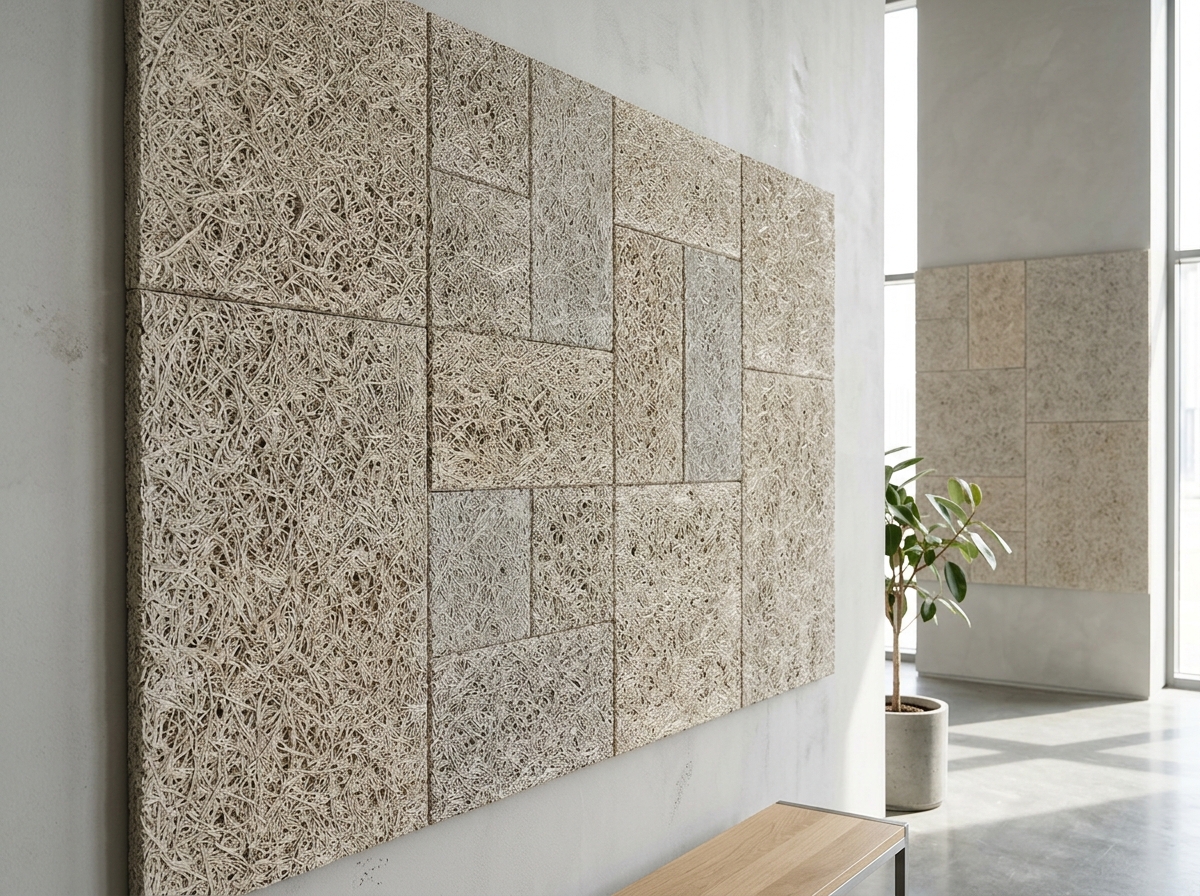
Acoustic wood wool panels are rigid boards manufactured using elongated wood fibres bonded together with a suitable mineral binder, commonly cement or magnesite-based material.
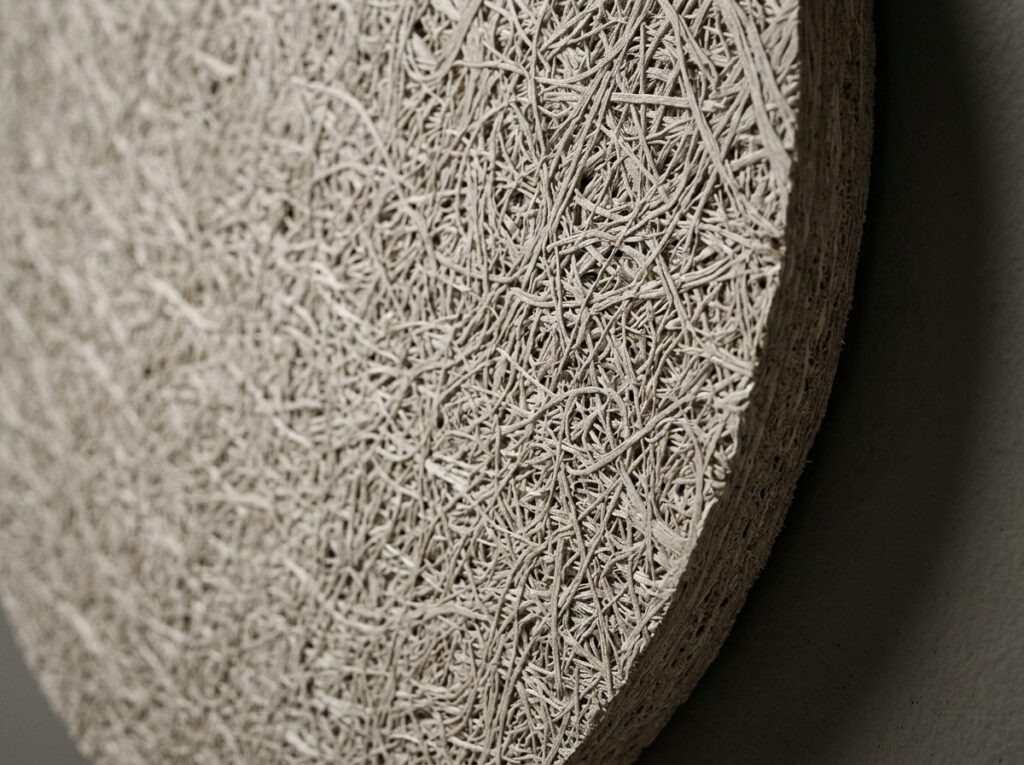
The resulting surface has a distinctive open, fibrous texture. Unlike a smooth decorative board, this structure allows sound to interact with the panel surface and enter its porous network.
When sound waves enter an absorptive material, some of their acoustic energy is dissipated through friction and related mechanisms within the material. This reduces the amount of sound reflected back into the room.
Wood wool panels can therefore help control reverberation, making spaces feel less echoing and improving speech clarity when the correct product and installation arrangement are selected.
Common product features include:
- A textured surface with a natural wood-fibre appearance.
- Rigid construction suitable for wall and ceiling applications.
- Different thicknesses and panel dimensions.
- Natural, painted, or other manufacturer-specific finishes.
- Compatibility with selected direct-fixing and suspended mounting systems.
- Potential integration with additional acoustic insulation behind the panels.
The exact composition, available finishes, and technical properties vary between manufacturers. Buyers should review the documentation for the particular product rather than assume that all wood wool panels perform identically.
Why Consider Wood Wool Acoustic Panels in Nairobi?
Nairobi has a wide range of building types, including corporate offices, educational facilities, hospitality venues, retail spaces, residential developments, and multipurpose halls. Each environment presents different acoustic and design requirements.
In many large rooms, sound reflects from hard surfaces such as concrete, plaster, glass, and tiled floors. These reflections can build up, making conversations harder to understand and increasing the perception of noise.
Wood wool panels can help address this problem by treating selected wall and ceiling surfaces.
1. Better Speech Intelligibility
Speech clarity is important in meeting rooms, classrooms, training centres, reception areas, and conference facilities.
When sound reflections persist for too long, spoken words can overlap acoustically. This makes it more difficult for listeners to distinguish individual words, particularly when several people are speaking.
Strategically positioned wood wool panels can absorb a portion of the reflected sound and help reduce reverberation.
For example, a training room in Nairobi may benefit from acoustic treatment on its ceiling and selected wall areas, especially where hard surfaces dominate the interior.
The appropriate coverage depends on room dimensions, existing finishes, occupancy, and the desired reverberation time.
2. A Distinctive Architectural Finish
Acoustic treatment does not have to look like a purely technical installation.
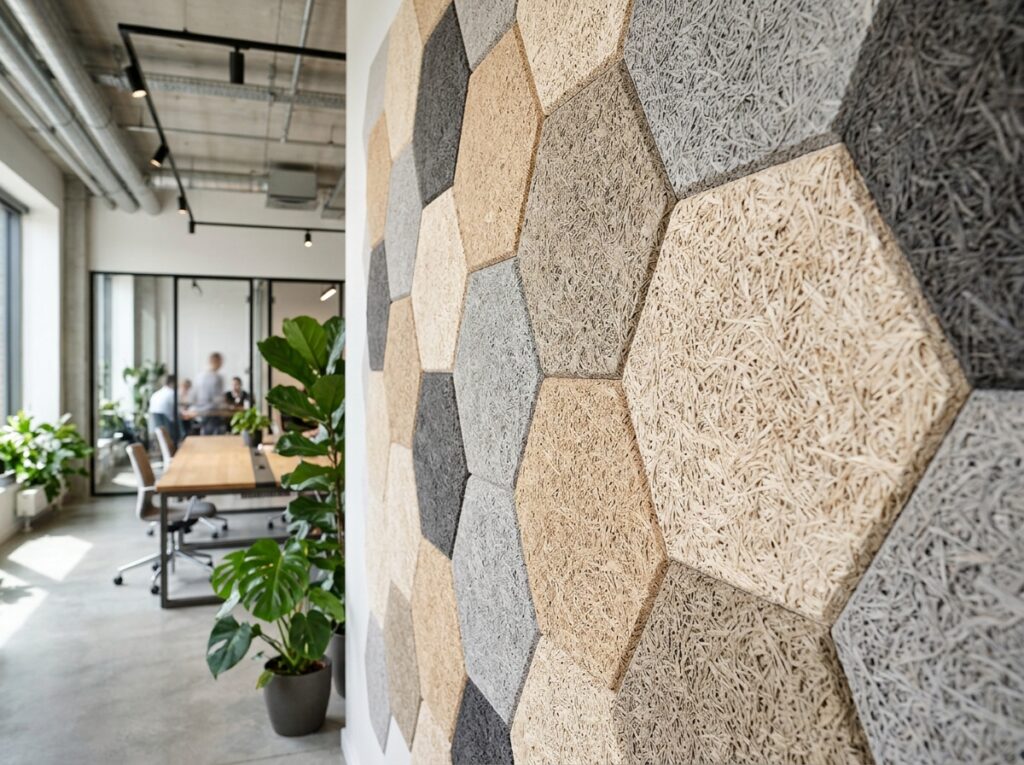
Wood wool panels have a visible fibre texture that can complement contemporary, industrial, minimalist, and natural-material interior schemes.
They can be used as full ceiling treatments, selected wall features, or coordinated panels that form part of a larger interior design.
Colour options and edge profiles depend on the manufacturer. Some products are supplied in their natural appearance, while others are available with painted finishes.
This combination of acoustic functionality and surface texture can be useful when designers want to improve sound quality without covering every surface with a fabric-wrapped product.
3. Suitable Options for Large Commercial Spaces
Large interiors often contain extensive reflective surfaces and considerable open volume. These conditions can create persistent reverberation, especially when the space is occupied by many people.
Wood wool panels may be appropriate for selected areas in:
- Corporate offices and meeting rooms.
- Schools, colleges, and lecture halls.
- Hotels, restaurants, and hospitality venues.
- Conference centres and auditoriums.
- Community halls and multipurpose facilities.
- Retail interiors and commercial reception areas.
The final specification should reflect the room’s purpose. A classroom, for instance, may require different acoustic treatment from a restaurant or a sports hall.
4. Durable Panel Construction
Many wood wool products use a mineral binder that gives the board its rigid structure.
This can make them suitable for projects where a soft, delicate finish is not desirable. Nevertheless, durability varies with composition, density, thickness, edge treatment, and mounting.
The panels should be assessed for their intended environment, particularly where they may experience physical contact, cleaning, humidity, or accidental impact.
A product designed for an indoor office ceiling should not automatically be assumed suitable for every exposed or exterior application.
5. Potential Thermal Benefits
Some wood wool panel products also provide a degree of thermal resistance because of their composition and construction.
However, thermal performance is separate from acoustic performance. The thermal conductivity or resistance of the specific panel should be checked if it forms part of a building’s thermal design.
Wood wool panels should not be treated as a substitute for a complete thermal insulation system unless the product and overall assembly have been specified for that purpose.
How Do Wood Wool Panels Absorb Sound?
The acoustic behaviour of wood wool panels depends on the interaction between their open surface structure and the way sound reaches the material.
When sound waves strike a wall or ceiling, some energy is reflected. A suitable absorptive surface allows sound to interact with its fibrous structure, dissipating part of that energy rather than reflecting all of it back into the room.
The resulting improvement depends on several variables.
Fibre structure: Fibre dimensions and the openness of the panel surface influence how sound interacts with the material.
Panel thickness: Thickness can affect absorption across different frequency ranges.
Mounting method: A panel fixed directly to a solid surface may perform differently from one installed with a cavity behind it.
Acoustic backing: Mineral wool or another suitable absorptive backing can change the performance of the complete installation.
Frequency range: A panel may absorb sound more effectively at some frequencies than others.
These factors explain why a product’s appearance alone cannot establish its acoustic effectiveness.
For projects that require a specific reverberation time or sound absorption target, the selection should be based on measured product data and, where appropriate, an acoustic assessment of the room.
Understanding NRC and Acoustic Performance
The Noise Reduction Coefficient, or NRC, is a commonly used indicator of a material’s sound absorption performance. It summarises absorption measurements at selected mid-frequency bands into a single rating.
A higher NRC generally indicates greater average absorption across those frequencies. However, it does not mean that a material blocks the same percentage of all sound or provides complete soundproofing.
Manufacturer test results demonstrate why the installation method matters. For example, Acoustical Surfaces publishes different NRC values for its Envirocoustic wood wool products depending on panel thickness, airspace, and the use of acoustic backing. Its published figures include values ranging from approximately 0.45 for one directly mounted configuration to higher values for configurations using additional backing. These results apply to the tested product and assembly, not to all wood wool panels. Source: Acoustical Surfaces — Envirocoustic panel specifications.
Before purchasing panels for a Nairobi project, request the relevant acoustic test report and confirm:
- The measured absorption rating.
- The test standard used.
- The panel thickness and composition.
- Whether an air gap or backing material was included.
- Whether the documented result applies to the proposed installation.
For demanding projects, octave-band or one-third-octave-band absorption data can provide more useful information than a single summary rating.
Acoustic Wood Wool Panels vs Other Acoustic Materials
Wood wool is one of several options available for managing indoor reverberation. The most suitable material depends on the design brief, performance target, budget, and installation environment.
| Material | Main characteristics | Typical considerations |
|---|---|---|
| Wood wool acoustic panels | Rigid, textured, wood-fibre surface | Suitable where a robust architectural finish and sound absorption are desired |
| PET acoustic panels | Lightweight polyester-fibre absorbers | Available in varied shapes, colours, and thicknesses |
| Fabric-wrapped panels | Soft decorative finish over an absorptive core | Useful when a smooth, upholstered appearance is preferred |
| Acoustic wood slatted panels | Decorative slats with an absorptive backing | Combine linear wood detailing with acoustic treatment |
| Acoustic foam | Lightweight porous material | Product performance, fire properties, and surface durability need careful evaluation |
These products are not interchangeable in every application. Wood wool may be preferred for its rigid texture, while PET or fabric-wrapped panels may suit a different aesthetic or installation requirement.
A comparison should use documented performance under comparable mounting conditions rather than relying on general claims about which material is best.
Selecting the Right Wood Wool Panel for Your Project
The best product is one that meets the project’s acoustic, architectural, and practical requirements together.
Choose the Appropriate Thickness
Wood wool panels are available in different thicknesses, depending on the manufacturer and product range.
Thicker panels may provide different absorption characteristics from thinner panels, but thickness alone does not determine performance. The backing and mounting configuration also matter.
Start with the room’s acoustic objectives, then compare the test data for available products.
Evaluate the Surface Finish
The surface will influence the appearance of the completed space.
Natural wood-fibre finishes can complement neutral interiors, while coloured products may be more appropriate for branded commercial spaces, schools, or hospitality environments.
Ask for physical samples when colour, texture, or the visual consistency of a large installation is important.
Check Panel Dimensions and Layout
Common panel formats may include square or rectangular boards, although sizes vary between manufacturers.
Consider the dimensions of the installation area, ceiling grid, lighting positions, ventilation outlets, and access panels.
Planning the layout before ordering helps reduce unnecessary cutting and ensures that the finished arrangement looks intentional.
Confirm Fire Classification
Fire performance is especially important in public buildings, educational facilities, hospitality venues, and commercial developments.
Do not assume that every wood wool panel has the same fire classification simply because it contains a mineral binder.
Request a valid classification report for the exact product and finish. Confirm whether the classification applies to the panel alone or to a particular installed assembly, and check the project’s applicable building and fire-safety requirements.
Consider the Installation Environment
Nairobi projects can differ considerably in indoor humidity, ventilation, exposure, and maintenance conditions.
Check the manufacturer’s guidance for moisture exposure, cleaning, storage, and installation. If panels will be used in a high-humidity or semi-exposed environment, obtain explicit confirmation that the selected product is suitable.
Where Can Wood Wool Panels Be Installed?
Offices and Meeting Rooms
In corporate interiors, panels can be installed on ceilings or selected walls to reduce reflected sound. This may improve communication during meetings and make shared workspaces more comfortable.
Treatment should be planned around room size, occupancy, and the position of speaking areas.
Schools and Lecture Halls
Classrooms require intelligible speech so that students can follow instructions and lessons.
Wood wool panels may be used as part of an acoustic strategy for classrooms, libraries, training rooms, and lecture spaces. The required coverage should reflect the room’s volume and its existing surfaces.
Restaurants and Hotels
Restaurants often combine hard floors, glass, furniture, and large open dining areas. Conversations from neighbouring tables can become difficult to distinguish when reverberation is excessive.
Ceiling-mounted or wall-mounted absorptive panels may help control reflected sound while contributing to the interior design.
The finish and cleaning requirements should be considered carefully in food-service and hospitality environments.
Auditoriums and Multipurpose Halls
Large halls can produce long reverberation times, especially when sound reflects from extensive walls and ceilings.
Wood wool panels may form part of the treatment strategy, but the acoustic design should account for the room’s volume, intended use, seating, sound system, and speech or music requirements.
A space designed primarily for spoken presentations may require a different treatment strategy from one intended for amplified music.
Residential Interiors
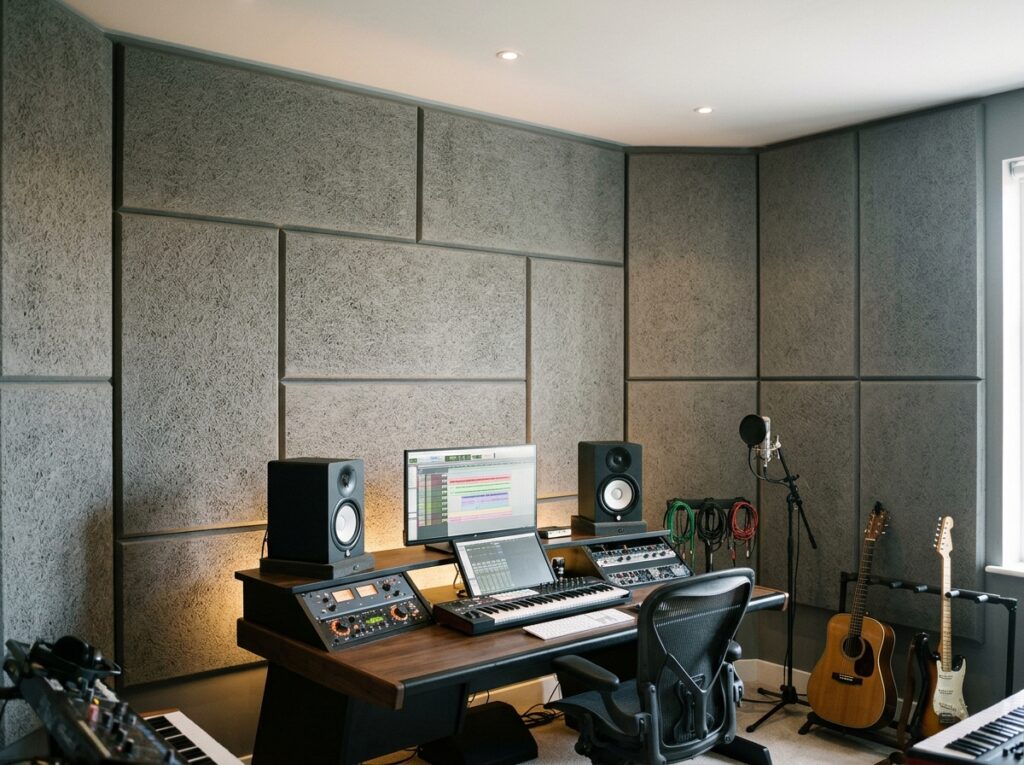
In houses and apartments, wood wool panels can be used in home offices, media rooms, hobby spaces, and other rooms where reflected sound affects comfort.
They are most useful when echo and room acoustics are the main concerns. They should not be expected to block traffic noise or prevent sound from passing between neighbouring rooms without additional sound-isolation measures.
Installation Methods and Their Impact on Performance
Installation is a critical part of achieving the intended acoustic result.
Direct Fixing
Panels may be fixed directly to a suitable wall or ceiling substrate using an approved adhesive or mechanical fixings, depending on the product.
This method can provide a relatively simple finish with minimal loss of room space.
However, directly mounted panels may perform differently from panels installed with a cavity or absorptive backing. Follow the manufacturer’s specified fixing method and substrate requirements.
Installation With an Air Gap
Mounting panels away from a solid surface creates an air cavity behind them.
An air gap can change the panel’s absorption characteristics, particularly across some lower and mid-frequency ranges. The improvement depends on the panel, cavity depth, and overall configuration.
The cavity should be designed according to tested data or suitable acoustic calculations rather than assuming that any gap will deliver the same benefit.
Installation With Acoustic Backing
Some installations combine wood wool panels with mineral wool or another suitable absorber behind the visible surface.
This arrangement can improve the absorption of the complete system, depending on the materials and mounting details.
The added backing must be compatible with the intended application, fire requirements, available space, and the manufacturer’s installation guidance.
Suspended Ceiling Systems
Where the selected panel is designed for a compatible suspended ceiling grid, the installation may provide a consistent appearance and convenient access to services above the ceiling.
Confirm panel dimensions, support requirements, access needs, and compatibility with lighting and mechanical systems before specifying the layout.
Common Purchasing and Installation Mistakes
Avoiding a few common mistakes can make the project more predictable.
Assuming acoustic absorption means soundproofing: Wood wool panels primarily help control reflections within a room. They do not automatically prevent sound transmission through walls or ceilings.
Choosing based only on price: Low initial cost may not account for the backing, fixings, finishing, or performance required for the application.
Ignoring tested mounting conditions: A published rating may depend on an air gap or backing that is absent from the proposed installation.
Overlooking fire documentation: Obtain the correct test and classification documents for the selected product.
Failing to coordinate other building services: Lighting, ventilation, sprinklers, access panels, and ceiling supports should be coordinated before installation.
Installing without checking the substrate: The supporting surface and fixing system must be suitable for the panel’s weight and the installation environment.
Ordering without confirming quantities: Account for the installation layout, cutting requirements, replacement panels, and any manufacturer-specific minimum order quantities.
Frequently Asked Questions
1. Are wood wool acoustic panels suitable for commercial buildings in Nairobi?
They can be suitable for offices, schools, hospitality venues, meeting rooms, and other commercial interiors where sound absorption and a textured architectural finish are required. The selected product must meet the project’s performance, fire-safety, and installation requirements.
2. Do wood wool panels completely soundproof a room?
No. Their primary purpose is to absorb reflected sound and reduce reverberation. Blocking sound transmission generally requires a properly designed construction using appropriate mass, airtightness, structural separation where necessary, and attention to flanking paths.
3. What affects the acoustic performance of wood wool panels?
Panel thickness, fibre structure, backing materials, air gaps, mounting arrangements, and frequency range all influence performance. Product-specific test data should guide selection.
4. Can wood wool panels be installed on walls and ceilings?
Many products are designed for both wall and ceiling applications. The manufacturer’s guidance should be checked for fixing methods, support requirements, panel weight, and the suitability of the substrate.
5. Are all wood wool panels fire-rated?
No. Fire classification depends on the particular product, its composition, finish, and sometimes the tested assembly. Buyers should request the relevant documentation rather than rely on general claims.
6. Can wood wool panels improve the acoustics of a classroom?
They can help reduce reverberation and improve speech clarity when correctly specified and positioned. The necessary coverage depends on the room dimensions, existing finishes, occupancy, and acoustic objectives.
7. How should wood wool acoustic panels be maintained?
Maintenance depends on the product finish and installation. Follow the manufacturer’s cleaning instructions, use suitable methods for the surface, and inspect the panels and fixings periodically for damage or deterioration.
8. What should I provide when requesting a quotation?
Provide the project location, room dimensions, intended application, approximate coverage, preferred finish, and any available acoustic or fire-performance requirements. Drawings and photographs can help clarify the installation area.
Conclusion: Choose Wood Wool Acoustic Panels for Better Room Acoustics
Acoustic wood wool panels provide a useful combination of sound absorption, rigid construction, and distinctive surface texture for projects in Nairobi, Kenya.
They can be considered for commercial offices, educational facilities, restaurants, hotels, public halls, and residential interiors where excessive reflected sound affects comfort or communication.
The key to a successful installation is selecting a product that matches the room’s acoustic requirements and confirming that its documented performance applies to the intended mounting arrangement. Thickness, backing, fire classification, finish, and installation quality should all form part of the decision.
For architects, contractors, designers, and property owners, evaluating these factors early can help prevent specification errors and create a more comfortable finished space.
Planning an acoustic improvement project in Nairobi? Compare wood wool panel specifications, review available test documentation, and select a suitable configuration for the intended room. A well-planned acoustic treatment can contribute to clearer communication, more comfortable interiors, and a visually consistent architectural finish.