
Modern buildings in Doha, Qatar are designed around comfort, functionality, and increasingly sophisticated interior environments. Apartments, villas, offices, hotels, restaurants, studios, medical facilities, and commercial buildings all have one acoustic challenge in common: unwanted sound can travel through walls, ceilings, floors, ducts, partitions, and mechanical spaces.
A beautifully finished room can still feel uncomfortable when conversations travel through a partition, television noise reaches a bedroom, equipment vibration enters an office, or sound moves between adjacent commercial spaces.
This is where Mass Loaded Vinyl (MLV) can become an important part of a properly designed sound isolation system.
MLV is a dense, flexible acoustic barrier designed primarily to reduce airborne sound transmission. Unlike decorative acoustic panels that mainly control reflections inside a room, MLV is installed as part of a building assembly to help reduce the amount of sound passing from one space to another.
For projects in Doha, understanding where MLV works, how it should be installed, and what other acoustic measures it needs to work alongside is essential for achieving practical soundproofing results.
What Is Mass Loaded Vinyl?
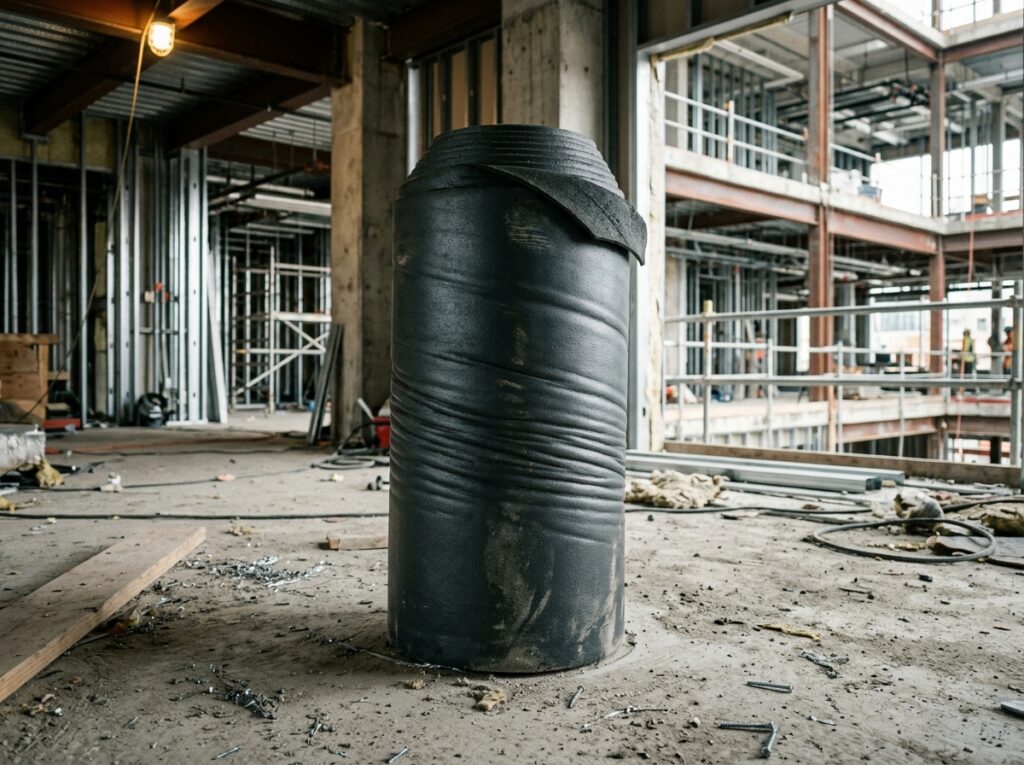
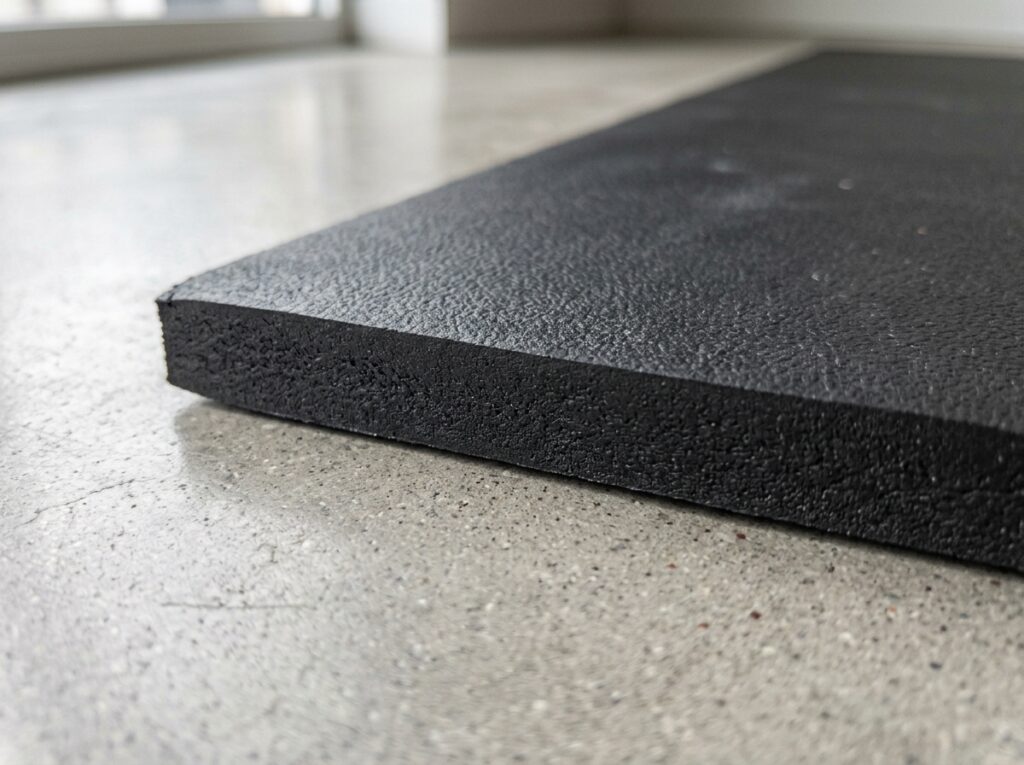
Mass Loaded Vinyl is a flexible, high-density sheet material used as a sound barrier.
Its basic principle is straightforward: adding mass to a building assembly can make it more difficult for airborne sound energy to pass through. Because MLV is also flexible rather than rigid like conventional boards, it can provide substantial mass without requiring the same thickness as many traditional construction materials.
Commercial MLV products are available in different thicknesses and surface weights. For example, one commercially documented product is available at approximately 0.5, 1 and 2 pounds per square foot depending on thickness. Its published transmission-loss data also varies with the weight of the barrier.
This makes MLV particularly useful when a project needs additional acoustic mass but has limited space within the wall, ceiling, or enclosure.
MLV is a sound barrier, not an acoustic decoration
This distinction is important.
MLV should not be confused with:
- PET acoustic panels
- Fabric-wrapped acoustic panels
- Wood slatted acoustic panels
- Wood wool panels
- Acoustic foam
- Decorative wall treatments
Those materials are generally used to manage sound inside a room by absorbing reflections and reducing reverberation.
MLV has a different job.
Its primary purpose is to help reduce sound transmission through an assembly.
Why MLV Can Be Useful in Doha Buildings
Doha has a wide variety of residential and commercial environments where controlling sound transmission can improve privacy and comfort.
Consider an apartment where one bedroom shares a wall with a living room. Without adequate isolation, conversations, television, music, or other airborne sounds can travel through the partition.
Similarly, an office may require greater speech privacy between meeting rooms. A hotel may need better separation between guest rooms. A villa may require sound isolation around entertainment areas.
In these situations, MLV can become one layer within a broader soundproofing assembly.
Common applications include:
| Application | Acoustic Objective |
|---|---|
| Apartment walls | Reduce airborne sound between rooms |
| Villa partitions | Improve privacy between spaces |
| Office walls | Reduce speech transfer |
| Hotel rooms | Improve separation between adjacent rooms |
| Home theatres | Limit sound transmission to nearby spaces |
| Recording rooms | Support sound isolation assemblies |
| Mechanical rooms | Help contain equipment noise |
| HVAC systems | Reduce noise transmission through ducts |
| Ceilings | Reduce airborne transmission between levels |
| Machinery enclosures | Create denser noise barriers |
The exact solution should depend on the source of the noise and the construction of the existing building.
How Mass Loaded Vinyl Reduces Sound Transmission
MLV works primarily through mass and flexibility.
When airborne sound reaches a wall, part of the acoustic energy can cause the wall assembly to vibrate. Increasing the mass of the assembly can make that movement more difficult.
MLV contributes additional density without requiring a very thick rigid board.
The material therefore becomes particularly useful when designers want to add a sound barrier inside an existing or newly constructed assembly without dramatically increasing wall thickness.
However, soundproofing is not simply a matter of putting the heaviest possible material onto a wall.
A successful system normally considers several factors:
- Mass
- Decoupling
- Damping
- Absorption within cavities
- Air sealing
- Flanking paths
Modern soundproofing guidance commonly treats mass, decoupling, and sealing as complementary parts of sound isolation rather than relying on one material alone.
MLV for Residential Soundproofing in Doha
Residential projects are one of the most practical areas for MLV.
Apartments and villas often contain rooms with very different acoustic requirements. A family room might be active during the evening, while bedrooms require a quieter environment.
MLV can be incorporated into wall and ceiling assemblies to help reduce airborne sound transfer.
Typical residential applications include:
- Bedroom-to-bedroom partitions
- Living room walls
- Home theatre rooms
- Music rooms
- Home offices
- Shared apartment walls
- Ceiling assemblies
- Mechanical spaces
- Entertainment areas
For example, a home theatre wall may require considerably more sound isolation than a standard bedroom partition.
Instead of treating the wall with decorative acoustic panels alone, a soundproofing design may incorporate MLV behind layers of gypsum board, combined with cavity insulation, acoustic sealant, and appropriate isolation techniques.
This creates a fundamentally different approach from simply putting acoustic panels on the finished wall.
Mass Loaded Vinyl for Offices and Meeting Rooms
Modern offices depend heavily on communication.
But communication also creates noise.
Open-plan workplaces, meeting rooms, executive offices, telephone rooms, consultation rooms, and conference spaces can all experience unwanted sound transfer.
MLV can be incorporated into partition systems where the objective is to reduce airborne speech transmission between rooms.
For example, a meeting room adjacent to a private office may require better sound isolation so that conversations inside the meeting room are less audible outside.
The MLV itself is only one component. Wall construction, ceiling continuity, doors, glazing, electrical outlets, HVAC penetrations, and other openings must also be considered.
A highly isolated wall can still perform poorly if sound bypasses it through another route.
MLV for Hotels and Hospitality Spaces
Hotels have particularly demanding acoustic requirements because guests expect privacy and comfort.
Noise can move between:
- Guest rooms
- Corridors
- Restaurants
- Meeting rooms
- Service areas
- Mechanical rooms
- Entertainment spaces
MLV can be incorporated into selected wall and ceiling assemblies to strengthen airborne sound isolation.
For hotel developments in Doha, acoustic planning should ideally begin during the design stage rather than after construction is complete.
This allows the acoustic system to be coordinated with:
- Partition layouts
- Doors
- HVAC
- Electrical services
- Plumbing
- Ceiling systems
- Fire-rated assemblies
- Interior finishes
The goal is not simply to install a soundproofing material but to create a continuous acoustic separation strategy.
MLV Around Mechanical Equipment
Not all noise problems originate from people.
Mechanical equipment can generate continuous airborne noise and vibration.
Examples include:
- HVAC equipment
- Pumps
- Fans
- Compressors
- Generators
- Air-handling equipment
- Industrial machinery
MLV is used commercially in machinery enclosures, ducts, piping, ceilings, walls, and other noise-control applications.
However, mechanical noise often includes structure-borne vibration as well as airborne noise.
This is an important limitation.
If a machine is physically transmitting vibration into the structure, simply adding MLV may not address the root problem. Vibration isolation mounts, resilient connections, decoupling systems, damping, and equipment-specific treatments may also be required.
MLV for HVAC Ducts and Pipes
Ductwork and piping can become unexpected pathways for noise.
Even when two rooms have well-built partitions, sound can travel through connected services.
MLV and MLV-based composite products are used in some applications involving ducts, pipes, HVAC systems, and mechanical spaces.
A barrier system can help reduce the amount of airborne noise transmitted through these pathways.
The exact material, thickness, backing, attachment method, temperature limitations, and fire requirements should always be checked against the specific application.
MLV in Walls: What Does the Assembly Look Like?
A typical sound isolation wall may contain several layers rather than a single material.
A simplified concept could include:
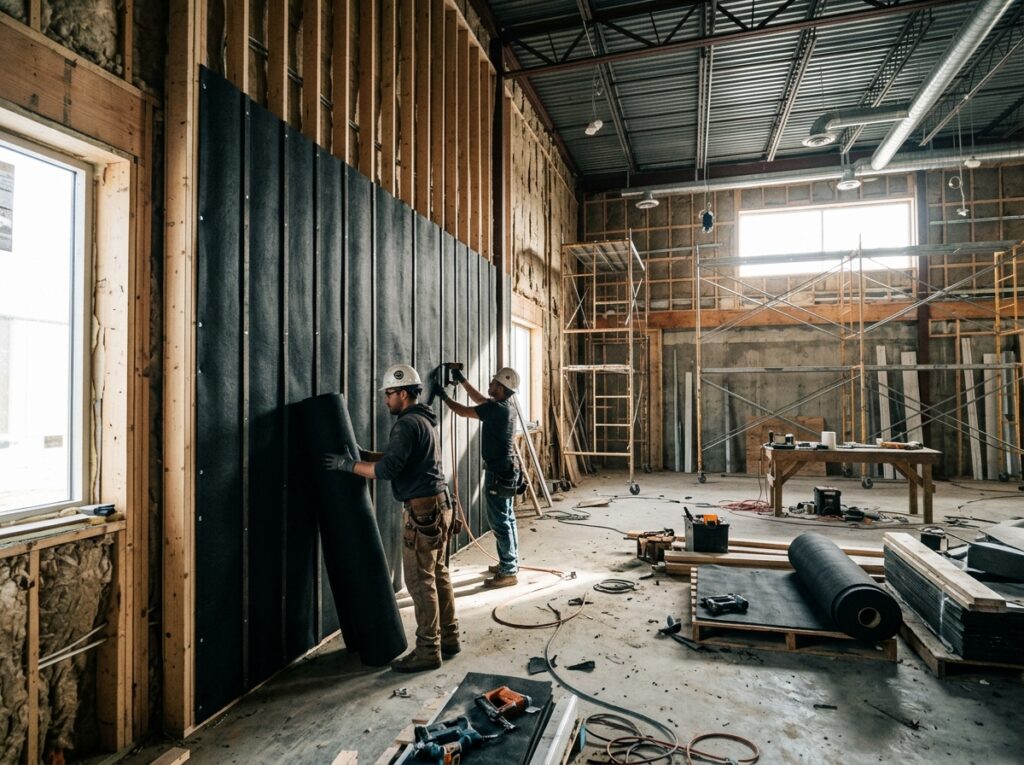
Room finish → gypsum board → MLV → cavity insulation → framing → gypsum board → adjacent room
The actual design can vary considerably depending on the required performance.
In some systems, additional gypsum layers, resilient channels, isolation clips, damping compounds, or other acoustic components may be incorporated.
The MLV becomes the mass barrier layer within this larger construction.
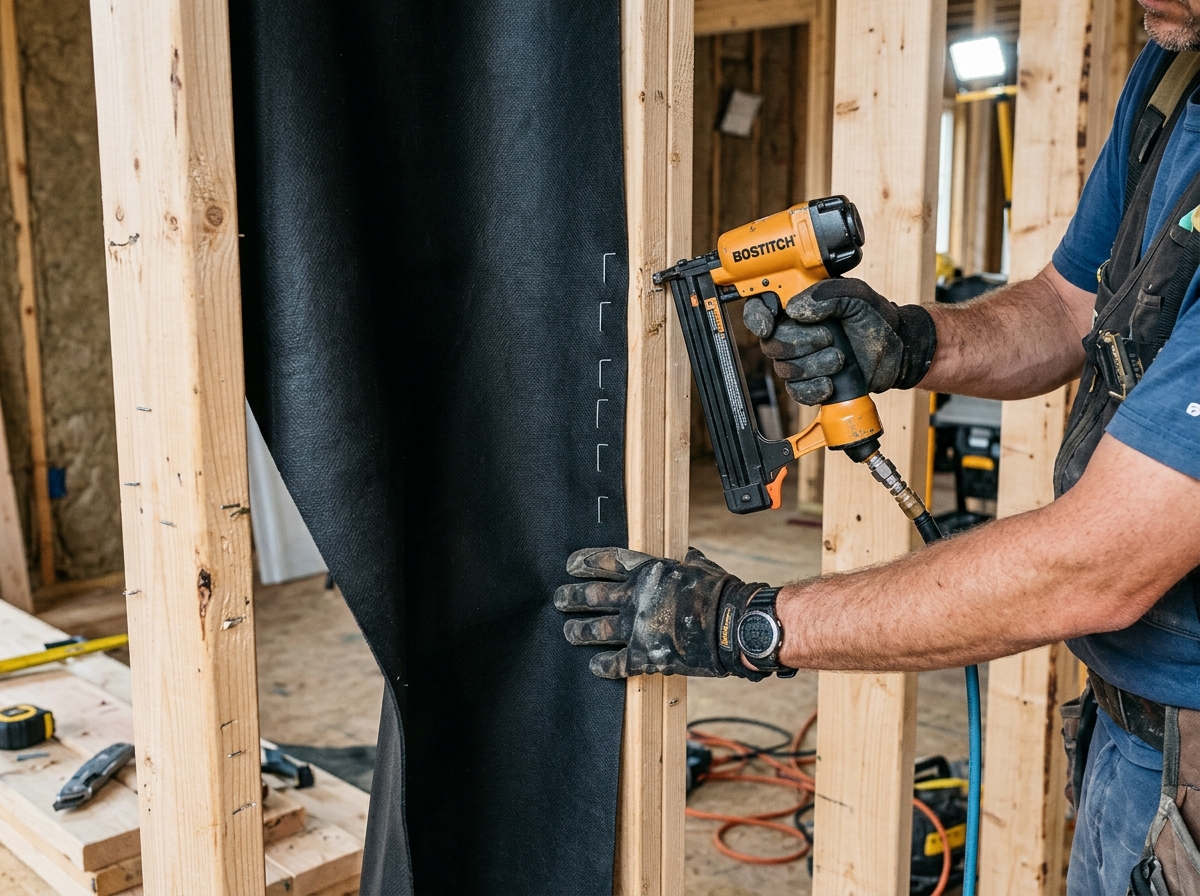
Professional installation guidance commonly places MLV over wall or ceiling framing before the finished drywall is installed. Seams and perimeter areas must then be properly treated so that gaps do not undermine the isolation system.
Why Sealing Matters as Much as the Barrier
One of the most overlooked parts of soundproofing is sealing.
Sound can travel through surprisingly small openings.
Potential weak points include:
- Electrical boxes
- Pipe penetrations
- HVAC openings
- Cable routes
- Door frames
- Ceiling edges
- Wall junctions
- MLV seams
- Service penetrations
Installation guidance for MLV systems specifically emphasizes sealing seams and perimeter joints before the final wall or ceiling finish is installed.
This is why professional soundproofing should be approached as a continuous system.
Adding MLV while leaving large gaps around it is unlikely to deliver the same result as a carefully sealed installation.
MLV and Ceiling Soundproofing
Ceilings can be particularly challenging because sound may travel through the ceiling assembly or through the open space above suspended ceiling systems.
MLV can be incorporated into ceiling soundproofing assemblies where airborne transmission between floors or rooms is a concern.
It may be installed around joists or as part of a composite ceiling barrier depending on the construction.
However, ceiling systems introduce additional considerations such as:
- Structural load
- Suspension systems
- Service penetrations
- HVAC ducts
- Electrical services
- Plenum spaces
- Fire requirements
Some commercial ceiling systems use MLV or MLV composite barriers above suspended ceilings, but the supporting structure must be capable of carrying the additional weight.
MLV Is Not a Complete Solution for Every Noise Problem
This is one of the most important points to understand before specifying MLV.
MLV is highly relevant to airborne sound isolation, but different noise sources require different strategies.
Airborne noise
Examples include:
- Speech
- Television
- Music
- General room noise
MLV can be useful as part of the sound isolation assembly.
Impact noise
Examples include:
- Footsteps
- Objects being dropped
- Furniture movement
These problems often require floor and structural isolation strategies rather than simply adding MLV.
Structure-borne vibration
Examples include:
- Machinery vibration
- Pumps
- Compressors
- Mechanical equipment
These may require vibration isolation and decoupling.
Reverberation
Examples include:
- Echo in offices
- Excessive reflections in restaurants
- Harsh sound in large rooms
These are primarily acoustic treatment problems and are generally addressed with absorptive materials rather than MLV.
MLV vs Acoustic Panels
| Feature | Mass Loaded Vinyl | Acoustic Panels |
|---|---|---|
| Primary purpose | Sound isolation | Sound absorption |
| Main target | Sound transmission | Reflections and reverberation |
| Typical location | Inside walls/ceilings/enclosures | Finished room surfaces |
| Blocks sound between rooms | Can contribute | Limited |
| Reduces echo | Not its primary purpose | Yes |
| Useful for speech privacy | As part of isolation system | Can improve room acoustics |
| Common construction role | Barrier layer | Interior acoustic treatment |
The two materials should not necessarily be viewed as competitors.
A high-quality acoustic project may require both.
MLV can help reduce transmission through the structure, while acoustic panels can improve the acoustic environment inside the room.
Choosing the Right MLV for a Doha Project
There is no single MLV specification that is automatically correct for every project.
Selection should consider:
1. Required acoustic performance
Determine how much sound isolation the room or building requires.
2. Available space
MLV can be valuable where additional wall thickness needs to remain relatively limited.
3. Barrier weight
Commercial products are available in different surface weights, and published transmission-loss results vary accordingly.
4. Installation location
Wall, ceiling, duct, pipe, machinery, and enclosure applications may require different installation methods or product constructions.
5. Fire requirements
Fire performance must be verified for the exact product and intended assembly rather than assumed from the generic term “MLV.”
6. Structural considerations
Heavier acoustic barriers add load. Ceiling systems and suspended assemblies should be checked before installation.
7. Existing construction
A retrofit project may require a different strategy from a new-build project.
Professional MLV Installation in Doha
Correct installation can make a major difference to the final acoustic result.
A professional soundproofing process may include:
Site inspection → Noise assessment → Source identification → Wall/ceiling evaluation → Acoustic design → Material selection → MLV installation → Sealing → Finishing → Performance review
During installation, the barrier should be positioned so that the intended assembly remains as continuous as possible.
Seams, corners, penetrations, and perimeter connections require particular attention.
MLV installation manuals commonly recommend covering the treated wall or ceiling with drywall after the barrier has been installed and sealing perimeter joints with appropriate acoustic sealant.
For a commercial or residential project in Doha, the installation should also be coordinated with applicable building, fire, electrical, and mechanical requirements.
Benefits of Mass Loaded Vinyl
When properly specified as part of a complete system, MLV can offer several advantages:
- Adds substantial acoustic mass
- Helps reduce airborne sound transmission
- Requires relatively little thickness compared with adding large rigid layers
- Can be incorporated into wall assemblies
- Can be used in ceilings
- Can support mechanical noise-control applications
- Works with other soundproofing materials
- Can be useful for retrofit and new construction
- Can improve privacy between spaces
Its biggest advantage is flexibility in system design: the material can become an additional acoustic barrier without having to completely redesign the room.
Limitations to Consider
MLV should still be treated realistically.
It is:
- Heavy
- Not structural
- Not a substitute for decoupling
- Not primarily an absorption material
- Not a complete solution for impact noise
- Not automatically effective against every low-frequency vibration
- Dependent on correct sealing and installation
Most importantly, a product’s published acoustic rating should not be treated as the guaranteed performance of an entire building assembly.
Laboratory ratings describe specific tested configurations. The final result in a real building can be affected by construction details and flanking paths.
Building a Complete Soundproofing Strategy
The strongest approach is rarely about choosing one “best” material.
Instead, the soundproofing system should be designed around the way the noise travels.
A project may combine:
- Mass Loaded Vinyl
- Acoustic insulation
- Multiple gypsum layers
- Acoustic sealant
- Resilient channels
- Isolation clips
- Damping compounds
- Sound-rated doors
- Acoustic glazing
- Pipe and duct treatments
- Vibration isolation
MLV can provide the barrier, while other components address absorption, vibration, damping, or structural separation.
This layered approach is especially important when dealing with demanding environments such as home theatres, recording spaces, hotels, offices, mechanical rooms, and commercial developments.
Why Professional Acoustic Planning Matters
A common mistake is choosing an acoustic material before identifying the actual source of the noise.
For example, a client may believe a wall needs MLV when the dominant noise is actually travelling through an adjacent ceiling, HVAC duct, door, window, or structural connection.
A professional assessment can identify:
- Where the noise originates
- Whether it is airborne or structure-borne
- Which surfaces are involved
- Whether flanking transmission exists
- Which acoustic assembly is appropriate
- Where barriers and seals should be installed
This approach reduces the risk of spending money on materials that do not address the actual transmission path.
Final Thoughts
Mass Loaded Vinyl can be a valuable component of modern soundproofing systems in Doha, Qatar.
Its main role is straightforward: provide a dense, flexible barrier that helps reduce airborne sound transmission through walls, ceilings, enclosures, ducts, and other assemblies.
But MLV should not be viewed as a standalone cure for every acoustic problem.
The best results come from understanding the noise source and combining the appropriate layers of mass, absorption, damping, decoupling, and sealing.
For residential apartments, villas, offices, hotels, studios, entertainment rooms, mechanical areas, and commercial buildings in Doha, a properly designed MLV system can become an important part of a broader strategy for creating quieter and more private spaces.
Frequently Asked Questions
1. What is Mass Loaded Vinyl used for?
Mass Loaded Vinyl is primarily used as a dense, flexible sound barrier to reduce airborne sound transmission through walls, ceilings, floors, ducts, machinery enclosures, and similar assemblies.
2. Is MLV the same as an acoustic panel?
No. MLV primarily helps with sound isolation, while acoustic panels are generally designed to absorb reflected sound and control reverberation inside a room.
3. Can MLV be installed inside walls?
Yes. MLV is commonly installed within wall assemblies, typically over framing and beneath the final drywall or finish layer.
4. Can MLV be used for ceilings?
Yes. MLV can be incorporated into ceiling soundproofing systems, although the supporting structure and ceiling construction must be considered because MLV adds significant weight.
5. Does MLV stop footsteps?
MLV alone is generally not the appropriate solution for impact noise such as footsteps. Impact and structure-borne noise may require decoupling and vibration-isolation measures.
6. Does MLV reduce echo?
Not as its primary function. Echo and reverberation are generally better controlled using absorptive acoustic treatments such as PET panels, fabric panels, wood wool, or other acoustic surfaces.
7. Can MLV be used around HVAC ducts?
Yes. MLV and composite MLV barrier products are used in certain duct, pipe, and HVAC noise-control applications.
8. Is thicker MLV always better?
Not necessarily. The appropriate barrier depends on the complete assembly, required performance, available space, structural limitations, and noise source. Different MLV weights have different published transmission-loss characteristics.
9. Should MLV be combined with other soundproofing materials?
In many projects, yes. MLV is generally most effective when integrated with other measures such as cavity insulation, additional mass, acoustic sealants, and decoupling systems.
10. Can MLV be used in existing buildings in Doha?
It can be incorporated into suitable retrofit assemblies, but the existing wall, ceiling, services, available space, and required acoustic performance should be evaluated before installation.