
Introduction
Unwanted noise can affect the comfort and functionality of residential, commercial, and industrial buildings. Conversations travelling between rooms, television sound passing through partitions, noisy plumbing, and equipment operating near occupied spaces can all create challenges when a building does not provide sufficient sound isolation.
For property owners, architects, contractors, and interior designers working in Kinshasa, Democratic Republic of the Congo, mass loaded vinyl (MLV) is an acoustic barrier material worth considering for projects that require improved control of airborne sound transmission.
Unlike decorative acoustic panels, which primarily absorb sound reflections inside a room, mass loaded vinyl is a dense, flexible material designed to add mass to a building element or noise-control assembly. It can be incorporated into suitable wall, ceiling, floor, ductwork, and equipment-enclosure systems.
The effectiveness of MLV depends on more than the material alone. The surrounding construction, installation method, airtightness, structural connections, and other sound-transmission paths all influence the final result.
This guide explores how mass loaded vinyl works, where it can be used in Kinshasa, how to choose an appropriate specification, and what to consider before purchasing or installing an acoustic barrier.
What Is Mass Loaded Vinyl?
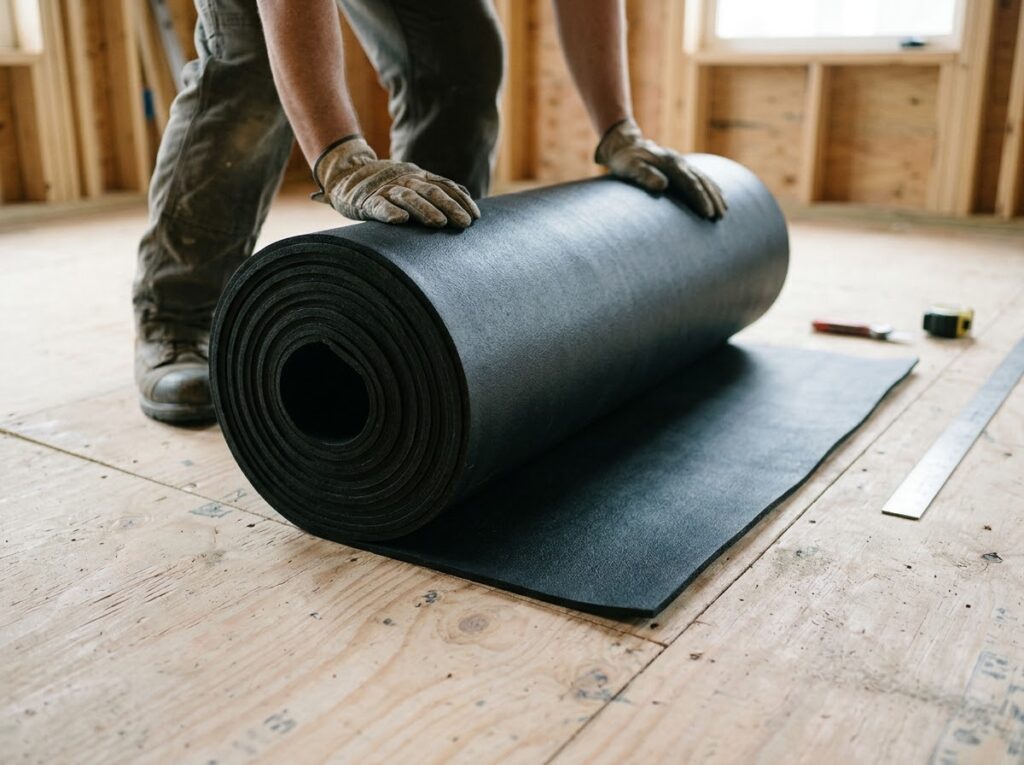
Mass loaded vinyl is a flexible, high-density polymer-based sound barrier. Its relatively high surface mass allows it to resist the transmission of airborne sound when incorporated into an appropriate construction assembly.
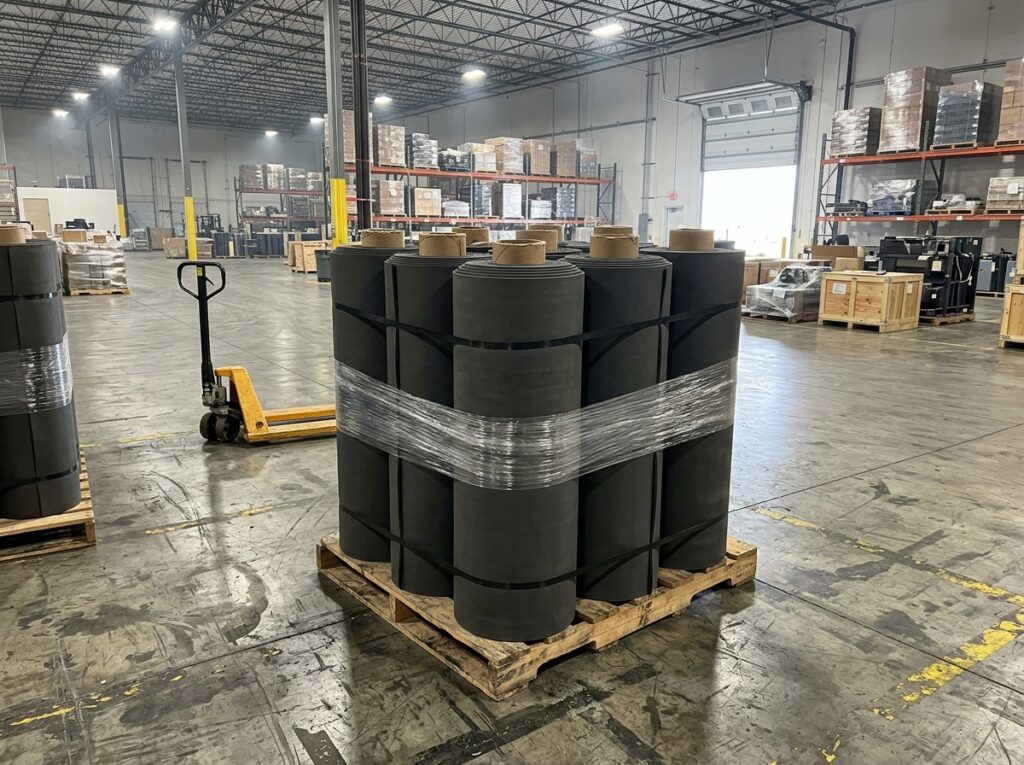
Unlike rigid boards, MLV can be supplied in rolls or sheets, making it useful in applications where a flexible barrier is easier to integrate into a wall, ceiling, partition, or equipment enclosure.
Depending on the product, MLV may be available in different thicknesses, surface weights, colours, and reinforced configurations.
Common applications include:
- Internal wall and partition assemblies.
- Ceiling and floor constructions designed for sound isolation.
- Home theatre and media-room construction.
- Office meeting rooms and private cabins.
- Hotel rooms and commercial partitions.
- Noise barriers around selected machinery and equipment.
- Ductwork and plumbing noise-control assemblies.
- Removable acoustic enclosures and industrial noise barriers.
Product specifications vary by manufacturer. For example, Acoustical Surfaces lists MLV options with surface weights of approximately 0.5, 1, and 2 pounds per square foot. Its published transmission-loss data shows different results for the different weights, demonstrating the importance of selecting the correct specification for the application. These figures describe the tested barrier material and should not be treated as guaranteed ratings for an entire wall or building. Source: Acoustical Surfaces MLV specifications
Why Consider MLV for Projects in Kinshasa?
Buildings have different acoustic requirements depending on their location, occupancy, construction, and intended use. Mass loaded vinyl can be useful when a project requires additional sound-isolating mass without relying exclusively on thicker rigid construction materials.
1. Improve Privacy Between Rooms
In homes, offices, consultation rooms, and meeting spaces, conversations may travel through lightweight partitions or poorly detailed wall assemblies.
MLV can be incorporated into a suitable partition to improve resistance to airborne sound transmission. Its performance depends on the complete construction, including wall framing, board layers, insulation, perimeter sealing, and any openings.
For projects where confidentiality matters, the entire partition should be assessed rather than relying on the vinyl barrier alone.
2. Support Residential Noise Control
Residential properties may experience unwanted sound from neighbouring rooms, entertainment systems, household equipment, or nearby activity.
When used as part of a properly designed assembly, MLV can contribute to reducing airborne sound passing through selected walls, ceilings, or floors.
However, sound may also travel through doors, windows, service penetrations, structural elements, and adjoining walls. These paths need to be considered if the objective is meaningful noise reduction.
3. Help Manage Noise Around Equipment
Mechanical rooms, pump areas, ventilation systems, and other equipment spaces may require additional noise control.
MLV can be incorporated into certain equipment enclosures, flexible barrier systems, and duct or pipe treatments. For machinery that generates significant vibration, additional measures such as resilient mounts, vibration isolation, and appropriate decoupling may also be necessary.
The selected barrier must be compatible with the operating temperature, moisture exposure, movement, and safety requirements of the installation.
4. Make Use of Flexible Installation Formats
MLV is available in flexible rolls and sheets, which can make it easier to incorporate into some building assemblies than rigid, heavy boards.
This flexibility is particularly useful when an acoustic design needs to accommodate framing, irregular surfaces, or selected equipment enclosures. Nevertheless, the material must be supported and fixed correctly because its weight can place demands on the structure and fasteners.
5. Combine Sound Isolation With Interior Finishes
MLV is typically concealed within a wall, ceiling, or floor assembly rather than used as the final decorative finish.
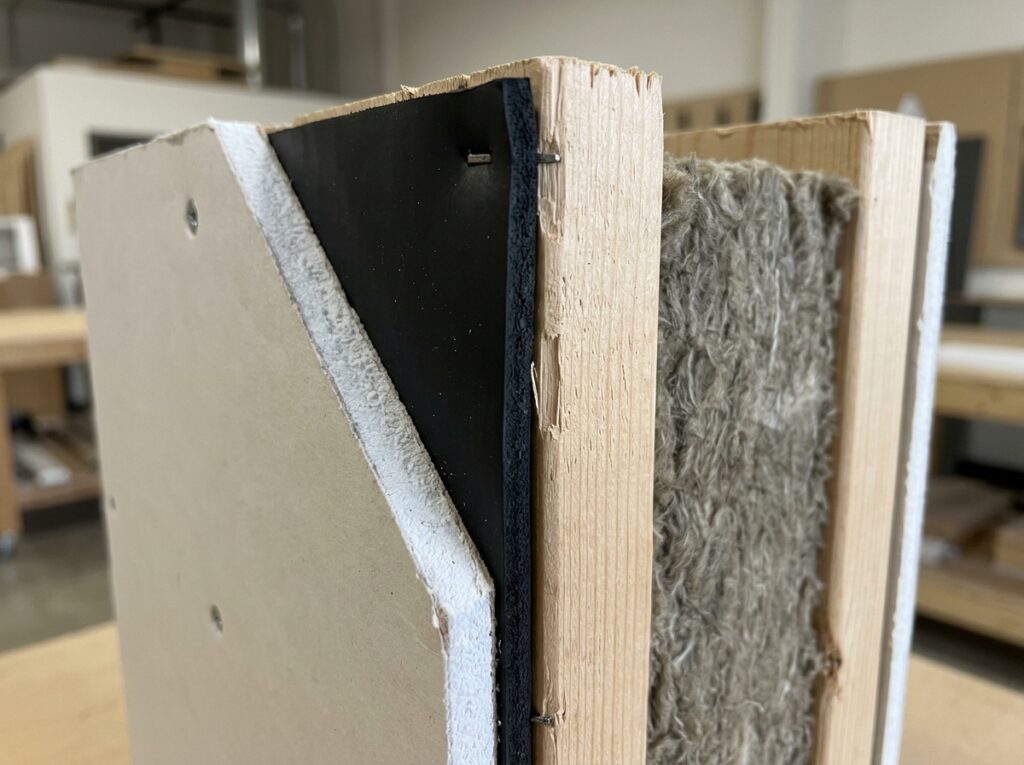
This allows the visible interior to retain a preferred appearance while a sound barrier forms part of the construction behind it. Plasterboard, other suitable finish boards, or specified protective layers may be installed over the barrier according to the approved system.
How Does Mass Loaded Vinyl Work?
MLV works primarily by adding mass to a sound-isolating assembly. In general, increasing the mass of a suitable barrier can improve its resistance to airborne sound transmission, although real-world performance also depends on resonance, stiffness, mounting, leakage, and the surrounding construction.
A successful assembly may combine several elements:
- Mass: Dense layers help resist airborne sound transmission.
- Absorption: Suitable porous insulation inside a cavity can absorb sound energy within the assembly.
- Decoupling: Separating layers or using appropriate resilient connections can reduce some vibration paths.
- Airtightness: Sealing gaps and openings helps prevent sound from bypassing the barrier.
- Sound-path control: Treating flanking paths reduces the chance that noise will travel around the improved partition.
These elements serve different purposes. MLV is not a replacement for every other acoustic component, and adding it to an unsuitable wall will not automatically produce a high-performing sound-isolation system.
Applications of Mass Loaded Vinyl
Residential Walls and Ceilings
MLV can be incorporated into selected wall and ceiling assemblies where airborne sound travels between rooms or adjoining properties.
Before choosing a system, assess the existing wall construction, available cavity depth, structural condition, electrical installations, and finish requirements. A retrofit may require different detailing from a new-build project.
Offices and Meeting Rooms
Businesses may need improved privacy for discussions, meetings, and telephone calls. MLV can be considered as one layer within a partition system designed to reduce sound transmission between rooms.
It should be paired with suitable construction detailing, including sealed perimeters, properly treated penetrations, and appropriate doors. A high-performing wall can still provide limited privacy if sound leaks through an untreated doorway or ceiling void.
Hotels and Hospitality Interiors
Hotels, guest accommodation, conference facilities, and hospitality spaces often need a balance between comfort, privacy, and efficient use of interior space.
MLV may be incorporated into selected room partitions, ceilings, or floor systems where the overall design requires additional sound isolation. The complete assembly should be evaluated for both airborne noise and, where relevant, impact sound.
Home Theatres and Entertainment Rooms
Home theatres and entertainment rooms can generate sound that disturbs people in adjoining spaces.
MLV may form part of the isolation design, but the room may also need appropriate doors, sealed openings, wall or ceiling decoupling, and carefully designed ventilation. Low-frequency sound from subwoofers can be particularly challenging and may require a more comprehensive construction solution.
Plumbing and Building Services
Water flow, pipe movement, and mechanical services can transmit noise through walls and structural connections.
MLV can be used in selected pipe-wrap or barrier configurations where the product is suitable for the operating conditions. However, pipe vibration, rigid connections, and impact noise may require resilient supports or other specialist treatments.
Industrial and Commercial Equipment
Certain machinery can produce persistent noise that affects workers or neighbouring occupied areas.
MLV can be used in suitable noise barriers, removable jackets, and equipment enclosures. The design must also consider ventilation, heat dissipation, equipment access, maintenance, and any applicable workplace or fire-safety requirements.
Choosing the Right MLV Specification
Selecting an appropriate product requires more than comparing thicknesses or choosing the heaviest available roll.
Surface Weight
Surface weight is an important specification because MLV is designed to function as a mass barrier. Manufacturers commonly state the weight per square foot or mass per square metre.
For example, Acoustical Surfaces lists MLV products with surface weights of 0.5, 1, and 2 pounds per square foot. Its published data reports different Sound Transmission Class (STC) values for these options under the stated test conditions. Those results are specific to the product and test method; the final assembly rating can be different. Source: Acoustical Surfaces
Thickness and Flexibility
Thickness is related to material construction, but it should not be used as the only measure of performance. Two products with similar thicknesses may have different surface weights, compositions, reinforcement, or test results.
Check the technical data sheet to confirm that the material is suitable for the intended application.
Sound Transmission Class (STC)
STC is a rating used to summarise airborne sound-isolation performance across a specified range of frequencies under standardised testing.
It is important to distinguish between the STC rating of a standalone barrier and that of a complete wall or floor assembly. A product rating cannot automatically be applied to an entire building element.
For meaningful comparisons, request test data for the proposed assembly or a technically comparable construction.
Reinforcement and Facing
Some MLV products include reinforcement or a facing layer to support installation or suit particular environments. These features can affect handling, durability, and suitability for industrial applications.
Choose a product with the correct construction for the intended use rather than assuming that all MLV rolls are interchangeable.
Fire and Environmental Requirements
Fire performance must be confirmed using documentation for the exact product and installation. Do not assume that a fire classification applies to every MLV product or to the complete assembly.
Projects in commercial buildings, hotels, schools, healthcare facilities, and industrial spaces should also consider the applicable local building requirements, temperature limits, moisture exposure, and manufacturer’s safety instructions.
Comparison of MLV Surface-Weight Options
| Nominal surface weight | General consideration | Important limitation |
|---|---|---|
| 0.5 lb/ft² | Lower-weight barrier option for selected assemblies | May not meet higher isolation requirements |
| 1 lb/ft² | Intermediate surface-weight option | Performance depends on construction and sealing |
| 2 lb/ft² | Heavier barrier option for applications requiring additional mass | Adds more dead load and may require stronger support |
These are broad comparison categories, not a universal specification for every project. Actual available weights and tested performance depend on the manufacturer.
Installation Best Practices for Kinshasa Projects
Correct installation is essential because even a suitable material can underperform if gaps, weak connections, or unsupported sections allow sound to bypass the barrier.
Inspect the Existing Construction
Identify the main source of noise and the route through which it travels. Determine whether the problem involves airborne sound through a partition, impact noise through a floor, vibration from equipment, or several paths at once.
The proposed solution should address the actual problem rather than simply adding material to the most convenient surface.
Plan the Complete Assembly
Decide where MLV will sit within the wall, ceiling, floor, or enclosure. Confirm compatibility with the other layers, framing, fixings, insulation, and finishing materials.
The assembly should be designed to preserve required structural, fire, moisture, and service-access performance.
Maintain a Continuous Barrier
MLV is most effective when installed as a continuous layer in accordance with the specified system. Seams, perimeters, joints, and service penetrations must be detailed properly to limit sound leakage.
Use the seam treatment and fixing method recommended by the manufacturer. Do not assume that one installation method is suitable for every product.
Check Structural Support
Because MLV can be relatively heavy, confirm that the substrate, framing, suspension system, and fixings can support the added load.
For overhead installations and equipment enclosures, safe support and maintenance access are particularly important.
Coordinate Services and Finishes
Electrical boxes, pipes, ducts, doors, and other penetrations can interrupt the barrier. Coordinate these details before closing the wall or ceiling so that the sound-isolation layer is not compromised.
Verify the Finished Result
Where performance is important, consider whether acoustic testing or inspection should be included in the project. A documented construction specification helps ensure that the installed assembly matches the intended design.
Common Mistakes to Avoid
- Expecting MLV to solve every type of noise: Airborne sound, impact sound, and vibration can require different measures.
- Choosing by thickness alone: Surface weight and tested performance are also important.
- Leaving gaps at seams and edges: Sound can bypass a barrier through openings and poorly sealed joints.
- Ignoring flanking transmission: Noise may travel through ceilings, floors, doors, ducts, or adjoining structures.
- Using product STC as the wall STC: The rating of a standalone barrier does not automatically represent the complete construction.
- Overlooking dead load: Heavy materials require suitable structural support.
- Ignoring fire and temperature requirements: Product documentation must match the installation environment.
Frequently Asked Questions
1. What is mass loaded vinyl used for?
Mass loaded vinyl is used as a flexible, dense sound barrier within suitable wall, ceiling, floor, duct, and equipment-enclosure systems to help reduce airborne sound transmission.
2. Is MLV suitable for residential projects in Kinshasa?
It can be considered for homes and apartments where additional sound isolation is needed. The appropriate design depends on the source of the noise, existing construction, available space, and desired performance.
3. Does mass loaded vinyl absorb echo?
MLV is primarily a sound-transmission barrier rather than an exposed sound-absorbing treatment. If a room has excessive echo, porous acoustic absorbers may be needed in addition to any sound-isolation work.
4. Can MLV be installed in an existing wall?
Depending on the wall construction, MLV may be incorporated during a retrofit. The design should account for available space, fixings, finish layers, electrical services, and the potential need to improve other parts of the assembly.
5. Does thicker MLV always provide better soundproofing?
Not necessarily. Surface weight, composition, assembly design, sealing, and installation all influence performance. Compare tested specifications rather than relying on thickness alone.
6. Can MLV control low-frequency noise?
MLV can contribute to an appropriate sound-isolation system, but low-frequency noise can be difficult to control. Depending on the source, additional mass, decoupling, vibration isolation, or a redesigned enclosure may be necessary.
7. What should buyers check before purchasing MLV?
Review surface weight, thickness, dimensions, tested acoustic data, fire documentation, temperature limits, installation instructions, and compatibility with the proposed construction.
8. Can MLV be used around machinery?
Certain MLV products are designed for noise barriers, equipment enclosures, and related industrial applications. Confirm that the selected product is suitable for the equipment’s temperature, movement, maintenance, and safety requirements.
Conclusion
Mass loaded vinyl provides a flexible way to introduce additional sound-isolating mass into suitable construction systems. For residential, commercial, hospitality, and industrial projects in Kinshasa, it may help reduce airborne sound transmission when selected and installed as part of a well-designed assembly.
The most important decision is not simply which roll is thickest or heaviest. It is identifying the source of the noise, understanding the path it follows, and choosing a complete system that addresses those conditions.
By comparing technical data, confirming fire and installation requirements, sealing the barrier carefully, and considering other sound-transmission paths, project teams can make better-informed decisions about using MLV in their buildings.
Explore mass loaded vinyl specifications and choose a sound-barrier solution suited to your project’s construction, noise-control requirements, and installation conditions in Kinshasa.