
Noise can travel through walls, ceilings, floors, ducts, pipes and building structures long before it becomes noticeable in the room where it is heard. In residential buildings, this may mean conversations or television noise passing through adjoining walls. In offices, it can affect privacy between meeting rooms. In hotels, apartments and commercial facilities, mechanical equipment and building services can create another layer of unwanted sound.
For projects requiring better sound isolation, Mass Loaded Vinyl in Libreville, Gabon can be incorporated into professionally designed soundproofing assemblies to help reduce airborne sound transmission.
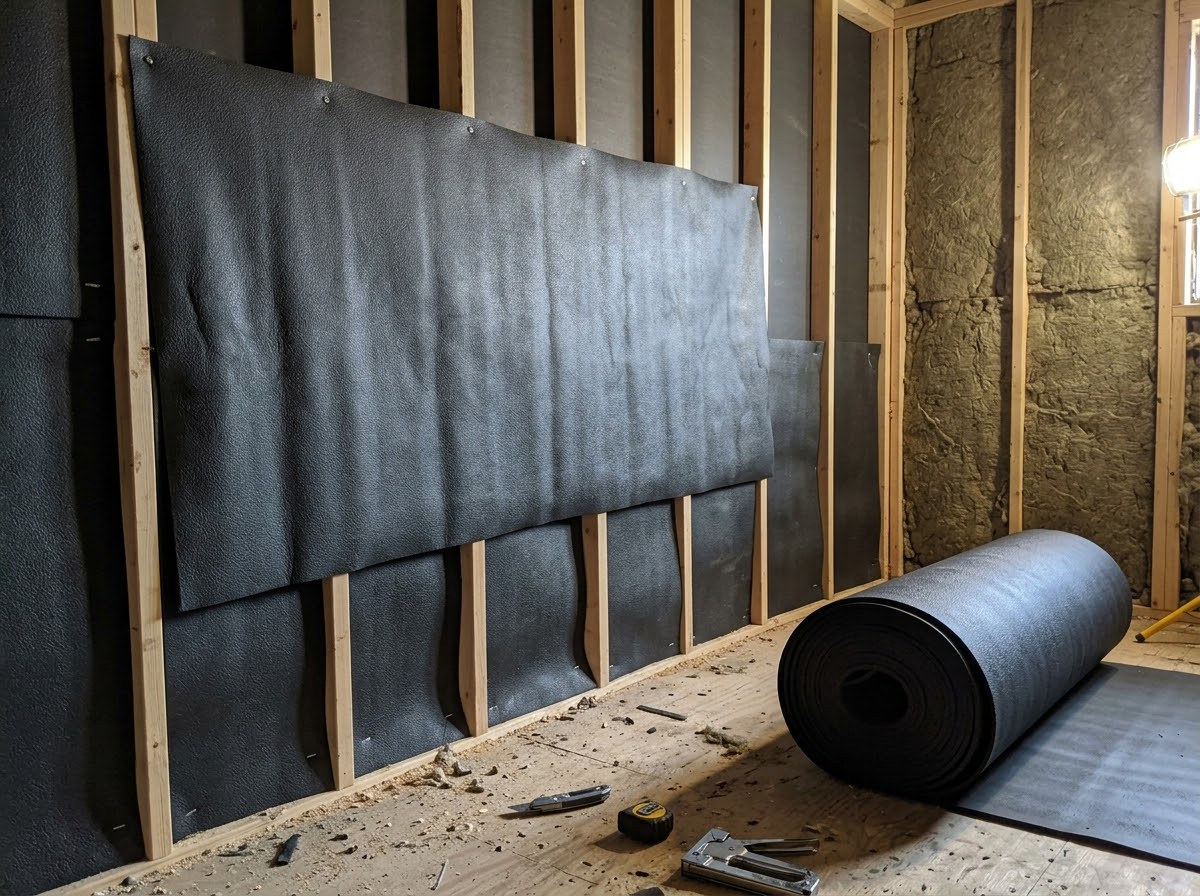
Mass Loaded Vinyl, commonly called MLV, is a dense and flexible acoustic barrier. Unlike conventional acoustic panels that primarily absorb sound reflections inside a room, MLV is designed to add mass to an assembly and reduce the transmission of airborne noise.
However, MLV should not be viewed as a complete soundproofing solution by itself. Its effectiveness depends heavily on how it is integrated with wall, ceiling or floor construction, how seams and penetrations are sealed, and whether other problems such as structural vibration or flanking transmission are also addressed.
What Is Mass Loaded Vinyl?
Mass Loaded Vinyl is a high-density, flexible sheet material developed specifically for sound isolation.
It is often described as a limp mass barrier because it combines significant surface mass with flexibility. This allows MLV to add acoustic mass without requiring the thickness associated with some conventional building materials.
MLV can be incorporated into:
- Wall assemblies
- Ceiling systems
- Floor constructions
- Mechanical enclosures
- HVAC systems
- Ductwork
- Pipe applications
- Equipment enclosures
- Commercial soundproofing systems
The exact performance depends on the specific product and assembly.
For example, one current MLV product range lists options of approximately 0.5, 1 and 2 lb/ft², with different thicknesses and tested sound-transmission characteristics. Its published standalone data shows that the 1 lb/ft² and 2 lb/ft² versions have different transmission-loss performance, demonstrating why product weight and specification matter when designing an acoustic barrier.
How Does MLV Help Reduce Noise?
MLV primarily works by adding mass to a sound-isolation assembly.
When airborne sound reaches a wall, ceiling or other building element, the structure can vibrate and transfer some of that acoustic energy to the other side. Increasing the mass of the assembly can make it more difficult for airborne sound energy to drive that structure.
MLV provides this additional mass in a relatively thin and flexible format.
This makes it useful where additional sound isolation is required but increasing the thickness of a wall or ceiling significantly may not be practical.
It is particularly relevant to airborne noise such as:
- Human speech
- Television sound
- General music
- Office conversations
- Commercial activity
- Equipment noise
- Building-service noise
MLV is less suitable as a standalone solution for impact noise and structure-borne vibration. Footsteps, heavy impacts and vibration transmitted directly through a building structure may require decoupling, resilient systems or vibration isolation in addition to mass.
MLV for Residential Soundproofing in Libreville
Residential buildings can experience noise from several directions.
A shared wall may allow conversations or television sound to pass between apartments. Noise may also travel through ceilings and floors between different levels of a building.
MLV can be incorporated into wall and ceiling assemblies to increase sound isolation.
For example, a soundproofing system may combine:
- Existing or new wall framing
- Acoustic insulation within the cavity
- Mass Loaded Vinyl
- Additional drywall or acoustic board
- Acoustic sealant
- Decoupling components where required
The purpose is not simply to install a sheet of MLV on a wall. The complete construction needs to work together.
A properly designed system can be particularly useful for bedrooms, home offices, media rooms and spaces where privacy is important.
Shared Walls and Noise Transfer
Shared walls are one of the most common areas where sound isolation becomes important.
Noise from an adjacent room can travel through the wall assembly and become clearly audible on the other side.
A common mistake is to focus exclusively on adding thicker wall material while ignoring gaps, electrical boxes, doors, ceilings and other transmission paths.
MLV can form part of a continuous sound barrier, but the entire assembly must be carefully sealed.
Installation guidance for MLV systems commonly recommends treating seams carefully and sealing perimeter joints. Where seams occur over framing, some installation systems specify butted joints with appropriate acoustic tape; where seams fall between framing members, certain systems recommend an overlap. Product-specific installation instructions should always take priority.
This attention to detail is essential for sound isolation.
Mass Loaded Vinyl for Office Privacy
Modern offices often require more than visual privacy.
Meeting rooms, executive offices, consultation rooms and conference spaces can require acoustic privacy as well.
A conversation that passes through a lightweight partition can become a privacy problem, particularly when sensitive information is being discussed.
MLV can be incorporated into partition systems to strengthen airborne sound isolation.
It can be used alongside:
- Acoustic cavity insulation
- Multiple board layers
- Resilient channels
- Acoustic sealants
- Sound-rated doors
- Acoustic glazing
- Decoupled wall systems
The correct combination depends on the building and the required level of privacy.
Rather than simply specifying the thickest MLV available, an acoustic professional can evaluate the complete partition and determine where improvements will have the greatest impact.
Ceiling Soundproofing With MLV
Noise does not always travel horizontally.
In multi-level buildings, sound can move vertically between floors and rooms.
Ceiling assemblies can therefore become an important part of a soundproofing strategy.
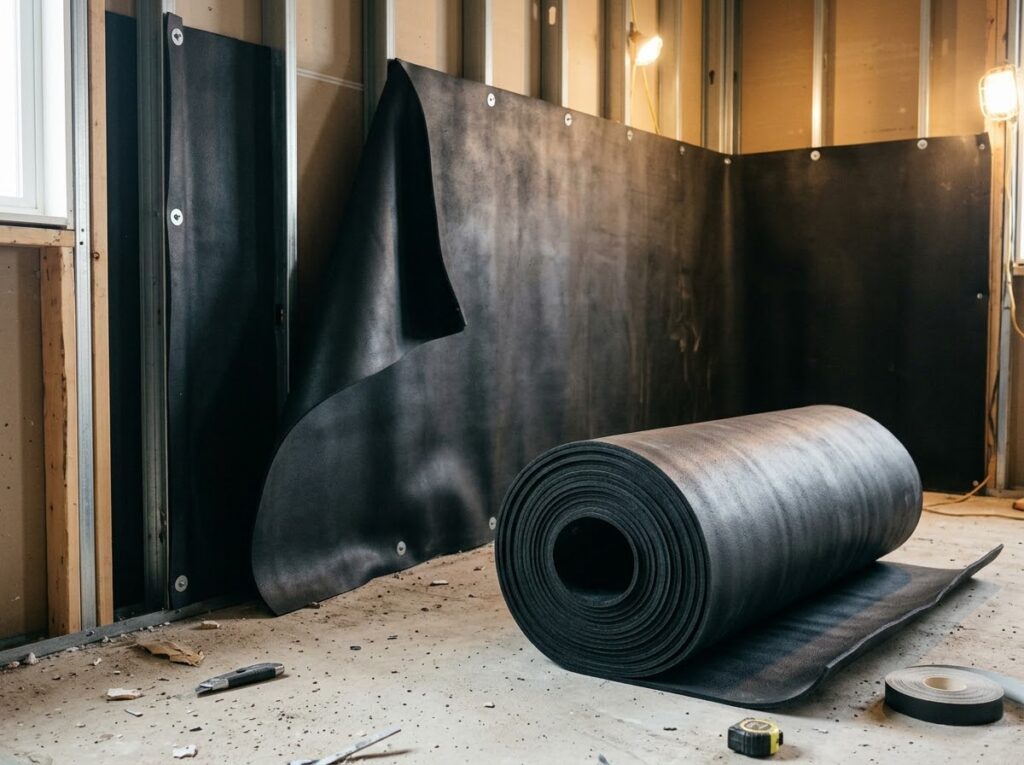
MLV can be installed within ceiling systems or over appropriate framing arrangements, depending on the construction.
One published MLV installation guide describes covering the complete wall or ceiling area, carefully treating seams, installing the finish layer over the barrier and sealing the perimeter.
This illustrates an important principle:
MLV works as part of an assembly, not as an isolated sheet.
The ceiling may also require cavity insulation, decoupling or additional mass depending on the type of noise being addressed.
MLV for Floors and Building Noise
Floors can be another pathway for unwanted sound.
However, it is important to distinguish between airborne sound and impact sound.
Airborne noise includes voices, television and music traveling through a floor-ceiling assembly.
Impact noise includes footsteps, dropped objects and other physical impacts.
MLV can contribute mass to floor or ceiling constructions, but it should not automatically be treated as a complete impact-noise solution.
For impact noise, the acoustic system may need resilient underlay, floating-floor construction or other isolation techniques.
The appropriate approach should therefore begin with identifying exactly what type of noise is being experienced.
Mechanical Rooms and Equipment Noise
Libreville buildings can also contain mechanical equipment that generates continuous noise.
Examples include:
- HVAC equipment
- Pumps
- Compressors
- Generators
- Fans
- Mechanical plant
- Utility equipment
MLV can be used in some equipment enclosures and mechanical sound-control systems to create a heavier barrier around the noise source. Manufacturers list machinery enclosures, ductwork and equipment barriers among applications for mass-loaded vinyl products.
However, equipment noise often contains both airborne and structure-borne components.
If vibration is transferred through mounting points, pipes or building structures, simply adding MLV around the equipment may not solve the entire problem.
A complete solution may therefore combine:
- Mass barriers
- Acoustic absorption
- Vibration isolation
- Flexible connections
- Equipment enclosures
- Duct treatment
- Pipe treatment
HVAC Ducts and Plumbing Noise
Building services can create unusual sound paths.
Air ducts can transmit airborne noise between rooms, while plumbing pipes can carry water-flow and mechanical noise through walls and floors.
Specialized MLV-based products can be used for duct and pipe applications. Some systems combine MLV with a decoupling layer to reduce direct vibration transfer between the barrier and the pipe or surface.
This can be useful in residential, hospitality and commercial construction where plumbing or HVAC noise is affecting occupied spaces.
The exact material should be selected according to the application, temperature conditions, fire requirements and installation environment.
Why MLV Is Useful for Retrofit Projects
One of the advantages of MLV is that it can provide additional mass without requiring an extremely thick barrier.
This can make it attractive for certain retrofit soundproofing projects.
For example, when improving an existing partition, the available wall thickness may be limited. A flexible mass barrier can sometimes be incorporated into a new wall layer or renovation assembly.
However, retrofit projects require careful investigation.
The installer should determine:
- Existing wall construction
- Stud arrangement
- Available cavity depth
- Existing insulation
- Electrical outlets
- Plumbing
- HVAC penetrations
- Door and window locations
- Ceiling connections
- Potential flanking paths
Adding MLV without addressing these factors may produce disappointing results.
Sealing Is Critical to Sound Isolation
One of the most important parts of an MLV installation is controlling gaps.
Sound can travel through very small openings.
Common problem areas include:
- Electrical outlets
- Pipe penetrations
- Duct openings
- Wall-to-ceiling junctions
- Wall-to-floor junctions
- Panel seams
- Door frames
- Service penetrations
An otherwise continuous barrier can lose effectiveness if these locations are left open.
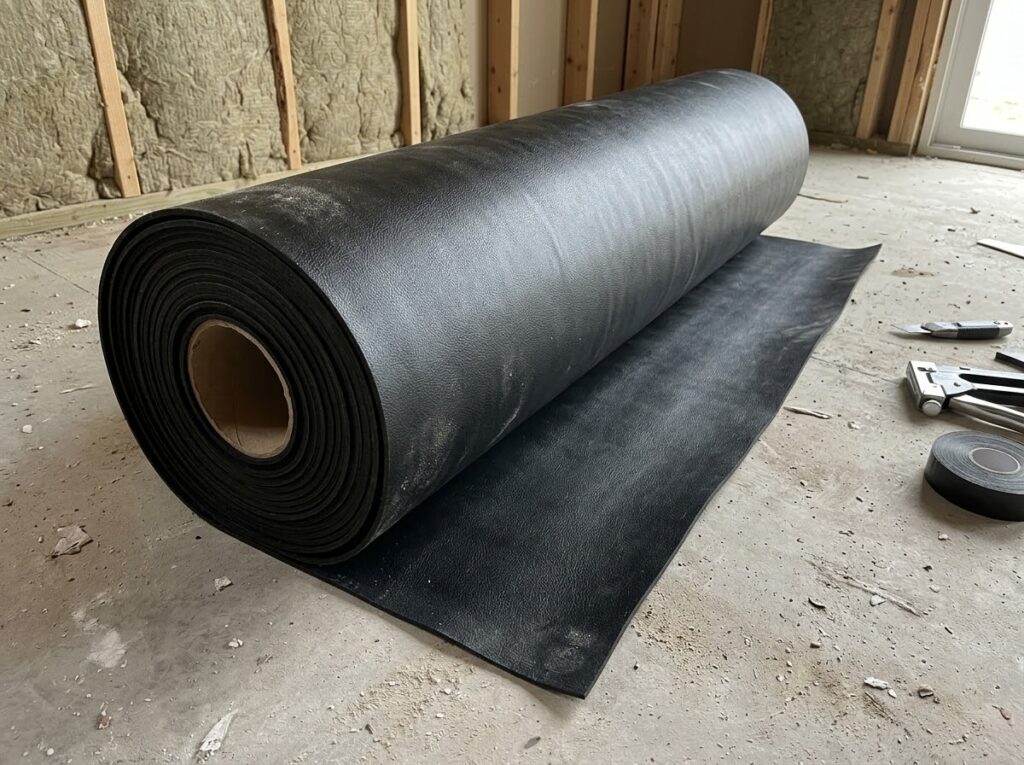
MLV installation guidance specifically emphasizes careful treatment of seams, penetrations and perimeter joints.
Acoustic sealants and appropriate tapes should be selected according to the system and manufacturer requirements.
MLV Thickness and Weight Matter
MLV should never be specified simply by the name “mass loaded vinyl.”
Different products have different surface weights, thicknesses and performance characteristics.
For example, one manufacturer currently lists:
| MLV Weight | Approx. Thickness | Published Standalone STC* |
|---|---|---|
| 0.5 lb/ft² | 1/16 inch | 20 |
| 1 lb/ft² | 1/8 inch | 27 |
| 2 lb/ft² | 1/4 inch | 31 |
*Values shown are specific to the cited product and test configuration and should not be treated as universal MLV ratings.
This is why technical data sheets should be reviewed before selecting a material.
The required MLV weight depends on the construction, available space, target performance and overall soundproofing strategy.
MLV Alone Is Not a Complete Soundproofing System
This is perhaps the most important point for any project in Libreville.
Adding mass is useful, but sound isolation depends on more than mass alone.
A complete soundproofing design may need to address four major elements:
1. Mass
Additional mass makes it more difficult for airborne sound energy to excite the building element.
2. Absorption
Cavity insulation can help control sound energy within wall or ceiling cavities.
3. Decoupling
Separating structural layers can reduce direct vibration transmission.
4. Sealing
Gaps and penetrations must be properly treated so sound cannot bypass the barrier.
Professional soundproofing guidance emphasizes that simply adding mass does not automatically guarantee proportional improvements because the way the mass is assembled is also important.
MLV and Flanking Noise
Sometimes the wall itself is not the main problem.
Sound can travel around a partition through:
- Ceilings
- Floors
- Adjacent walls
- HVAC ducts
- Electrical pathways
- Structural connections
- Doors
- Windows
This is known as flanking transmission.
Imagine installing a high-performance soundproof wall but leaving a lightweight door in the same room. Sound may simply travel through the door instead.
The same principle applies to ceilings, ventilation systems and service penetrations.
An acoustic assessment should therefore examine the complete transmission path rather than focusing on one material.
Professional MLV Soundproofing Services in Libreville
A professional soundproofing project should begin with the noise problem rather than the product.
The process can include:
Site Assessment
Identify the source, direction and type of unwanted noise.
Acoustic Analysis
Determine whether the problem is primarily airborne, impact-related, structure-borne or a combination.
System Design
Select appropriate combinations of MLV, insulation, drywall, decoupling and sealing materials.
Detailed Installation
Install the barrier continuously while carefully treating seams and penetrations.
Finishing
Complete the wall, ceiling or floor assembly without creating new acoustic weak points.
Final Inspection
Check the completed system for gaps, penetrations, loose sections and installation defects.
This service-based approach can produce a much more reliable result than treating MLV as a standalone product.
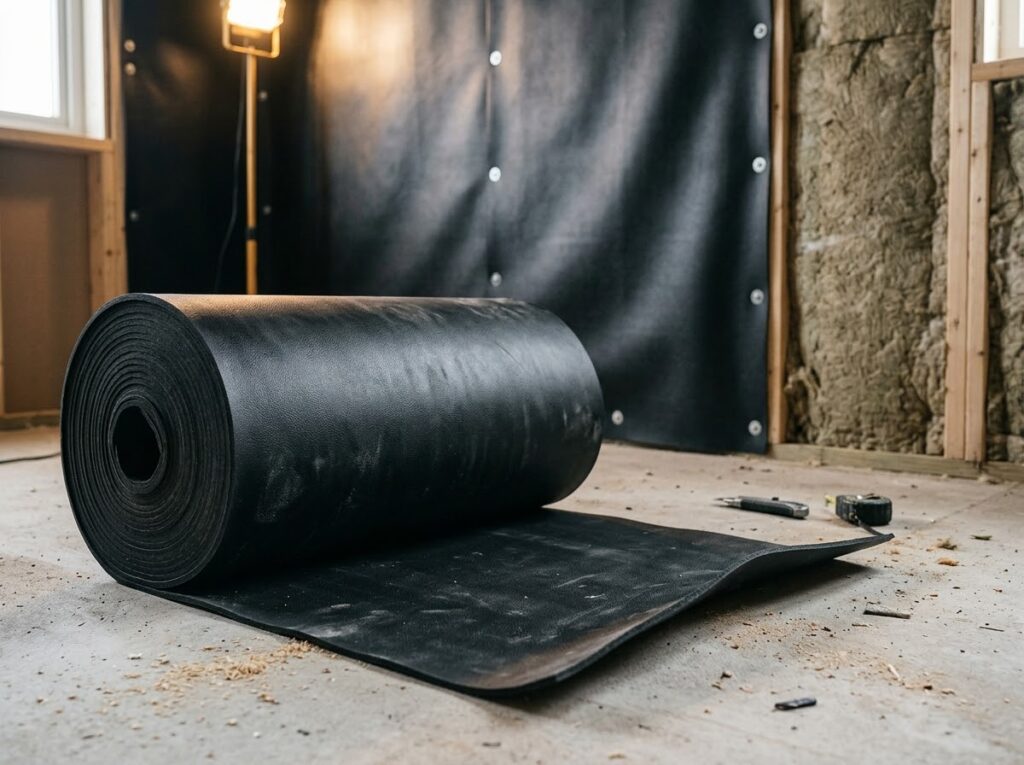
Common MLV Soundproofing Mistakes
Using MLV Without Identifying the Noise Type
MLV is particularly relevant to airborne sound isolation. It should not automatically be used for every noise problem.
Leaving Gaps Around Services
Small openings can create significant sound paths.
Ignoring Doors and Windows
A strong wall can still perform poorly if doors or windows provide weak transmission paths.
Assuming More Weight Always Solves Everything
More mass is not necessarily the complete answer. Assembly design, decoupling and sealing also matter.
Installing Without Considering Flanking
Noise may bypass the treated wall through ceilings, floors or adjacent structures.
Choosing MLV Without Checking Technical Data
Different products have different weights, thicknesses, fire characteristics and tested acoustic performance.
Where Can MLV Be Used in Libreville?
MLV can potentially form part of sound isolation systems for:
| Application | Typical Acoustic Objective |
|---|---|
| Apartment walls | Reduce airborne noise between rooms |
| Office partitions | Improve speech privacy |
| Meeting rooms | Reduce conversation transfer |
| Hotel rooms | Improve guest privacy |
| Ceilings | Reduce vertical airborne transmission |
| Floors | Add mass within suitable assemblies |
| Mechanical rooms | Contain equipment noise |
| HVAC ducts | Reduce airborne duct transmission |
| Plumbing | Support pipe-noise control systems |
| Equipment enclosures | Create heavier acoustic barriers |
| Studios | Support broader sound-isolation assemblies |
| Home theatres | Reduce sound transmission to adjacent spaces |
The suitability of MLV depends on the specific construction and acoustic objective.
Frequently Asked Questions
What is Mass Loaded Vinyl used for?
MLV is primarily used as a dense, flexible sound barrier to reduce airborne sound transmission through walls, ceilings, floors, equipment enclosures and certain building-service applications.
Is MLV the same as an acoustic panel?
No. Acoustic panels are generally designed to absorb sound reflections within a room. MLV is primarily designed to reduce sound transmission through an assembly.
Can MLV completely soundproof a wall?
Not by itself. MLV is normally one component of a larger sound-isolation assembly that may also include cavity insulation, additional mass, decoupling and acoustic sealing.
Is thicker MLV always better?
Not necessarily. Different MLV weights provide different performance, but the overall wall, ceiling or floor assembly is equally important.
Can MLV be used in ceilings?
Yes. MLV products are used in certain ceiling sound-isolation assemblies. Installation should follow the selected product’s technical requirements.
Can MLV reduce low-frequency noise?
MLV can contribute to sound isolation, but low-frequency and vibration problems can be particularly difficult. Additional decoupling, damping or vibration-isolation measures may be required depending on the source.
Can MLV be used around pipes and ducts?
Yes. Specialized MLV-based systems are available for ductwork and plumbing applications, including products that combine MLV with a decoupling layer.
Conclusion
Mass Loaded Vinyl can play an important role in modern soundproofing systems throughout Libreville, Gabon. Its combination of high surface mass and flexibility makes it useful for strengthening walls, ceilings, floors, equipment enclosures and selected building-service applications.
But the strongest results come from system-based soundproofing, not from relying on MLV alone.
The correct MLV weight must be selected for the application, seams and penetrations must be carefully sealed, and additional measures such as cavity insulation, decoupling, damping or vibration isolation may be required.
Whether the objective is improving apartment privacy, reducing office noise, controlling hotel-room sound transmission or addressing mechanical equipment noise, the first step is identifying how the sound is travelling.
With proper acoustic assessment, system design and professional installation, MLV can become a valuable layer within a comprehensive sound-isolation solution for modern buildings in Libreville.