
Unwanted noise can affect the comfort and functionality of almost any building. Conversations passing through shared walls, equipment operating near occupied rooms, television sound travelling between apartments, and mechanical noise spreading through ceilings can all create acoustic challenges.
In many cases, the problem is not simply that a room is noisy. The real issue is that sound is travelling through the building structure and reaching spaces where it is unwanted.
For property owners, architects, contractors and commercial developers in Niamey, Niger, Mass Loaded Vinyl (MLV) can be an important component of a professionally designed soundproofing system.
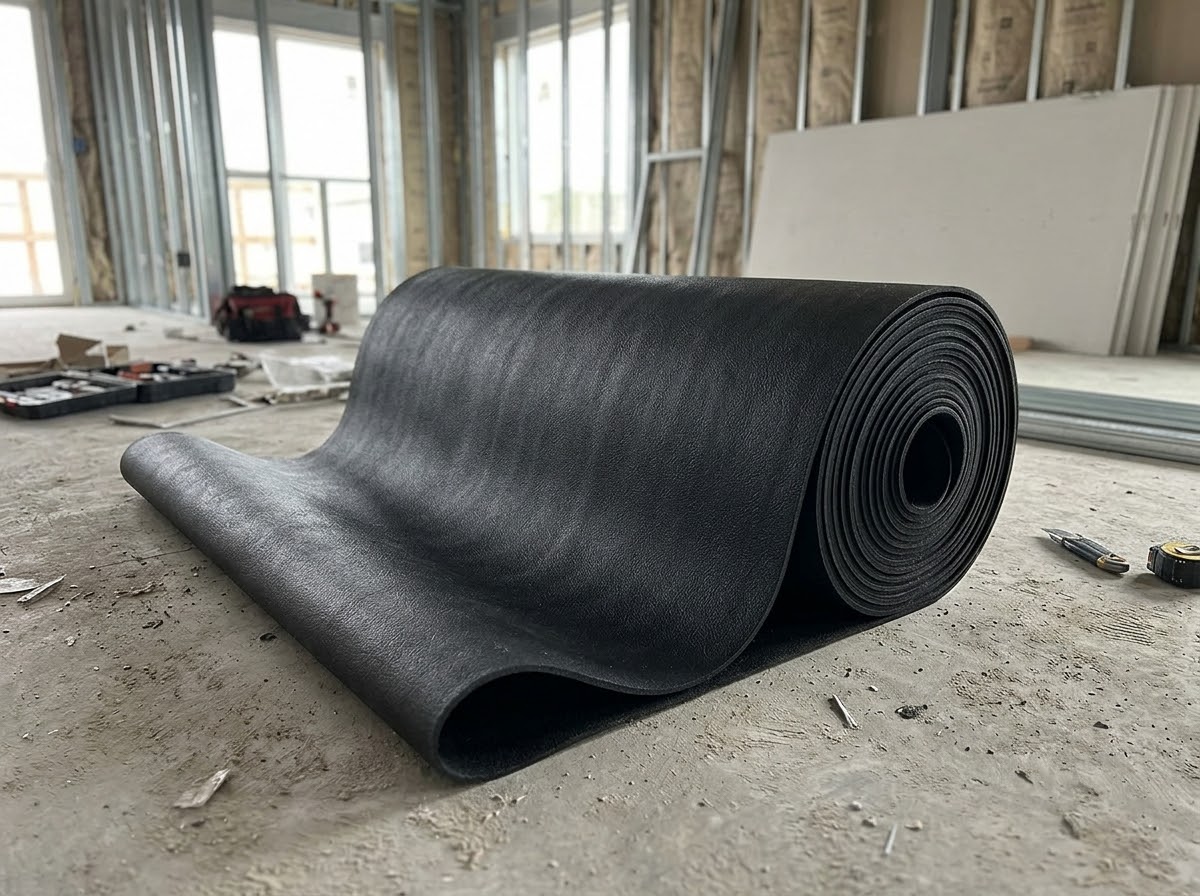
MLV is a dense, flexible acoustic barrier used to add mass to walls, ceilings, floors and certain equipment enclosures. It is primarily intended to reduce airborne sound transmission rather than absorb echo within a room. Its effectiveness depends on the product specification and the way it is incorporated into the complete construction assembly. <Cite refs={[“turn969317search12″,”turn969317search3”]}/>
Whether a project involves an existing apartment, a new office, a hotel, a conference room or a mechanical service area, the first step is understanding how the noise travels. Once the transmission path has been identified, MLV can be evaluated as part of a broader acoustic solution.
What Is Mass Loaded Vinyl?
Mass Loaded Vinyl is a dense, flexible sheet material developed for sound-isolation applications. It is commonly supplied in rolls and installed as a barrier within or behind a finished construction layer.
Depending on the manufacturer, MLV may use a vinyl or other polymer base combined with dense mineral fillers. Products vary in composition, thickness, surface weight and technical performance, so the material specification should always be checked before installation. <Cite refs={[“turn969317search12″,”turn969317search3”]}/>
Unlike rigid wallboards, MLV is flexible enough to be incorporated into different building configurations without requiring a thick, freestanding barrier.
Typical applications include:
- Residential wall assemblies
- Commercial partitions
- Ceiling sound-isolation systems
- Selected floor constructions
- Mechanical equipment enclosures
- HVAC ductwork
- Plumbing and pipe-noise systems
- Industrial noise-control applications
The appropriate application depends on the noise source, available space, building construction and required performance.
Why Buildings Need Sound Isolation
Buildings contain multiple pathways through which sound can travel.
A wall may transmit airborne sound, while gaps around doors or service penetrations can allow sound to bypass the wall entirely. Ceilings, floors, ducts and structural connections can also carry unwanted noise into neighbouring spaces.
Common problems include:
- Conversations passing between offices
- Television noise travelling between apartments
- Meeting-room discussions affecting nearby work areas
- Mechanical equipment disturbing occupied rooms
- Plumbing noise spreading through partitions
- Noise travelling through lightweight ceilings
Adding MLV can increase the mass of a suitable construction assembly. However, it will not automatically resolve every noise problem. Gaps, vibration transmission and flanking paths must also be considered.
How Mass Loaded Vinyl Helps Reduce Airborne Noise
When sound reaches a building element, it can cause that element to vibrate. Some of this energy may then be transmitted to the space on the other side.
Increasing the mass of an appropriate assembly can help reduce the amount of airborne sound transmitted through it.
MLV provides additional mass in a flexible sheet, allowing it to be integrated into certain wall and ceiling systems where space is limited. Manufacturers describe its use as a barrier layer within walls, ceilings, floors and equipment-related applications. <Cite refs={[“turn969317search12″,”turn969317search8”]}/>
However, sound isolation depends on the complete assembly, not just the MLV layer. A successful design may also require:
- Cavity insulation
- Additional drywall or board layers
- Resilient channels or clips
- Acoustic sealant
- Properly sealed joints
- Suitable doors and windows
- Vibration-isolation components
The best solution is therefore selected according to the actual transmission path rather than the product name alone.
MLV for Existing Buildings in Niamey
Improving the acoustic performance of an existing building can be more complicated than designing a new construction system.
The walls may already be finished, ceiling heights may be restricted, and electrical or mechanical services may limit the available space.
MLV can be considered for certain retrofit projects because its flexible construction allows it to be incorporated into a new lining or an upgraded wall assembly.
A retrofit assessment should establish:
- Whether the noise is airborne or structure-borne.
- How the existing wall or ceiling is constructed.
- Whether the noise is passing through the surface or around it.
- Whether additional framing can be accommodated.
- Where electrical outlets, pipes and ducts are located.
- Whether the finished wall thickness can increase.
- Which acoustic performance target is appropriate.
Depending on the findings, a suitable retrofit may combine MLV with new framing, insulation, additional board layers and acoustic sealing.
Simply attaching a thin barrier to an existing wall without evaluating the surrounding construction may not provide the expected improvement.
Strengthening Shared Walls Between Rooms
Shared walls are a common source of sound complaints in residential and commercial buildings.
A lightweight partition may transmit voices, television sound and other everyday noise into an adjoining space.
MLV can be incorporated into a strengthened wall assembly to add mass without relying exclusively on thick, heavy boards.
A typical system might include:
- The existing wall or supporting frame
- Cavity insulation where appropriate
- An MLV barrier layer
- Additional board layers
- Acoustic treatment around the perimeter
- Sealing around penetrations
The precise arrangement depends on the original wall and the intended result.
For example, an office requiring speech privacy may need a different system from a residential wall affected by louder entertainment noise.
The objective is to improve the complete partition rather than relying on MLV as a standalone sheet.
Soundproofing Office Partitions
Offices need acoustic privacy as well as visual separation.
Conversations in meeting rooms, consultation areas and management offices may contain information that should not be easily understood in neighbouring spaces.
MLV can form part of a sound-isolation system for suitable partitions, particularly where additional mass is required without an excessively thick wall.
A professional design may combine MLV with insulated cavities, resilient framing, acoustic sealants and appropriate doors.
It is also important to consider the ceiling void. If a partition stops at a suspended ceiling, sound may travel over the wall and into the adjacent room.
In that situation, upgrading the wall alone may not address the main transmission path.
MLV for Ceiling Sound Isolation
Sound can travel vertically as well as horizontally.
In multi-storey buildings, airborne noise may pass through floor-ceiling assemblies, while mechanical equipment above a room can introduce additional noise.
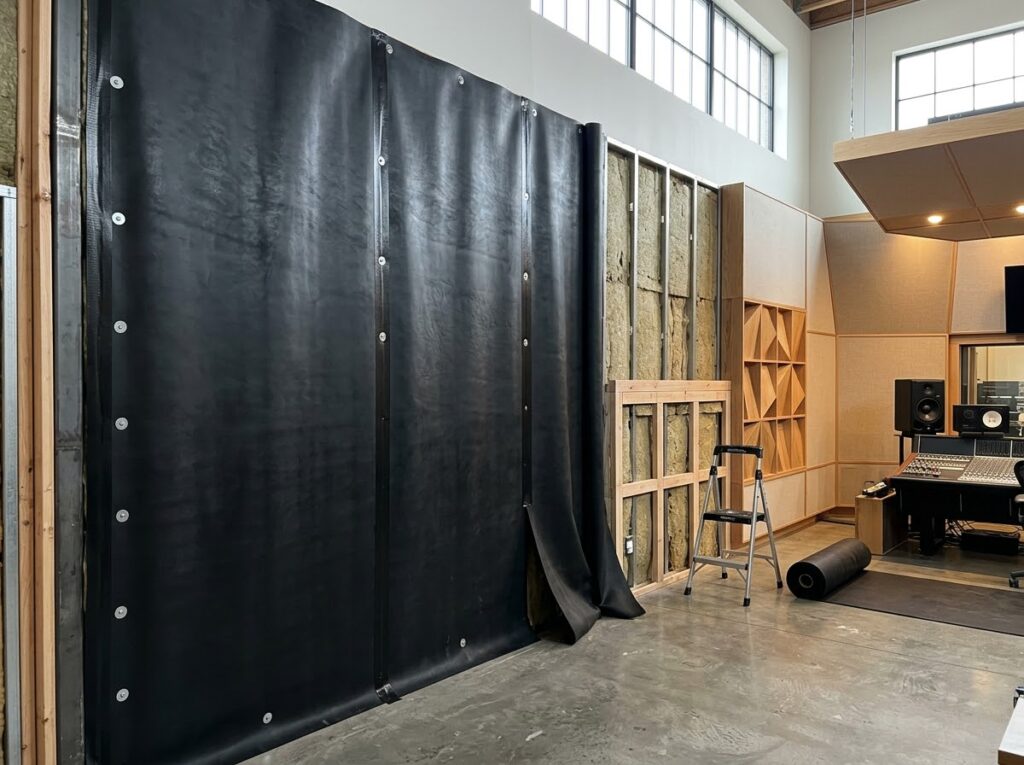
MLV can be incorporated into suitable ceiling systems as an added barrier layer.
A complete ceiling design may include:
- Structural framing
- Cavity insulation
- MLV
- Resilient support components
- Gypsum board or another approved finish
- Sealed perimeter joints
The required arrangement depends on the existing structure and the type of noise being addressed.
It is essential to support the material adequately, particularly because heavier MLV products can place additional loads on the installation. Manufacturer instructions should be followed for fasteners, framing and ceiling applications. <Cite refs={[“turn969317search13″,”turn969317search15”]}/>
Controlling Mechanical and Equipment Noise
Mechanical equipment can create persistent noise that affects nearby rooms.
Potential sources include fans, pumps, compressors, generators and HVAC equipment.
MLV may be useful as one layer in an appropriately designed equipment enclosure or duct-noise-control system. Certain manufacturers also list pipework and ductwork among their MLV applications. <Cite refs={[“turn969317search12″,”turn969317search3”]}/>
However, equipment noise often contains more than one component.
Airborne sound may escape from the equipment, while vibration can travel through mounting points, pipes and structural connections.
For this reason, a complete solution may require:
- A suitably designed acoustic enclosure
- MLV or another mass barrier
- Sound-absorbing internal lining
- Vibration-isolation mounts
- Flexible pipe or duct connections
- Appropriate ventilation openings
- Sealed service penetrations
The enclosure must also be designed to maintain safe operating temperatures and allow required maintenance access.
MLV for HVAC Ducts and Plumbing
Building services can transmit noise between rooms even when the surrounding walls are relatively substantial.
Air ducts can carry airborne noise, while pipes may transmit water-flow sounds or vibration from pumps and other equipment.
Specialized MLV-based materials can be used in certain duct and pipe applications. Installation methods vary by product and must suit the temperature, surface, moisture conditions and operating environment. <Cite refs={[“turn969317search12″,”turn969317search7”]}/>
Before selecting a treatment, an acoustic assessment should determine whether the problem comes from the duct or pipe itself, vibration at its supports, sound escaping through openings, or noise travelling through connected building elements.
Treating the wrong pathway may produce little improvement.
Choosing the Right MLV Weight and Thickness
Not all MLV products have the same mass or performance.
Manufacturers offer different surface weights, and the appropriate selection depends on the assembly, installation constraints and acoustic target.
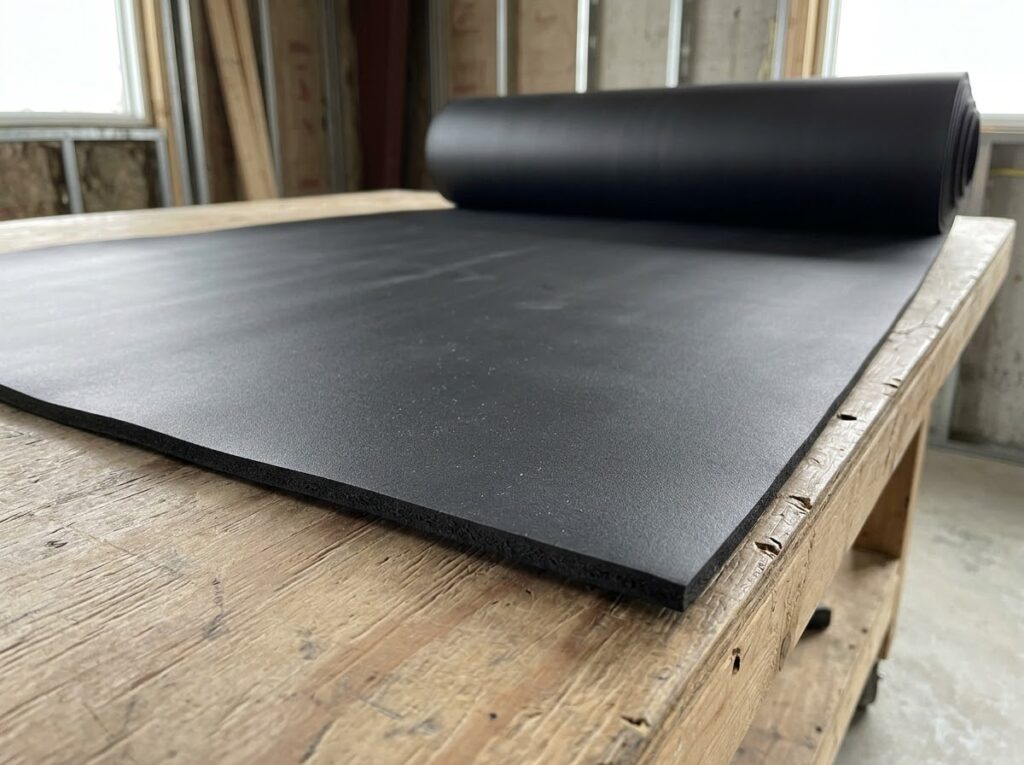
For illustration, one published product data sheet lists the following specifications for its particular MLV range. <Cite refs={[“turn969317search12”]}/>
| Product surface weight | Listed thickness | Published standalone STC |
|---|---|---|
| 0.6 lb/ft² | 1/16 inch | 22 |
| 1 lb/ft² | 1/8 inch | 26 |
| 2 lb/ft² | 1/4 inch | 32 |
These are manufacturer-specific figures, not universal ratings for all MLV products. Standalone material ratings should also not be confused with the STC rating of a complete installed wall or ceiling.
A suitable specification should consider the product’s technical data, compatibility with the assembly and the expected acoustic outcome.
Why Sealing and Installation Matter
A dense acoustic barrier can lose effectiveness if sound can travel around it through gaps and openings.
Common weak points include:
- Unsealed panel seams
- Electrical boxes
- Pipe penetrations
- Duct openings
- Wall-to-ceiling junctions
- Wall-to-floor junctions
- Gaps around door frames
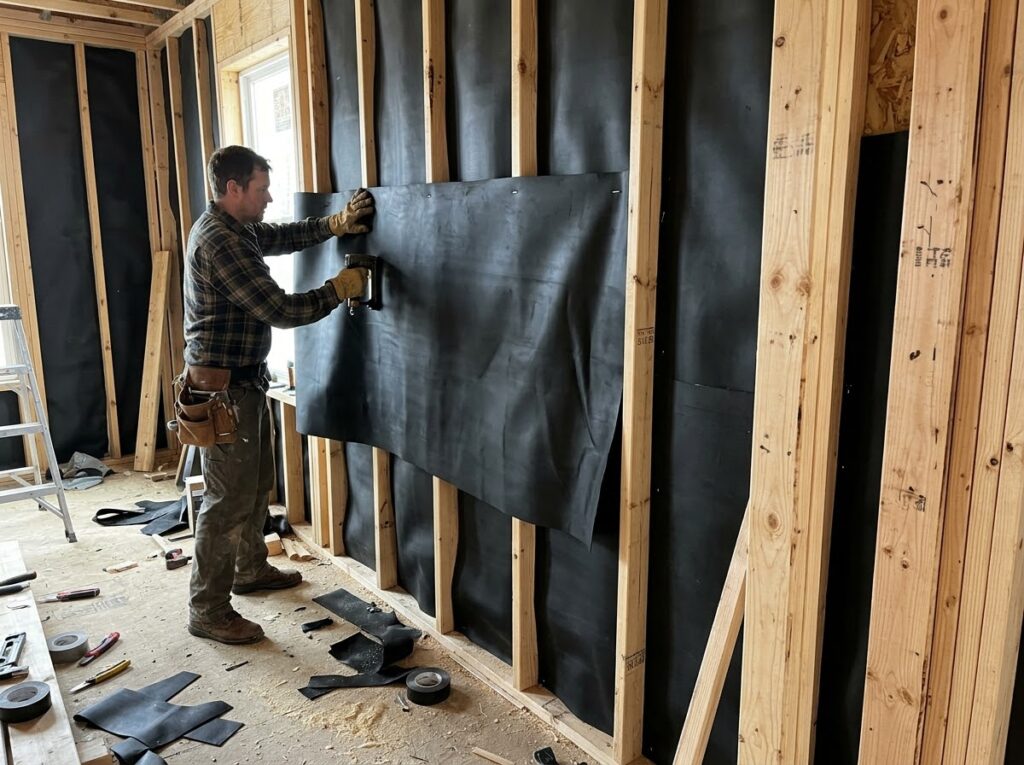
Installation guidance for MLV systems emphasizes continuous coverage and careful treatment of seams and perimeter joints. The specific method—such as butting, overlapping or taping joints—must follow the selected product’s instructions. <Cite refs={[“turn969317search4″,”turn969317search5”]}/>
Fasteners must also support the material’s weight without tearing it. For overhead installations, appropriate framing and fixing details are particularly important.
Professional installation helps ensure that the barrier remains continuous and that the finished construction does not introduce avoidable acoustic weak points.
MLV Alone Is Not a Complete Soundproofing System
One of the most common misconceptions is that installing MLV will automatically solve all noise problems.
MLV is primarily a mass barrier. It does not replace every other soundproofing measure.
A comprehensive system may require four complementary elements:
Mass: Additional mass can help reduce airborne sound transmission.
Absorption: Cavity insulation can help manage sound energy within the construction.
Decoupling: Resilient systems can reduce direct vibration transfer between structural layers.
Sealing: Gaps and penetrations must be treated to prevent sound from bypassing the barrier.
The balance between these elements depends on the building and noise source. A wall affected by speech may require a different approach from a ceiling affected by equipment vibration or a floor affected by footsteps.
Impact noise and structure-borne vibration often require resilient underlays, isolation mounts or other specialized measures. MLV alone should not be assumed to resolve them. <Cite refs={[“turn969317search7″,”turn969317search8”]}/>
Common MLV Installation Mistakes
Selecting a Product Without Assessing the Noise
The first step is identifying how the sound travels. A mass barrier may not be the main requirement for impact or vibration noise.
Leaving Gaps at the Edges
Sound can bypass an otherwise effective barrier through unsealed joints and penetrations.
Ignoring Doors and Windows
A well-built wall may still provide limited overall privacy if sound passes through a weak door or window.
Using an Unverified Performance Rating
A standalone MLV rating does not automatically represent the performance of a completed building assembly.
Neglecting Structural Support
Heavy sheet materials need appropriate fixing and support, especially on ceilings.
Ignoring Flanking Transmission
Sound may travel through adjoining walls, ceilings, floors, ducts or other connected elements.
Avoiding these mistakes requires coordinated design, suitable materials and careful installation.
Applications for Mass Loaded Vinyl in Niamey
| Building or space | Potential application |
|---|---|
| Residential properties | Strengthening suitable shared-wall assemblies |
| Offices | Supporting speech privacy |
| Meeting rooms | Reducing airborne sound transfer |
| Hotels | Improving room-to-room isolation |
| Commercial buildings | Treating selected partitions and ceilings |
| Mechanical rooms | Supporting equipment enclosures |
| HVAC systems | Treating suitable duct-noise pathways |
| Plumbing systems | Supporting pipe-noise treatment |
| Studios and media rooms | Forming part of a broader isolation system |
| Renovation projects | Adding mass where construction allows |
The suitability of MLV depends on the building’s construction, the source of noise and the required result.
Professional Soundproofing Services in Niamey
A professional soundproofing project should begin with an assessment rather than a predetermined material choice.
The process can include:
- Site inspection: Review the affected rooms, surrounding spaces and building construction.
- Noise assessment: Identify whether the problem is airborne, impact-related or vibration-related.
- Transmission-path analysis: Examine walls, ceilings, floors, doors, ducts and penetrations.
- System design: Select a suitable combination of MLV, insulation, framing, resilient components and sealing.
- Installation planning: Coordinate material support, joints, services and finishing.
- Quality inspection: Check continuity, fixings and perimeter sealing.
- Performance verification: Where appropriate, assess the completed assembly against the project requirements.
This process helps match the system to the problem instead of relying on a single material to address every form of unwanted noise.
Frequently Asked Questions
What is Mass Loaded Vinyl used for?
MLV is a dense, flexible barrier used to add mass to suitable building assemblies and help reduce airborne sound transmission. Applications can include walls, ceilings, selected floor systems, equipment enclosures, ducts and pipes. <Cite refs={[“turn969317search12″,”turn969317search3”]}/>
Is MLV an acoustic absorption panel?
No. Acoustic absorption panels are designed primarily to reduce reflections inside a room. MLV is primarily used as a sound-isolation barrier.
Can MLV make a wall completely soundproof?
No material can guarantee complete soundproofing in every construction. MLV may improve a suitable assembly, but results depend on the full construction, sealing, flanking paths and type of noise.
Is heavier MLV always better?
Greater surface mass can help, but the complete assembly determines the result. The best specification depends on the acoustic target, supporting structure and installation conditions.
Can MLV be installed in ceilings?
Yes, where the product is suitable for the application and the ceiling framing and fixings are designed to support its weight. Manufacturer-specific installation instructions should be followed. <Cite refs={[“turn969317search13″,”turn969317search15”]}/>
Does MLV stop footsteps?
MLV alone is not generally a complete solution for impact noise such as footsteps. Resilient underlays, floating-floor construction or structural isolation may be needed.
Can MLV be used around pipes and ducts?
Certain MLV-based systems are designed for pipe and duct applications. The selected product must suit the service conditions, and vibration transmission should be considered separately. <Cite refs={[“turn969317search12″,”turn969317search7”]}/>
Why should installation be handled professionally?
Professional installation helps maintain continuous barrier coverage, seal joints, support the material properly and address sound paths that could bypass the treated area.
Conclusion
Mass Loaded Vinyl can be a valuable component of sound-isolation systems for residential, commercial and mechanical environments in Niamey, Niger.
Its dense, flexible construction makes it useful when additional mass is needed without relying entirely on thicker, heavier building layers. However, its effectiveness depends on the complete wall, ceiling, floor or equipment assembly—not simply on the presence of an MLV sheet.
The most reliable approach begins with identifying the type of noise, examining how it travels, selecting a suitable product and integrating it with the necessary insulation, decoupling and sealing measures.
For renovation projects and new construction alike, professional acoustic planning can help prevent common installation mistakes and create a soundproofing strategy tailored to the building’s actual requirements.
With the right design and installation, MLV can support improved acoustic privacy and a more comfortable indoor environment while remaining one component of a properly engineered sound-isolation system.