
Modern buildings in Riyadh, Saudi Arabia are increasingly designed around open layouts, lightweight partitions, large mechanical systems, entertainment areas, offices, studios, and multi-level spaces. While these designs offer flexibility and functionality, they can also create unwanted sound transmission between rooms.
A conversation in one office may be audible in another. Equipment noise can travel through partitions. Music from an entertainment room can move into adjacent spaces. HVAC and mechanical systems can create persistent background noise.
One material often incorporated into these situations is Mass Loaded Vinyl (MLV).
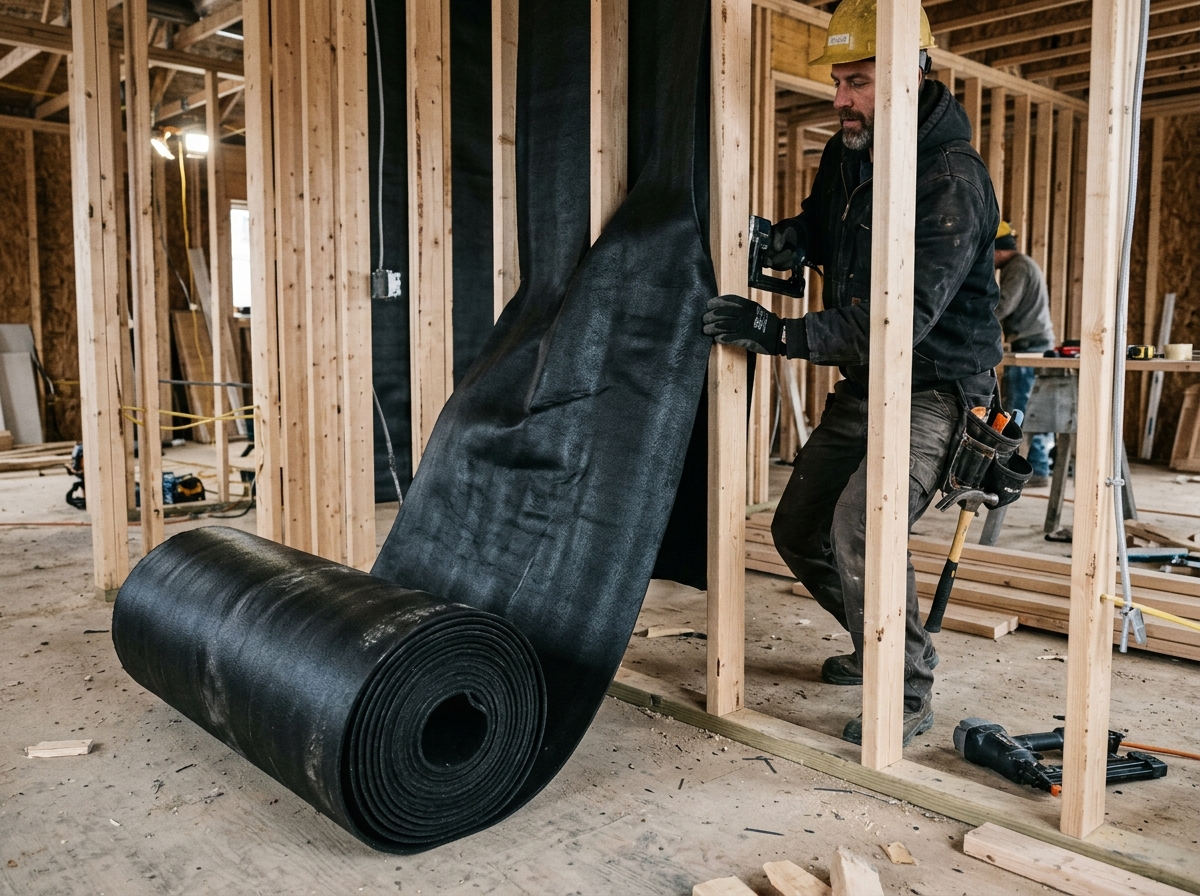
Unlike decorative acoustic panels that primarily absorb sound inside a room, MLV is designed as a dense, flexible sound barrier that helps reduce airborne sound transmission through building assemblies. It can be incorporated into walls, ceilings, floors, doors, ductwork, and equipment enclosures depending on the requirements of the project. (Acoustical Surfaces)
For projects in Riyadh, however, the important question is not simply whether MLV is effective. The real question is where and how it should become part of the overall soundproofing system.
What Is Mass Loaded Vinyl?
Mass Loaded Vinyl is a heavy, flexible membrane manufactured by combining a polymer or vinyl base with dense mineral fillers. This creates a material with substantial surface mass while keeping it flexible enough to be installed in relatively thin spaces. (RKM Homes)
Its primary purpose is to help reduce airborne sound transmission.
This makes MLV fundamentally different from materials such as acoustic foam or decorative PET panels.
| Material | Primary Function |
|---|---|
| Mass Loaded Vinyl | Reduce sound transmission |
| Acoustic PET Panels | Absorb reflections and reverberation |
| Wood Wool Panels | Improve room absorption |
| Acoustic Foam | Reduce reflections inside rooms |
| Acoustic Sealant | Close sound leakage paths |
| Rubber Underlay | Help control impact/structure-borne noise |
MLV is therefore usually most useful as one layer within a properly designed sound isolation assembly, rather than as a complete soundproofing solution by itself.
Why MLV Can Be Useful in Riyadh Projects
Riyadh contains a wide variety of residential, commercial, hospitality, entertainment, office, and industrial environments where sound isolation may be required.
The flexibility of MLV allows it to be incorporated into different construction assemblies without requiring extremely thick rigid barriers.
It can be used in:
- Office partitions
- Meeting rooms
- Home theatres
- Recording and media rooms
- Apartments and villas
- Hotel rooms
- Entertainment spaces
- Commercial studios
- Mechanical rooms
- HVAC systems
- Equipment enclosures
- Walls and ceilings
- Selected floor assemblies
MLV is also suitable for both new construction and certain retrofit applications, although the appropriate installation method depends heavily on the existing construction. (Mass Loaded Vinyl Australia)
MLV and the Difference Between Absorption and Sound Isolation
One of the most common mistakes in acoustic projects is treating every acoustic material as though it performs the same function.
It does not.
Imagine a meeting room with hard walls, glass, a hard ceiling, and a tiled floor.
Inside that room, voices may bounce around, creating reverberation and making conversations difficult to understand.
That is an acoustic absorption problem.
Now imagine that people in the room next door can clearly hear those conversations.
That is a sound isolation problem.
MLV primarily belongs to the second category.
It helps create a barrier against sound transmission rather than simply making the original room quieter internally. (Acoustical Surfaces)
This distinction is particularly important when planning a complete soundproofing system in Riyadh.
Using Mass Loaded Vinyl Inside Walls
One of the most common applications for MLV is within wall assemblies.
A typical sound isolation approach may involve several layers rather than relying on one material.
For example:
Existing wall / framing → MLV barrier → acoustic cavity treatment → gypsum board → sealed perimeter
The exact configuration can vary depending on the existing wall, available space, required performance, and construction method.
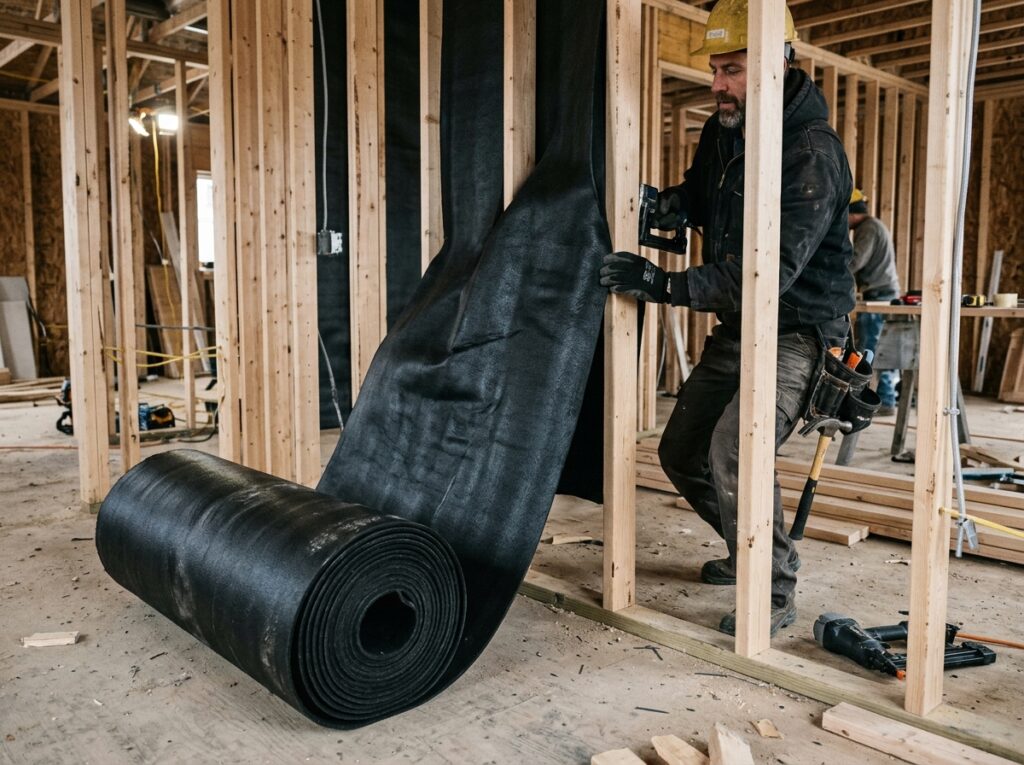
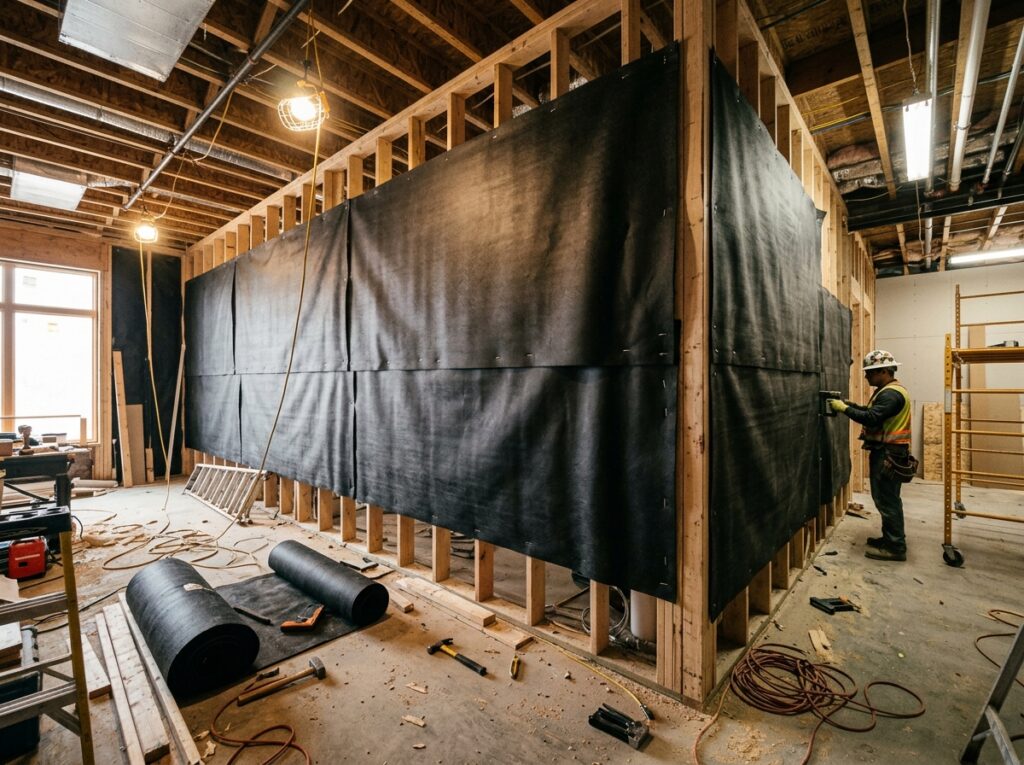
MLV may be installed over framing before the finished wall layers are installed, or incorporated into a retrofit assembly where the existing construction permits it. (Second Skin Audio)
Why wall installation matters
Sound can pass through:
- Lightweight partitions
- Wall cavities
- Electrical boxes
- Service penetrations
- Doors
- Gaps around frames
- Junctions between walls and ceilings
This means adding MLV to only one section of a wall may not solve the entire problem.
A successful sound isolation system needs continuity.
MLV for Office and Meeting Room Privacy
Office environments are particularly sensitive to speech transmission.
Private discussions taking place inside:
- Boardrooms
- Executive offices
- HR rooms
- Consultation rooms
- Meeting rooms
- Interview rooms
may need improved acoustic separation from adjacent spaces.
MLV can become part of the wall or ceiling assembly used to reduce airborne speech transmission.
However, the wall itself is only one potential pathway.
A soundproofing assessment should also consider:
Doors + glazing + ceilings + partitions + electrical penetrations + HVAC pathways + flanking transmission
A heavily treated wall will not necessarily provide the expected privacy if sound simply travels around it through another weak point.
Mass Loaded Vinyl for Home Theatres and Entertainment Rooms
Home theatres and entertainment rooms often create the opposite problem.
Instead of trying to keep outside sound from entering, the objective may be to prevent movie dialogue, music, subwoofer energy, or entertainment noise from disturbing surrounding rooms.
MLV can be incorporated into walls, ceilings, or other assemblies as part of the sound isolation strategy.
But there is an important limitation.
MLV is not a universal solution for bass or impact noise.
Low-frequency sound and structure-borne vibration can require additional approaches, such as:
- Decoupling
- Resilient systems
- Damping
- Structural isolation
- Special floor assemblies
- Acoustic doors
- Sealed wall systems
MLV itself is primarily associated with airborne sound isolation, and some MLV manufacturers specifically note that it is not the appropriate standalone treatment for footfall impact noise. (TotalMass MLV)
MLV in Ceilings and Floor Assemblies
Sound does not always travel horizontally.
In multi-level buildings, noise can move between floors through ceilings and floor structures.
MLV can therefore be incorporated into certain ceiling and floor assemblies.
Ceiling applications
A ceiling assembly may use MLV alongside other acoustic layers to reduce airborne noise coming from an adjacent or upper space.
Potential applications include:
- Apartments
- Villas
- Hotels
- Offices
- Studios
- Home theatres
- Commercial buildings
However, footsteps and impact sounds require a different strategy. MLV alone should not be treated as an impact-noise solution. (Second Skin Audio)
Floor applications
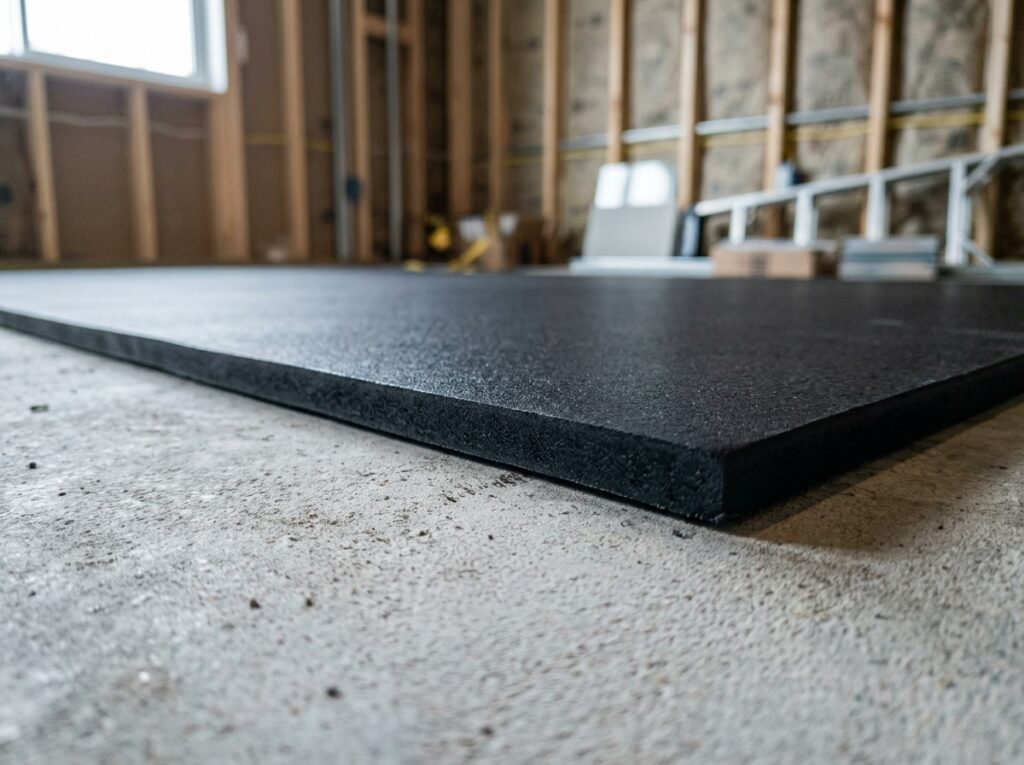
MLV can also be installed between layers within certain floor assemblies.
The correct build-up depends on whether the project is primarily dealing with:
- Airborne noise
- Footfall noise
- Mechanical vibration
- Music
- Room-to-room transmission
For impact noise, resilient or rubber underlayment systems may be more appropriate or may need to work alongside other isolation measures. (TotalMass MLV)
MLV for HVAC, Ducts and Mechanical Noise
Not every noise problem starts with a person or entertainment system.
Mechanical equipment can also create unwanted noise.
HVAC systems, ducts, pipes, generators, machinery, and other equipment can transmit sound and vibration through a building.
Because MLV is flexible, it can be incorporated into certain mechanical noise-control applications and wrapped around suitable ducts or equipment as part of an enclosure or barrier system. (TotalMass MLV)
This makes MLV particularly useful when a rigid sound barrier would be difficult to install around irregular shapes.
Why Sealing Is Just as Important as the Barrier
Installing a heavy acoustic barrier does not automatically create a soundproof wall.
Small openings can become significant sound paths.
During installation, attention should be given to:
- MLV seams
- Wall edges
- Electrical outlets
- Switch boxes
- Pipe penetrations
- HVAC openings
- Door frames
- Ceiling junctions
- Service penetrations
Installation guidance for MLV emphasizes careful seam treatment and sealing around penetrations because gaps can compromise the continuity of the sound barrier. (Mass Loaded Vinyl Australia)
This is why professional soundproofing is more than simply attaching MLV to a wall.
MLV Weight and Thickness: What Should You Choose?
MLV products are available in different surface weights and thicknesses.
For example, commercial products can be available around 0.5, 1, or 2 lb/ft², with performance varying according to the product and the complete construction assembly. One manufacturer lists examples of approximately STC 26 for a 1 lb/ft² product and STC 32 for a 2 lb/ft² product, but these values should not be treated as universal ratings for every installation. (Memtech Acoustics)
This is important because the MLV specification alone does not determine the final soundproofing performance of a wall or ceiling.
The complete assembly matters.
A professional assessment should consider:
- Existing wall construction
- Required sound isolation
- Available cavity depth
- MLV surface weight
- Number of finishing layers
- Decoupling requirements
- Absorptive cavity treatment
- Doors and windows
- Mechanical pathways
- Sealing requirements
MLV vs Acoustic Panels
These two solutions are often confused.
| MLV | Acoustic Panels |
|---|---|
| Primarily reduces transmission | Primarily absorbs reflections |
| Used within building assemblies | Usually exposed inside rooms |
| Helps isolate rooms | Helps improve room acoustics |
| Useful for airborne noise | Useful for reverberation |
| Can be hidden behind finishes | Usually visible |
| Used in walls, ceilings and other assemblies | Used on walls/ceilings |
For example, a conference room might need MLV in the wall assembly to reduce speech transmission to another room while also requiring PET or fabric acoustic panels inside the room to reduce echo.
These materials can therefore perform complementary roles.
MLV for New Construction vs Retrofit Projects
The planning stage can significantly affect the final result.
New Construction
When walls and ceilings have not yet been closed, MLV can be incorporated into the assembly more easily.
This provides opportunities to coordinate:
- Framing
- Insulation
- MLV
- Drywall
- Electrical services
- HVAC
- Doors
- Acoustic sealing
Existing Buildings
Retrofit work requires more careful planning.
Existing finishes may need to be removed, or a new acoustic layer may need to be constructed over the existing surface.
The available space, structural loading, door clearances, electrical outlets, and ceiling height can all affect the design.
A professional site assessment can determine whether MLV should be used directly, incorporated behind a new lining, or combined with other soundproofing methods.
MLV Is One Part of a Complete Soundproofing System
A strong soundproofing design usually works through several acoustic principles rather than relying on one material.
Depending on the project, these can include:
Mass
Adding dense materials helps resist airborne sound transmission.
Decoupling
Separating structural layers can reduce vibration transfer.
Absorption
Cavity insulation can help control sound within wall and ceiling cavities.
Damping
Specialized layers can reduce vibration within construction elements.
Airtightness
Sealing gaps prevents sound from bypassing the main barrier.
Weak-point treatment
Doors, windows, ducts, outlets, and other penetrations must be considered.
MLV can contribute the mass/barrier component, but the complete design should be based on the actual noise pathway.
Where Mass Loaded Vinyl Can Make Sense in Riyadh
For projects across Riyadh, MLV may be considered for:
- Residential soundproofing
- Villa entertainment rooms
- Home cinemas
- Office partitions
- Boardrooms
- Recording studios
- Podcast rooms
- Commercial studios
- Hotel rooms
- Mechanical spaces
- HVAC noise control
- Equipment enclosures
- Multi-level sound isolation
- Renovation projects
The correct application depends on the noise source and the construction through which that noise is travelling.
Professional MLV Soundproofing in Riyadh
Mass Loaded Vinyl can look simple because it arrives as a flexible sheet.
The difficult part is knowing where it should be placed, what it should be combined with, and how the entire assembly should be sealed.
A professional soundproofing service can begin with an assessment of the space and identify the dominant transmission paths before recommending a construction system.
The process may include:
Site Assessment → Noise Source Identification → Acoustic Design → Material Selection → MLV Installation → Sealing → Finishing → Performance Review
This approach prevents the common mistake of installing an acoustic material without first identifying the actual problem.
Final Thoughts
Mass Loaded Vinyl can be a valuable component of sound isolation projects in Riyadh, Saudi Arabia, particularly where airborne noise needs to be reduced without adding an extremely thick rigid barrier.
Its flexibility allows it to be incorporated into walls, ceilings, floors, doors, ducts, and equipment enclosures, while its high surface mass makes it useful as part of a sound barrier assembly. (Acoustical Surfaces)
But MLV should not be viewed as a standalone cure for every type of noise.
The best results come from identifying the noise pathway first and then combining mass, sealing, absorption, damping, and decoupling where appropriate.
For residential, commercial, studio, hospitality, and specialist soundproofing projects in Riyadh, a properly designed MLV system can become an important hidden layer in creating quieter and more private interiors.
Frequently Asked Questions
1. What is Mass Loaded Vinyl used for?
MLV is primarily used to reduce airborne sound transmission through walls, ceilings, floors, doors, ducts, and other building assemblies. (Acoustical Surfaces)
2. Does MLV absorb sound?
MLV is primarily a sound isolation/barrier material, not a conventional sound-absorbing acoustic panel. It is designed to reduce sound transmission through a structure.
3. Can MLV be installed inside walls?
Yes. It can be incorporated into wall assemblies behind drywall or other finish layers, depending on the construction design. (Second Skin Audio)
4. Can MLV be used in ceilings?
Yes. MLV can be incorporated into ceiling assemblies to help reduce airborne sound transmission. However, footsteps and other impact noise may require additional isolation measures. (Second Skin Audio)
5. Is MLV suitable for home theatres?
It can be part of a home-theatre sound isolation system, especially where the objective is to reduce airborne music and entertainment noise reaching adjacent rooms.
6. Does MLV stop footsteps?
MLV should not be considered a standalone solution for impact footfall noise. Impact noise generally requires resilient or decoupled floor/ceiling solutions. (TotalMass MLV)
7. Is thicker MLV always better?
Not necessarily. Surface weight, construction, installation, sealing, and the complete wall or ceiling assembly all affect performance. Product-specific specifications should be reviewed before selection.
8. Can MLV be used in existing buildings?
Yes, MLV can be incorporated into certain retrofit systems, although the available space and existing construction need to be assessed first. (Mass Loaded Vinyl Australia)
9. Why does MLV need to be sealed?
Gaps and penetrations can create pathways for sound to bypass the barrier. Maintaining continuity and properly treating seams and edges is therefore an important part of installation. (Mass Loaded Vinyl Australia)
10. Should MLV be used alone?
For many projects, no. MLV is generally most effective when it forms part of a complete sound isolation assembly designed around the specific noise source and building structure. (Acoustical Surfaces)