
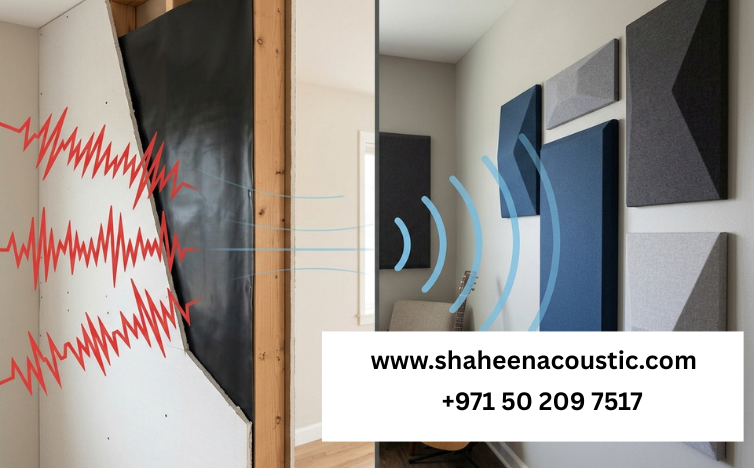
When planning any acoustic treatment, one of the most common mistakes is assuming all soundproofing materials perform the same function. In reality, Mass Loaded Vinyl (MLV) and acoustic panels serve completely different purposes. Choosing the wrong one can result in poor performance, wasted budget, and ongoing noise issues. Understanding how each works is essential for achieving effective sound control.
Mass Loaded Vinyl is designed to block sound, while acoustic panels are built to absorb sound within a space. These two materials are not competitors—they solve different acoustic problems and are often used together for the best results.
What Is MLV Soundproofing?
Mass Loaded Vinyl (MLV) is a dense, flexible material used to stop sound from passing through walls, ceilings, and floors. Its effectiveness comes from its high mass and density, which resist sound transmission and reduce noise transfer between spaces.
Unlike traditional materials, MLV delivers strong sound-blocking performance without requiring thick construction layers. It is commonly installed behind drywall, inside partitions, or under flooring to create a barrier against external noise such as traffic, machinery, or neighboring rooms.
Because it works as a barrier, MLV is ideal when the goal is to prevent sound from entering or leaving a space.
What Are Acoustic Panels?
Acoustic panels, on the other hand, are designed to absorb sound rather than block it. These panels are typically made from porous materials like foam, fabric, or mineral wool that capture sound waves and reduce reflections.
Their main purpose is to control echo, reverberation, and sound clarity inside a room. They improve speech intelligibility, recording quality, and overall acoustic comfort, but they do not stop sound from traveling through walls.
This makes acoustic panels highly effective in spaces like offices, meeting rooms, studios, and auditoriums where internal sound quality matters more than external noise isolation.
Key Difference: Blocking vs Absorbing
The fundamental difference between MLV and acoustic panels lies in how they treat sound. MLV works by adding mass to a structure, making it harder for sound waves to pass through. Acoustic panels work by absorbing sound energy within a room, reducing reflections and echo.
This distinction is critical. If noise is coming from outside, acoustic panels alone will not solve the problem. Similarly, if a room has echo or poor sound clarity, MLV will not fix it because it does not absorb sound.
Performance in Real Environments
In practical applications, MLV is used where sound isolation is required. For example, it is effective in offices near busy roads, generator rooms, or shared walls where noise leakage must be minimized.
Acoustic panels are used in environments where sound quality matters. They are commonly installed in conference rooms, home studios, restaurants, and classrooms to reduce echo and improve clarity.

In most professional acoustic setups, both materials are combined. MLV blocks unwanted external noise, while acoustic panels refine the internal sound environment.
Which One Should You Choose?
The right choice depends entirely on the problem you are trying to solve. If the issue is noise entering or leaving a space, MLV is the correct solution. If the issue is echo, reverberation, or poor sound quality inside a room, acoustic panels are the better option.
For complete acoustic performance, relying on only one material is rarely enough. A combination of sound blocking and sound absorption delivers the most effective and balanced results.
Call us: Contact Shaheen Acoustic Soundproofing Expert in Dubai For Soundproofing: +971 50 209 7517
Conclusion
MLV soundproofing and acoustic panels serve different but equally important roles in acoustic design. MLV is essential for blocking sound transmission, while acoustic panels are necessary for improving sound quality within a space.
Understanding this difference allows you to make the right decision and avoid ineffective solutions. For optimal results, both materials should be used together as part of a well-planned acoustic system that addresses both noise control and sound clarity.