
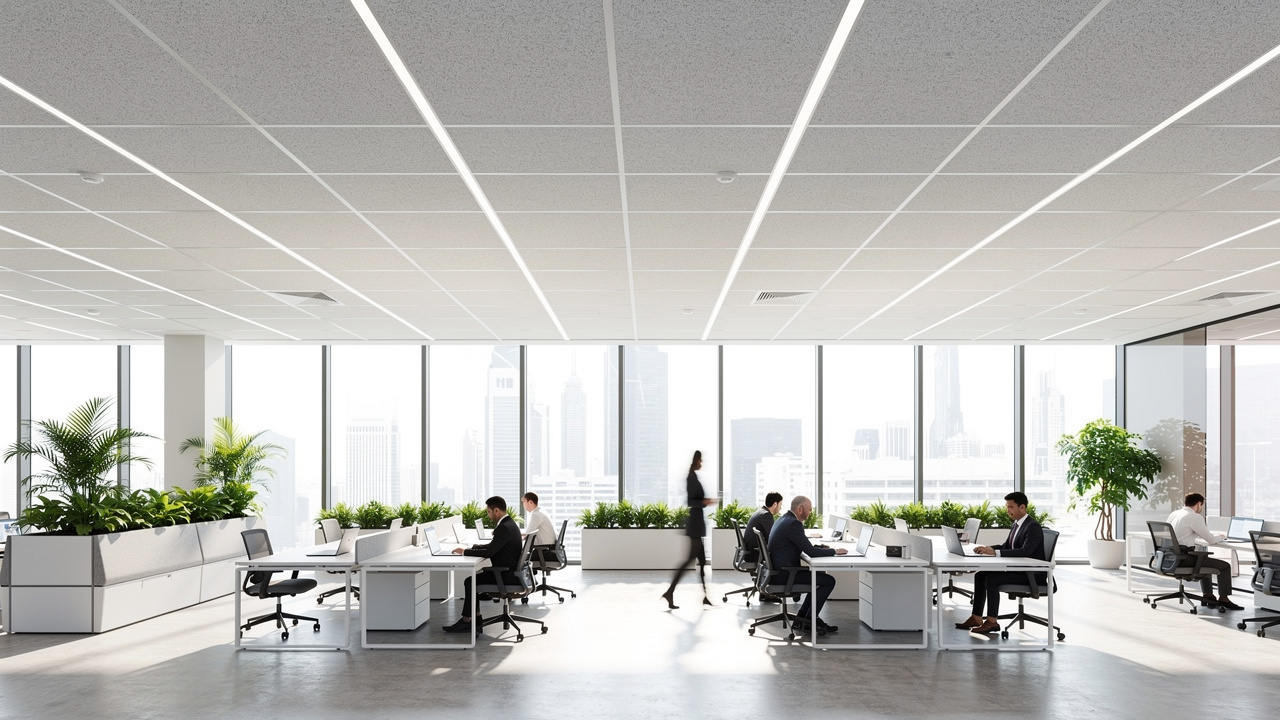
Open-plan offices across Dubai can feel noisy and stressful because every phone call and meeting echoes across the floor. When Top Acoustic Ceiling Tiles are missing, sound keeps bouncing around and focus slowly disappears.
Acoustic ceiling tiles are sound-absorbing panels fitted into the ceiling grid so they soak up echo instead of reflecting it. Chosen well, they calm open work areas, sharpen speech in meeting rooms, and give private offices real confidentiality. This guide explains the Top Acoustic Ceiling Tiles for modern office interiors, how they work, and which options fit UAE buildings and budgets.
Read on to see how the right tiles can change everyday office sound.
Key Takeaways
Acoustic ceiling tiles calm busy offices by cutting echo, lowering noise levels, and helping people focus.
Different tile types fit different zones: some suit open desks, others are better for meeting rooms or private offices.
Two key numbers guide tile choice: NRC shows how much sound a tile absorbs, while STC relates to sound blocking between rooms.
Shaheen Acoustic helps offices across the UAE choose, design, and install Top Acoustic Ceiling Tiles with professional fitting.
What Are Acoustic Ceiling Tiles And Why Do Modern Offices Need Them?

Acoustic ceiling tiles are ceiling panels that absorb sound, so offices use them to control echo and noise. They sit in a suspended grid or fix directly to the slab, turning a hard, reflective ceiling into a large sound-absorbing surface.
In practice, well-chosen tiles can:
Reduce reverberation so conversations die down more quickly.
Improve speech clarity during calls, presentations, and training.
Make open work areas, corridors, and support spaces feel calmer.
Most tiles use porous materials such as mineral fiber, fiberglass, wood wool, or fabric-wrapped boards. Tiny air pockets inside these materials turn sound energy into a small amount of heat, which reduces reverberation and softens harsh reflections.
The key performance measure is Noise Reduction Coefficient (NRC), which runs from 0 to 1 and shows how much sound the tile absorbs on average. An NRC of 0.80 means the tile absorbs about 80 percent of incident sound energy. Guidance from the Ceilings & Interior Systems Construction Association notes that higher NRC values are especially helpful in open-plan offices where many people talk at once.
In UAE workplaces filled with glass partitions, polished stone floors, and minimal fabric, sound often lingers. Research gathered in the World Green Building Council report on health and productivity links poor acoustics with noticeable drops in performance on complex tasks, a finding also supported by the Global Acoustic Ceiling Tiles market analysis documenting the growing demand for acoustic solutions in commercial interiors. For business owners in Dubai or Abu Dhabi, that lost focus quickly turns into lost revenue.
By adding Top Acoustic Ceiling Tiles across open work areas, corridors, and meeting rooms, companies create a calmer sound field without changing layouts or furniture. Shaheen Acoustic designs these ceiling systems so teams can still collaborate, but with controlled background noise and clearer speech.
Top Types Of Acoustic Ceiling Tiles For Office Interiors

The main types of acoustic ceiling tiles for office interiors fall into a few material families. Each family balances sound control, appearance, cost, and maintenance in a different way, which helps match products to office zones.
Here is a quick comparison of common choices in the UAE market. Performance ranges below are typical values from suppliers and manufacturers such as Shaheen Acoustic, Armstrong Ceilings, Knauf AMF, and Ecophon by Saint-Gobain.
| Tile Type | NRC Range | Best For | Key Advantage |
|---|---|---|---|
| Mineral Fiber | 0.55–0.95 | Open offices, general commercial | Cost-effective, fire-resistant |
| Fiberglass | 0.90–1.00 | Conference rooms, call centers | Very high absorption, moisture-resistant |
| Wood Wool | 0.55–0.75 | Executive offices, boutique workspaces | Natural aesthetic, durable |
| Fabric-Covered Panels | 0.70–0.90 | Meeting rooms, collaborative zones | Design flexibility, brand integration |
| Metal Perforated Panels | 0.60–0.80 | Corporate HQs, premium fit-outs | Sleek look, highly durable |
Mineral fiber tiles are the workhorse option for many Dubai offices. They offer solid NRC performance, good fire ratings, and fit standard 600 x 600 millimeter grids, so they replace existing tiles quickly during a refit. Maintenance stays simple: damaged tiles can be swapped out without disturbing the whole ceiling.
Fiberglass tiles reach the highest NRC values and stay stable in humid conditions, which suits coastal cities like Dubai and Abu Dhabi. They shine in boardrooms, training rooms, and call centers where speech clarity matters most and where hard surfaces would otherwise cause strong reflections.
Wood wool panels mix mineral binders with wood fibers to give a warm, textured look that architects in Dubai Design District often favor for creative studios. Their tougher surface handles the knocks of day-to-day office life while still providing useful absorption.
Fabric-covered panels work well when companies want branded colors or graphics on ceilings in meeting rooms or reception areas. The fabric layer allows almost any color, texture, or printed artwork, so ceilings can tie closely to interior design and brand guidelines.
Metal perforated ceilings appear in high-profile lobbies and corporate headquarters, where long life and a sleek look matter alongside sound control. Backed by acoustic fleece or mineral wool infill, these systems combine durability with respectable NRC values.
Shaheen Acoustic supplies all of these Top Acoustic Ceiling Tiles in thicknesses from 9 to 24 millimeters, with NRC values up to 0.90. Their team helps match each type to the right office space, from dense open floors in Business Bay to smaller suites in Abu Dhabi Global Market.
How Do You Choose The Right Acoustic Ceiling Tiles For Your Office?

Choosing the right acoustic ceiling tiles for your office starts with three main performance questions. You need to know:
How much sound to absorb inside each room or zone.
How much sound to block between neighboring spaces.
How tiles will cope with UAE heat and humidity over time.
First comes NRC, which deals with sound inside the room. For open-plan offices, many acoustic consultants, including those cited by the Acoustical Society of America, recommend tiles with NRC around 0.70 or higher. That level shortens reverberation, so conversations nearby fade faster and do not mask distant speech. In lounge areas or creative zones, slightly lower NRC may still feel comfortable, especially when carpet and soft seating add support.
Sound Transmission Class (STC) matters for privacy between spaces. Ceilings work together with walls and plenum barriers to reach the target STC. Private offices, HR rooms, and executive suites near Sheikh Zayed Road traffic often need higher STC than open collaboration zones. Shaheen Acoustic looks at both NRC and full system STC when proposing Top Acoustic Ceiling Tiles for enclosed rooms.
Humidity resistance is another key filter in the UAE. Tiles near chilled water pipes or supply diffusers must resist sagging as conditions change between cool nights and very warm days. Fiberglass and treated mineral fiber products tested for high relative humidity keep their shape longer, which reduces replacement costs for facility managers, particularly in seismic or structurally dynamic regions where the Practice for Installation of ceiling suspension systems subject to earthquake ground motions prescribes additional resilience requirements. Guidance from ASHRAE highlights how moisture cycling can shorten the life of interior finishes that are not properly rated.
Office layout and finishes complete the picture. Hard, glossy interiors in towers at Dubai Marina often need higher NRC than carpeted offices in older low-rise buildings. Shaheen Acoustic usually begins with a quick acoustic review, including reverberation time estimates and sample layouts, so tile choice is based on measured needs rather than guesswork.
“Every office has its own acoustic requirements based on size, layout, ceiling height, and interior materials. Generic or off-the-shelf products often fail to deliver consistent results.”
— Shaheen Acoustic
“Tip: When you compare tiles, look at NRC, STC, and humidity ratings together so you do not optimize one factor at the expense of the others.”
— Shaheen Acoustic
Why Shaheen Acoustic Is A Leading Choice For Office Acoustic Ceiling Tiles In The UAE
Shaheen Acoustic is a specialist provider focused on office acoustics, which makes the company a strong choice for Top Acoustic Ceiling Tiles across the UAE. With more than a decade of local experience on thousands of projects for clients ranging from small businesses to regional headquarters, the team understands how Gulf offices actually perform once people move in.
Their ceiling portfolio covers mineral fiber, fiberglass, wood wool, metal, and fabric-covered systems, along with acoustic baffles for exposed ceilings in tech-style offices at Dubai Internet City or d3. Tiles come in multiple thicknesses, colors, and edge profiles, including options that match popular grids from brands like Armstrong and Knauf. For design-led projects, Shaheen Acoustic also supplies custom printed acoustic panels so ceilings can carry brand colors, logos, or subtle patterns.
A key advantage is climate-ready product selection. Only materials that pass internal checks for humidity resistance, fire classification, and indoor air quality reach Shaheen Acoustic catalogs. According to guidance from the U.S. Green Building Council, better acoustic and indoor environmental quality support healthier workplaces and lower absenteeism. By pairing eco-friendly materials with strong sound control, Shaheen Acoustic helps offices meet both comfort and sustainability goals.
Service is fully project-based rather than box-based. The team works closely with architects, interior designers, and fit-out contractors from early design through handover in Dubai, Abu Dhabi, Sharjah, and other Gulf cities such as Doha and Riyadh. That way, the specified Top Acoustic Ceiling Tiles align with lighting layouts, sprinklers, and mechanical systems, instead of becoming an afterthought during construction.
How Professional Installation Impacts Acoustic Performance In UAE Offices

Professional installation has a major effect on how well acoustic ceiling tiles perform in real UAE offices. Even the best Top Acoustic Ceiling Tiles can underperform if gaps, leaks, or layout mistakes let sound slip around the system.
Common site issues include loose tiles at grid edges, cut tiles left unsealed around lights and diffusers, and open plenum paths above partitions — all of which are addressed within the Practice for Installation of metal ceiling suspension systems published by ASTM International. Research shared by CISCA shows that poor detailing can reduce effective absorption or isolation by large margins compared with laboratory values, a finding consistent with peer-reviewed work on the Review of Modelling and prediction methods for flanking sound transmissions in real building assemblies. For a company that expects a quieter office after renovation, that shortfall feels like wasted budget.
Shaheen Acoustic addresses this through a clear process:
Acoustic review and layout – The team starts with an acoustic review and ceiling layout, noting noisy sources such as printers, pantry areas, and fan-coil units.
Coverage planning – They plan coverage using a mix of full tiles, feature panels, and, where needed, ceiling baffles in tall spaces.
Careful installation – Grids are leveled carefully, perimeter trims are sealed, and junctions with partitions and services receive special attention.
Checks in critical rooms – Meeting rooms, boardrooms, and confidential spaces receive extra checks around services and wall junctions.
For occupied offices in places like DIFC or Abu Dhabi Corniche, work sequences are planned to limit downtime, often outside core hours. After completion, Shaheen Acoustic can arrange basic reverberation tests or spot checks so facility managers hear and measure the improvement that the ceiling brings.
“Tip: Ask your installer to explain how the ceiling connects to partitions and services before work starts. Good plenum detailing is just as important as the tiles you see from below.”
— Shaheen Acoustic
The Bottom Line
The right acoustic ceiling tiles turn noisy, echo-prone floors into comfortable places for focused work, calls, and meetings. Matching tile type, NRC, STC, and humidity resistance to UAE office conditions, then installing carefully, gives a clear lift in day-to-day comfort. Shaheen Acoustic brings local know-how, tested materials, and skilled teams to every ceiling project, from compact suites to full corporate towers.
Conclusion

By choosing Top Acoustic Ceiling Tiles that fit each space, and by trusting experienced installers, offices across Dubai and the wider Gulf gain quieter, more professional interiors. Shaheen Acoustic is ready to review drawings, visit your site, and prepare an acoustic ceiling proposal that fits your budget and schedule.
Frequently Asked Questions
Question 1: What NRC Rating Should I Look For In Acoustic Ceiling Tiles For An Open-Plan Office?
For open-plan offices, aim for acoustic ceiling tiles with an NRC of at least 0.70. Higher values, such as 0.85 or 0.90, create noticeably quieter backgrounds and better speech clarity. Shaheen Acoustic supplies tiles across this range, including mineral fiber and fiberglass options rated up to NRC 0.90.
Question 2: Are Acoustic Ceiling Tiles Suitable For The UAE’s Hot And Humid Climate?
Yes, acoustic ceiling tiles work well in the UAE when products are rated for high humidity. Fiberglass and treated mineral fiber tiles handle moisture cycling better than standard boards and resist sagging. Shaheen Acoustic selects and tests its ranges specifically for Gulf climate conditions and common HVAC setups.
Question 3: What Is The Difference Between Acoustic Ceiling Tiles And Ceiling Baffles?
Acoustic ceiling tiles sit flat in a suspended grid and suit enclosed rooms or classic office ceilings. Ceiling baffles hang vertically from the slab and expose more surface area to sound, which helps in open or industrial-style spaces. Shaheen Acoustic designs offices using both tiles and baffles where each type works best.
Question 4: How Long Does Professional Acoustic Ceiling Tile Installation Take For An Office?
Smaller offices can often be completed in a few nights or a single weekend, while large floors take longer. Actual time depends on ceiling height, existing services, and how many areas must stay live during work. Shaheen Acoustic plans programs around business hours so teams keep working with minimal disruption.
Question 5: Can Acoustic Ceiling Tiles Be Customized To Match Our Office Branding?
Yes, many acoustic tiles and panels can be customized to reflect your branding. Shaheen Acoustic offers fabric-wrapped and printed acoustic panels that carry company colors, patterns, or logos. These work particularly well in reception areas, meeting rooms, and collaboration zones that welcome clients and staff every day.